If You Drool While You Sleep, It Could Be a Sign Your Brain Is Doing Something Important
Waking up to a wet pillow can be embarrassing, especially when you notice it happening regularly. But drooling during sleep is far more common than many people realize. In most cases, it is not a sign that something is wrong with your brain. Instead, it can simply reflect what happens to your muscles, breathing, and saliva production while you are asleep.
The popular claim that “if you drool while you sleep, it means your brain is healthy” sounds reassuring, but the reality is more complicated. Drooling can happen for many different reasons, and understanding those reasons can tell you more about your sleep than the amount of saliva on your pillow.
During the day, swallowing happens automatically. You produce saliva continuously, and your brain coordinates the muscles of your mouth and throat so that saliva is swallowed without you having to think about it. When you fall asleep, however, the nervous system changes how the body operates. Muscle activity decreases, including activity in some of the muscles responsible for keeping your mouth closed.
That is one reason saliva can sometimes escape while you sleep.
What Happens to Your Brain During Sleep?
Sleep is not simply a period when the brain “turns off.” Quite the opposite. The brain remains highly active throughout the night, cycling through several stages of sleep.
During non-REM sleep, the body gradually becomes more relaxed, while brain activity changes in predictable patterns. During REM sleep, brain activity becomes more similar to waking activity, while most of the body’s skeletal muscles are temporarily inhibited. These changes help create the distinctive characteristics of dreaming and sleeping.
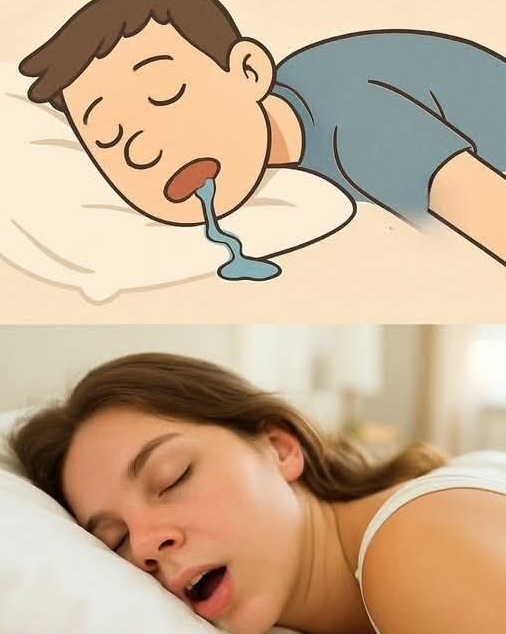
As the muscles of the face and jaw relax, your mouth may open slightly. If you are sleeping on your side or stomach, gravity can then allow saliva to move toward the edge of your mouth.
The result is something very ordinary: drooling.
So while the brain is certainly involved in controlling swallowing and muscle activity, drooling itself should not automatically be interpreted as proof that the brain is functioning particularly well.
Why Do Some People Drool More Than Others?
One of the biggest factors is sleeping position.
People who sleep on their sides or stomachs may be more likely to notice saliva on their pillows because gravity makes it easier for saliva to leave the mouth. Someone sleeping on their back may be less likely to experience visible drooling because saliva tends to remain inside the mouth and can be swallowed naturally.
Nasal congestion can also contribute.
When your nose is blocked because of allergies, a cold, sinus problems, or other irritation, you may begin breathing through your mouth. Mouth breathing can cause the lips to remain open during sleep, making drooling more noticeable.
Certain medications and medical conditions can also affect saliva production or swallowing. Some people naturally produce more saliva than others, while others may experience excessive salivation because of irritation, reflux, nausea, or other factors.
Even temporary circumstances can make drooling more likely. After an unusually exhausting day, for example, you may sleep more deeply than usual. Deeper relaxation of the facial muscles can contribute to an open mouth and increased drooling.
Does Drooling Mean You Are Sleeping Deeply?
Not necessarily.
This is another popular idea that gets repeated online: that drooling proves you have reached deep, restorative sleep.
There is a small grain of truth behind the idea that muscle relaxation and sleep stages can influence drooling, but drooling cannot be used as a reliable measure of sleep quality.
A person can sleep deeply without drooling at all. Another person can drool frequently while still having disrupted or poor-quality sleep.
Sleep quality is influenced by many factors, including sleep duration, nighttime awakenings, breathing patterns, stress, environment, and underlying health conditions.
If you wake up feeling refreshed and occasionally notice that you drooled, there is generally no reason to panic.
When Should You Pay Attention?
Occasional drooling is usually harmless. However, a sudden or significant change deserves attention if it occurs alongside other symptoms.
For example, loud and persistent snoring, gasping during sleep, repeated nighttime awakenings, morning headaches, or excessive daytime sleepiness can sometimes indicate a sleep-related breathing disorder such as obstructive sleep apnea.
Sleep apnea occurs when breathing repeatedly becomes restricted or stops temporarily during sleep. The condition can affect sleep quality and overall health, so persistent symptoms should not be ignored.
Drooling can also be associated with difficulty swallowing. If someone begins drooling excessively while awake, frequently choking on food or liquids, developing unexplained facial weakness, or experiencing sudden difficulty speaking, that is very different from ordinary nighttime drooling and requires prompt medical attention.
The important point is not to diagnose yourself based on one symptom.
Your Pillow Does Not Tell the Whole Story
Social media often turns ordinary bodily behaviors into dramatic health claims. A headline might say that drooling means your brain is “working perfectly,” “entering deep sleep,” or “detoxifying itself.”
These claims can be misleading.
The brain does perform extraordinary work while we sleep. It regulates breathing, heart rate, body temperature, hormone activity, memory processing, and numerous other functions. Sleep also plays an important role in learning, emotional regulation, and physical recovery.
But drooling is not a simple window into brain health.
It is better understood as a possible consequence of the normal changes that happen to the body during sleep.
The Connection Between Sleep and the Nervous System
There is still something fascinating about drooling: it demonstrates how closely the brain and body are connected.
Swallowing is a complex process involving the brain, nerves, muscles, and throat. While awake, swallowing occurs so automatically that most people never think about it.
During sleep, however, swallowing becomes less frequent. The muscles controlling the jaw, lips, and throat also behave differently. If saliva accumulates while you are sleeping, your body may eventually swallow it, but some may escape if your mouth is open.
This is one of the many subtle differences between being awake and asleep.
The brain is essentially changing the body’s priorities. Conscious awareness decreases, muscles relax, and automatic functions continue operating in the background.
Simple Ways to Reduce Nighttime Drooling
If drooling bothers you, several simple strategies may help.
First, consider your sleeping position. Sleeping on your back may reduce the amount of saliva that escapes from your mouth.
Second, address nasal congestion. If allergies or a stuffy nose are causing you to breathe through your mouth, treating the underlying congestion may improve nighttime breathing.
Third, pay attention to your overall sleep habits. Maintaining a consistent sleep schedule and creating a comfortable sleeping environment can help support healthier sleep.
If you regularly wake up with a completely soaked pillow, have difficulty breathing at night, or experience excessive daytime fatigue, consider discussing the symptoms with a healthcare professional.
The Bottom Line
Drooling while sleeping is usually not something to be ashamed of or frightened by. It can happen because your facial muscles relax, your mouth opens, your sleeping position allows saliva to escape, or you are breathing through your mouth because of congestion.
The brain is highly active during sleep, but drooling by itself is not a reliable test of brain health or sleep quality.
The real lesson is that our bodies perform countless automatic processes while we sleep. Something as simple as waking up with a damp pillow can be a reminder of how much our nervous system continues to coordinate even when we are completely unaware of it.
So the next time you discover evidence of nighttime drooling, don’t immediately assume something is wrong. For many people, it is simply one of the ordinary and surprisingly complex things the body does while resting.
What matters most is the bigger picture. If you generally sleep well, wake feeling refreshed, and have no concerning symptoms, occasional drooling is usually nothing more than an inconvenient side effect of being asleep. If it is frequent, excessive, or accompanied by breathing problems, swallowing difficulties, or major daytime fatigue, that’s when it becomes worth investigating.
In other words, your pillow may tell you that you drooled—but it cannot tell you the whole story about your brain.