Hope Walz and the Growing Political Divide: “My Dad Is Everything Trump Will Never Be”
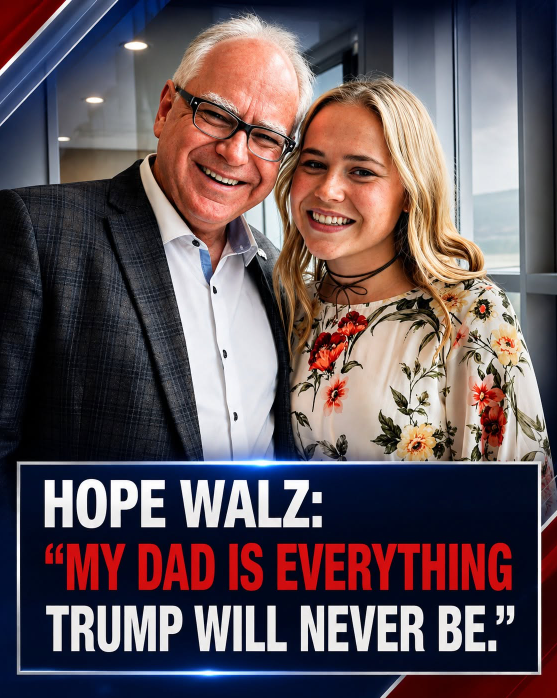
A provocative political headline circulating online claims that Hope Walz, daughter of Minnesota politician Tim Walz, declared, “My dad is everything Trump will never be.” The line is designed to sound like a dramatic personal confrontation between two prominent political families.
However, there is an important problem with treating the headline as a confirmed quotation: current reliable reporting does not establish that Hope Walz recently made that exact statement. What is documented is that Hope has repeatedly defended her father, criticized Donald Trump and his supporters, and developed a substantial social-media following through outspoken political commentary.
That distinction matters because social-media headlines frequently transform the general sentiment of someone’s comments into a much sharper quotation. A headline may capture the tone of a person’s argument without being a word-for-word statement.
Still, the broader story behind the headline is genuine—and it reveals a fascinating relationship between politics, family loyalty and generational activism.
Hope Walz became a familiar political figure
Hope Walz was not originally a national political celebrity.
Before her father became the Democratic vice-presidential nominee in 2024, she was largely known only within her family and community. That changed dramatically when Tim Walz joined Kamala Harris’s presidential ticket.
During the campaign, Hope frequently appeared beside her father. Her personality, humor and informal social-media presence helped present Tim Walz not simply as a politician but as a father.
The Washington Post described her as a near-constant companion to her father during the 2024 campaign and noted that her presence helped connect him with younger voters.
That was unusual in modern presidential politics.
Political families are nothing new, of course. But Hope’s approach was different from the traditional carefully scripted appearances associated with political children. She used social media to speak in a much more personal and conversational way.
That made her relatable to many young followers—and controversial to others.
Her relationship with her father became part of the political story
Tim Walz frequently spoke publicly about his family.
During the 2024 campaign, he discussed the years of fertility treatments he and his wife, Gwen, experienced before Hope was born. He explained that they chose her name because of what her arrival represented to them.
The emotional family story became part of the candidate’s public image.
Hope, meanwhile, provided something that political advertising cannot easily manufacture: an authentic-looking family relationship.
Videos of father and daughter joking together, exercising and traveling attracted significant attention.
For supporters, those moments showed a warm and genuine side of the candidate.
For critics, they became another example of the way political campaigns use family members to shape a candidate’s image.
Either way, Hope had entered the political conversation.
Her voice became increasingly independent
After the 2024 election, Hope did not disappear from public life.
Instead, she continued using social media to discuss politics, culture, relationships and her experiences during the campaign.
USA TODAY reported in 2025 that Hope had gained hundreds of thousands of TikTok followers and was increasingly reaching young women with her political and cultural commentary.
That evolution is important.
Hope is not simply repeating her father’s speeches.
She has developed her own voice.
Sometimes that voice is humorous. Sometimes it is sharply political. And sometimes it is openly confrontational.
Her willingness to criticize political opponents has made her a recognizable figure among younger progressive audiences.
Her criticism of Trump has become particularly personal
The conflict between Hope and Trump’s political movement became more intense during 2025.
After Donald Trump made a derogatory comment about Tim Walz, Hope responded publicly and condemned both the language and the subsequent harassment directed toward her family. Multiple outlets reported on her reaction.
The episode demonstrated something that often gets lost in political arguments: politicians may be public figures, but their families experience the consequences of political attacks as well.
Hope argued that the rhetoric surrounding her father had spilled over into abuse directed at relatives.
That transformed the disagreement from an abstract political debate into something personal.
It also helps explain why a headline portraying Hope as contrasting her father with Trump resonates so strongly with audiences.
“Everything Trump will never be”
The wording of the viral headline is powerful because it reduces a complicated political disagreement to a simple moral comparison.
On one side is Tim Walz, portrayed by his daughter as compassionate, approachable and committed to his family.
On the other is Donald Trump, portrayed by critics as aggressive, confrontational and intensely focused on political combat.
But these are political interpretations, not objective measurements.
Supporters of Trump would obviously describe the comparison very differently. They might argue that Trump’s willingness to confront opponents is precisely what makes him effective. They could point to his political resilience and his ability to maintain a powerful connection with his supporters.
Supporters of Walz, meanwhile, often emphasize his background as a teacher, football coach and father.
The disagreement therefore goes far beyond two individuals.
It represents two very different visions of political leadership.
Why family members matter in modern politics
Political children occupy a strange position.
They did not choose their parents’ careers, yet they can become public figures because of them.
Some avoid politics completely.
Others embrace it.
Hope Walz has clearly chosen the second path.
Her visibility illustrates how political communication has changed. A candidate no longer depends entirely on television interviews, campaign commercials or newspaper profiles.
A family member with a smartphone can reach hundreds of thousands of people directly.
That can be enormously powerful.
It can also be risky.
Social-media personalities are exposed to criticism from people on every side of the political spectrum. A single sentence can be clipped, reposted and transformed into a viral controversy within hours.
Hope’s public role continued after her father’s political setback
Tim Walz eventually announced that he would not seek reelection as Minnesota governor in 2026.
Hope discussed the decision publicly and explained that the family had experienced considerable pressure and scrutiny. Reports about her comments appeared across several news organizations in January 2026.
Her comments showed that political campaigns can affect families long after an election is over.
The experience also appears to have strengthened Hope’s willingness to discuss politics on her own terms.
Rather than disappearing after the Harris-Walz campaign ended, she continued building an independent public identity.
That may ultimately become more important than any single viral quote.
A new generation of political voices
Perhaps the most interesting aspect of Hope Walz’s story is not the headline itself.
It is what she represents.
She belongs to a generation that communicates politics differently from previous generations.
For many younger Americans, political opinions are formed through TikTok videos, Instagram posts, podcasts, YouTube channels and short-form commentary.
The messenger can be as important as the message.
A young person may be more likely to listen to someone who speaks casually from a bedroom, apartment or running trail than to a traditional political advertisement.
Hope has recognized that dynamic.
Her public persona combines politics with everyday life, allowing followers to see a personality rather than simply a campaign slogan.
The danger of viral political quotations
This is also why readers should be cautious with headlines like the one claiming she said, “My dad is everything Trump will never be.”
The sentiment may reflect her broader political position.
But that does not mean the exact sentence was spoken.
The current evidence supports the broader conclusion that Hope is strongly supportive of her father and has repeatedly criticized Trump and his movement.
It does not establish the headline’s exact wording as a verified recent quote.
That difference is especially important in political coverage.
A fabricated quotation can make a person appear to have said something dramatically more inflammatory than anything they actually said.
The larger story
Hope Walz’s rise from political family member to independent social-media personality illustrates how rapidly political communication is changing.
Her father gave her a connection to national politics.
Her own personality gave her an audience.
And her willingness to speak openly about political disagreements gave her a distinct identity.
Whether someone agrees with her politics or strongly disagrees with them, her influence demonstrates the growing role of younger voices in American political conversation.
The headline may therefore be more dramatic than the evidence currently supports.
But the underlying story is real.
Hope Walz has become an increasingly visible political commentator, and her loyalty to her father has repeatedly placed her in direct conflict with Donald Trump and his supporters.
For her followers, that loyalty represents courage and family solidarity.
For her critics, it represents partisan activism.
For Hope herself, it appears to be a continuation of something that began during the 2024 campaign: standing beside her father and using her own voice to explain why she believes he deserves support.
The exact phrase “My dad is everything Trump will never be” should therefore be treated cautiously unless a primary source confirms it.
But the sentiment behind the viral story captures a genuine political divide—one involving not only competing candidates and ideologies, but also two families whose lives have become deeply intertwined with America’s increasingly intense political culture.