The Volkswagen Schwimmwagen: The Remarkable WWII Vehicle That Could Drive on Land and Water
Few military vehicles from the Second World War are as unusual as the Volkswagen Schwimmwagen. At first glance, it looks like a small, strangely shaped Volkswagen with oversized fenders and a compact body. Look more closely, however, and its unusual design begins to make sense. The Schwimmwagen was created to do something most military vehicles of its era could not: travel effectively on both land and water.
Produced during the Second World War, the Volkswagen Type 166 Schwimmwagen became the most-produced amphibious vehicle in history. Approximately 15,000 examples were manufactured between 1942 and 1944. Today, surviving examples are exceptionally rare, making large gatherings of these vehicles an extraordinary sight for military-history enthusiasts and classic-car collectors.
One of the most fascinating places to see surviving Schwimmwagens together is Hessisch Oldendorf in Germany. The town has become associated with major gatherings of historic Volkswagen vehicles, where rare machines can be displayed, driven, and, on special occasions, demonstrated in the water.
Seeing one Schwimmwagen operating is remarkable enough.
Seeing many of them together is something else entirely.
And watching a group of these historic vehicles enter the Weser River and travel through the water provides a remarkable connection between modern enthusiasts and the engineering intentions of the original designers.
An Unusual Military Requirement
The Schwimmwagen was developed during a period when military mobility was critically important. Armies operating across Europe frequently encountered rivers, streams, flooded roads, marshes, and other obstacles that could slow conventional vehicles.
Military planners wanted vehicles capable of transporting personnel and equipment across difficult terrain without requiring a bridge every time a river appeared.
The answer was an amphibious vehicle.
The basic concept was simple: create a vehicle that could function as a normal automobile on land while also remaining buoyant and capable of moving through water.
The engineering challenge was anything but simple.
A vehicle designed to operate in water needs a watertight body, propulsion capable of working in the water, and sufficient stability to remain afloat. At the same time, it still needs wheels, suspension, steering, brakes, and a conventional drivetrain capable of functioning on land.
The Schwimmwagen brought these requirements together in a remarkably compact package.
Its rounded body helped provide buoyancy, while the vehicle’s design incorporated a folding propeller system at the rear. When the vehicle entered the water, the propeller could be lowered into position and driven mechanically by the engine.
The front wheels acted as rudders for steering.
That meant the vehicle did not simply float helplessly like a boat.
It could actually maneuver through the water.
The Volkswagen Connection
The Schwimmwagen was closely related to the engineering philosophy behind the Volkswagen Kübelwagen. Both were designed around Volkswagen’s compact air-cooled engine and practical mechanical architecture.
The Schwimmwagen’s engine was mounted at the rear, and its relatively light construction helped make amphibious operation possible.
The result was a vehicle that looked almost comical compared with the massive tanks and armored vehicles of the era.
But appearance could be deceptive.
The Schwimmwagen was engineered for difficult environments and could be used across terrain where larger vehicles might struggle.
Its four-wheel-drive capability on certain configurations also helped it navigate muddy roads, fields, forest tracks, and other challenging surfaces.
In water, the vehicle transformed from a small military automobile into something resembling a tiny motorboat.
That transformation is one of the reasons the Schwimmwagen remains so fascinating today.
Around 15,000 Were Built
Approximately 15,000 Schwimmwagens were produced during the war, making the Type 166 the most-produced amphibious military vehicle of the Second World War.
Yet very few survived.
Wartime vehicles faced extremely harsh conditions. They were exposed to mud, water, mechanical stress, combat damage, neglect, and eventually decades of corrosion. Many were abandoned, dismantled, scrapped, or simply disappeared.
Amphibious vehicles faced an additional problem: water is particularly unforgiving to machinery.
Saltwater exposure, moisture, corrosion, and long periods of storage can destroy mechanical components and bodywork.
Consequently, authentic surviving Schwimmwagens are among the most prized historic Volkswagen vehicles.
A restored example can represent years of research, painstaking mechanical work, and considerable expense.
That makes a gathering featuring multiple surviving Schwimmwagens particularly significant.
Hessisch Oldendorf
Hessisch Oldendorf has become an important destination for Volkswagen enthusiasts because of its historic gatherings and celebrations of early Volkswagen engineering.
The sight of multiple Schwimmwagens assembled together is extraordinary precisely because these vehicles are no longer common.
At most classic-car gatherings, seeing one historic amphibious Volkswagen would be enough to attract attention.
At Hessisch Oldendorf, enthusiasts have had the opportunity to see several survivors gathered together.
Even more remarkable is the opportunity to witness them being used for their original purpose.
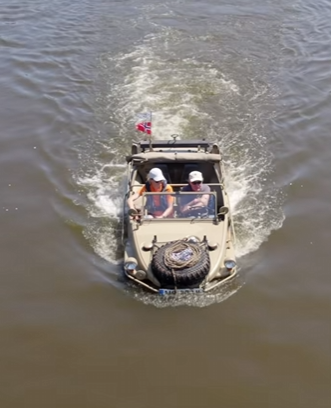
Instead of simply sitting on display behind barriers, some restored Schwimmwagens have been demonstrated in the Weser River.
The spectacle is difficult to describe without appreciating just how unusual these machines are.
A line of small historic military vehicles approaches the river.
The vehicles enter the water.
Their wheels disappear beneath the surface.
Then the rear-mounted propellers begin doing their work.
Suddenly, vehicles that look like strange old automobiles become boats.
For spectators, it is a fascinating glimpse into the engineering world of the 1940s.
Traveling Through the Weser
The Weser River provides an especially impressive setting for such demonstrations.
Watching a Schwimmwagen travel through a river is not merely a visual novelty. It demonstrates why the vehicle was created in the first place.
Modern viewers are accustomed to specialized machines. Cars drive on roads. Boats travel on water. Trucks transport heavy loads. Military vehicles are designed for specific roles.
The Schwimmwagen combined two worlds.
It was neither a conventional automobile nor a conventional boat.
It was a compromise designed around mobility.
The river demonstration therefore becomes a kind of living history.
Instead of simply reading about amphibious military vehicles in a museum, spectators can see the basic concept operating in real water.
The vehicle moves slowly compared with modern boats, but that is part of the experience. Its purpose was not speed. Its purpose was mobility.
A Piece of Living History
Historic vehicles are valuable because they preserve more than machinery.
They preserve ideas.
The Schwimmwagen tells the story of a period when engineers were challenged to solve extraordinary transportation problems with comparatively limited technology.
Its design reflects the priorities of wartime Germany: mobility, simplicity, mass production, and adaptability.
At the same time, modern gatherings allow historians and collectors to study these vehicles outside the static environment of a museum.
Mechanical details can be examined.
Restoration techniques can be compared.
Historical information can be exchanged between enthusiasts.
And perhaps most importantly, younger generations can see the machines in operation.
That is why events such as those at Hessisch Oldendorf are more than ordinary car shows.
They are opportunities to preserve mechanical history.
Why the Schwimmwagen Still Fascinates People
More than eight decades after its wartime production ended, the Schwimmwagen continues to capture attention because it looks almost impossible.
People see a small Volkswagen traveling toward a river and naturally wonder what will happen next.
Then it enters the water.
The wheels keep turning.
The propeller begins moving.
And the vehicle continues forward.
That moment demonstrates the ingenuity of amphibious engineering better than any photograph or technical drawing.
The Schwimmwagen may have been created for a very serious wartime purpose, but today its surviving examples serve another purpose: education, preservation, and historical remembrance.
Every surviving vehicle represents a fragment of a vanished industrial world.
Every successful restoration prevents another piece of that history from disappearing.
And every time one of these vehicles enters the water, spectators are given a rare opportunity to witness an extraordinary piece of twentieth-century engineering doing exactly what it was designed to do.
A Rare Sight Worth Preserving
The Volkswagen Schwimmwagen is not simply an old military vehicle.
It is a reminder of how dramatically transportation technology can evolve when engineers are confronted with difficult problems.
Approximately 15,000 were built, but only a small number survive today.
That makes gatherings at Hessisch Oldendorf particularly remarkable.
Seeing one Schwimmwagen is memorable.
Seeing several together is rare.
Watching them travel miles through the Weser River, functioning as amphibious vehicles just as their designers intended, is something truly special.
For enthusiasts, historians, and casual spectators alike, the experience offers a direct connection to the past.
The vehicles may be old.
Their engines may be comparatively modest.
Their river speed may seem slow by modern standards.
But when those distinctive little machines leave the riverbank and begin moving across the water, their extraordinary design suddenly becomes clear.
More than eighty years later, the Schwimmwagen can still make people stop, watch, and wonder.
And that may be the greatest testament of all to the ingenuity behind one of the most unusual military vehicles ever built.