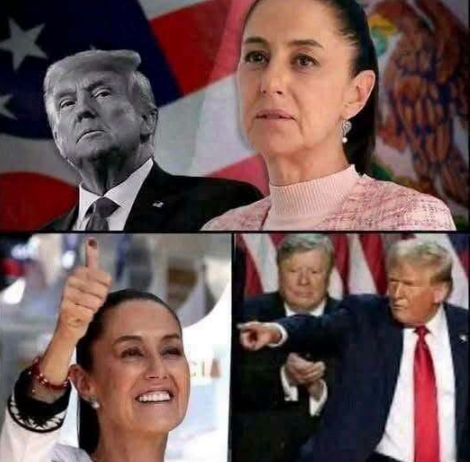
Mexican President Says U.S. Military Intervention in Mexico Is “Not on the Table” as Tensions With Trump Continue
Relations between Mexico and the United States have entered another complicated chapter as Mexican President Claudia Sheinbaum continues to emphasize her country’s sovereignty while working with President Donald Trump on security, trade, immigration, and other issues.
The relationship between the two neighboring countries has been marked by both cooperation and disagreement. One of the most sensitive issues has been the question of whether the United States could take military action against drug cartels operating in Mexico. Sheinbaum has repeatedly rejected the idea of American troops conducting operations on Mexican territory, while maintaining that Mexico is willing to cooperate with the United States against organized crime.
In January 2026, Sheinbaum said that she had made clear to Trump that the deployment of U.S. troops inside Mexico was “not on the table.” She described discussions between the two governments as involving security, drug trafficking, trade and investment, while stressing respect for both nations’ sovereignty.
That distinction has become central to Mexico’s position. Sheinbaum has argued that cooperation between the two governments is possible without allowing foreign military forces to operate independently inside Mexico.
The disagreement is rooted in a broader debate over how the two countries should confront powerful criminal organizations. Trump has repeatedly taken a hard-line position toward Mexican cartels and has pushed for stronger measures against groups involved in drug trafficking and other criminal activity. Mexico, however, has insisted that any security cooperation must respect Mexican sovereignty.
This does not mean that Mexico is refusing to cooperate with Washington.
Instead, Sheinbaum has promoted intelligence sharing, law-enforcement cooperation and coordinated efforts against organized crime. Her government has sought to demonstrate that Mexico can take action against criminal organizations itself while preventing the United States from becoming directly involved militarily on Mexican soil.
That position has occasionally produced sharp exchanges between the two presidents.
In 2025, after reports emerged that Trump had authorized military planning involving drug cartels in Latin America, Sheinbaum publicly rejected the possibility of an invasion or American military operation inside Mexico. She stated that the United States would not enter Mexico with troops and described such intervention as completely unacceptable.
For Mexico, the issue carries particular historical significance. The country has a long history of conflict and intervention involving the United States, making sovereignty an especially powerful political issue. Mexican leaders therefore face considerable domestic pressure whenever Washington appears to suggest that American forces could operate inside Mexican territory.
Sheinbaum has attempted to balance that sensitivity with the practical reality that Mexico and the United States are deeply interconnected.
The two countries share one of the world’s most important economic relationships. Millions of people depend on cross-border commerce, manufacturing, agriculture and tourism. Mexico is also a major supplier of goods to American consumers, while the United States remains Mexico’s most important trading partner.
Security cooperation is equally important. Drugs move north from Mexico into the United States, while firearms and money frequently move south. Both governments therefore have strong reasons to cooperate, even when their approaches differ.
The challenge for Sheinbaum is maintaining that cooperation without appearing to surrender Mexican independence.
Her message has consequently been consistent: Mexico can work with Washington, but cooperation does not mean accepting American control over Mexican territory.
That distinction became particularly important as Trump continued to speak aggressively about cartels. Mexican officials have argued that organized crime is a serious national-security problem that Mexico must confront through its own institutions.
At the same time, the Mexican government has increased cooperation with American authorities on security matters. Sheinbaum has emphasized that Mexico can share intelligence and coordinate with U.S. agencies while retaining control over operations conducted inside its borders.
The debate is not purely political. It also has economic consequences.
Recent events involving avocado exports illustrate how closely security and trade have become connected. In August 2026, the United States temporarily suspended government activities in parts of Michoacán because of security concerns. The suspension affected inspections required for avocado exports, creating uncertainty for one of Mexico’s most important agricultural industries. The United States later announced that some activities would resume under enhanced security measures.
Michoacán demonstrates why both countries have an interest in stability. Mexico supplies more than 80 percent of U.S. avocado imports, meaning disruptions can affect American consumers as well as Mexican producers.
Sheinbaum’s government has responded to security concerns by increasing the presence of Mexican security forces in affected areas. In the avocado-producing region, more than 1,500 military and National Guard personnel were deployed as part of efforts to improve security and protect agricultural operations.
These developments show that the relationship between Mexico and the United States is more complicated than simple confrontation.
Trump and Sheinbaum can disagree strongly on military intervention while continuing to cooperate on trade and law enforcement. The two countries remain economically dependent on one another, and neither side benefits from a prolonged breakdown in relations.
For Trump, the central concern is preventing drugs and organized crime from affecting American communities. For Sheinbaum, the central concern is protecting Mexico’s sovereignty while addressing criminal organizations through Mexican institutions.
Those objectives can overlap, but they can also collide.
The biggest question is therefore how far the two governments are willing to go in their cooperation. Mexico has shown that it is prepared to share information and coordinate with American authorities. What it has consistently resisted is the presence of American military forces operating independently inside Mexican territory.
That position remains one of Sheinbaum’s clearest messages to Washington.
It is also important to be cautious about viral headlines claiming that Sheinbaum made dramatic statements about Trump personally. Numerous fabricated quotes and misleading social-media posts have circulated in the past. For example, fact-checkers found no evidence that Sheinbaum made a widely circulated insulting statement supposedly directed at Trump, and the claim was rated false.
That is why the incomplete headline “Mexican president states that Trump is not…” should not automatically be turned into a sensational quotation without identifying the original statement.
What can be established is that Sheinbaum has repeatedly drawn a line between cooperation and intervention. She has maintained that Mexico is willing to work closely with the United States on security, drug trafficking and trade, but that Mexican territory remains under Mexican authority.
The relationship between Sheinbaum and Trump will likely continue to involve moments of tension as well as negotiation. Both leaders have strong political constituencies at home and both have reasons to demonstrate toughness.
Yet geography and economics make cooperation unavoidable.
Mexico and the United States share a border, enormous trade flows and intertwined security challenges. Neither country can completely isolate itself from the other.
For now, Sheinbaum’s position remains straightforward: Mexico can cooperate with the United States, but it will not simply hand Washington control over Mexican territory. That principle has become one of the defining issues in the relationship between the two governments.
As discussions over security, organized crime and trade continue, the future of U.S.-Mexico relations will depend largely on whether the two presidents can find ways to pursue common interests without crossing the sovereignty line that Mexico has repeatedly declared non-negotiable.