The Pope and Trump Face-Off? What This Viral Image Really Says About Power, Faith, and Politics
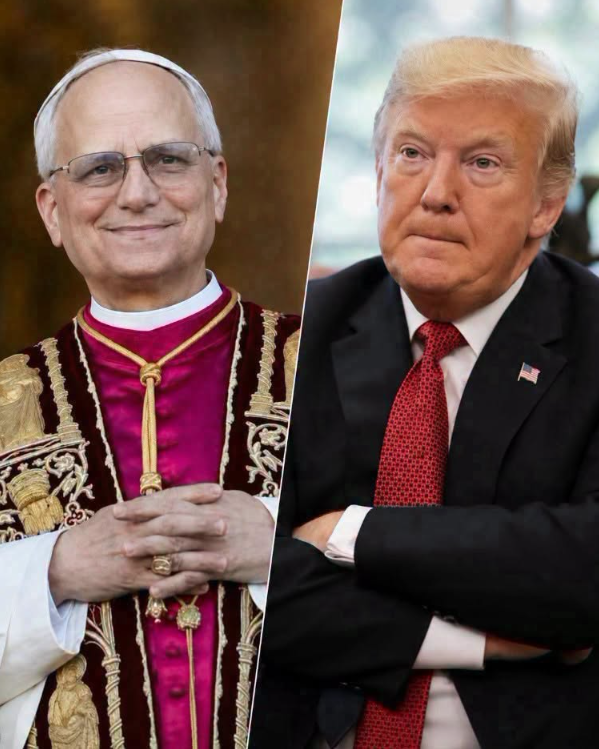
A striking image showing a Catholic pope beside former U.S. President Donald Trump has been circulating with a provocative message suggesting that the new pope is “not a fan” of Trump. The side-by-side photograph is designed to make viewers stop scrolling, but the most important question is not simply what the image appears to show. It is what the image actually proves.
The answer is: very little by itself.
The photograph creates an immediate visual contrast. On one side is a religious leader dressed in elaborate papal vestments, presenting a calm and composed appearance. On the other is Trump, shown in a formal suit and red tie with a serious expression. The image appears carefully selected to suggest a confrontation between two powerful personalities.
But photographs can tell only part of a story.
A facial expression does not establish what someone is thinking. A pose does not prove hostility. And a composite or side-by-side image does not demonstrate that two people are engaged in a political dispute.
That distinction becomes especially important when social media posts claim that a religious leader has publicly attacked a political figure.
The Catholic Church occupies a unique position in global affairs. The pope is not simply a religious celebrity. The office carries enormous spiritual, diplomatic, and cultural influence. Popes routinely speak about war, poverty, immigration, human dignity, economic inequality, peace, the environment, and the responsibilities of governments.
Those statements can sometimes overlap with political debates.
But disagreement over a policy does not automatically mean personal hostility toward a politician.
This is where viral headlines can become misleading.
A headline saying that a pope “is NOT a fan” of Trump is much more dramatic than saying that the pope has expressed views on issues that may differ from positions associated with Trump.
The distinction matters.
Religious leaders can criticize policies without declaring personal hatred for the people who support them. Likewise, politicians can disagree with religious leaders without being enemies.
Throughout history, popes have interacted with presidents, prime ministers, kings, dictators, diplomats, and political movements. These relationships have often been complicated.
Sometimes there is agreement.
Sometimes there is disagreement.
Sometimes both occur at the same time.
The Catholic Church’s teachings cover subjects that frequently become political issues. Questions about immigration, poverty, war, healthcare, abortion, refugees, the death penalty, and the treatment of marginalized people can place religious teaching directly into political conversations.
As a result, people from different political backgrounds may interpret the same papal statement differently.
One person may see it as a moral teaching.
Another may see it as political criticism.
A third may see it as a general appeal to compassion rather than a statement about any particular politician.
That is why context matters.
The image itself adds another layer to the story.
The composition puts the two figures close together while visually separating them with a diagonal divide. That creates the impression of a showdown. It is a familiar technique used in political graphics because viewers instantly understand the message: two powerful figures, two different worlds, one apparent conflict.
The pope’s elaborate clothing symbolizes religious authority.
Trump’s businesslike suit symbolizes political authority.
Placed beside each other, the image almost tells a story before the viewer reads a single word.
But visual storytelling is not the same as factual evidence.
A serious expression does not necessarily mean anger.
A neutral expression does not necessarily mean approval.
And a photograph can be taken at a moment that has nothing to do with the headline accompanying it.
The same photograph can even be reused in completely different stories.
That is why readers should be cautious when a viral post says, “See his tweets,” or makes a dramatic claim about something supposedly said online.
The best way to evaluate such a claim is to locate the original statement.
Was it actually posted by the person being discussed?
Was the account official?
When was it posted?
What was the complete context?
Was the statement altered, cropped, or paraphrased?
Those questions can transform a sensational story into a much more accurate one.
Social media has made political and religious controversies move faster than ever. A single screenshot can reach thousands of people before anyone checks whether it is authentic.
Once a claim becomes viral, repetition can make it feel true.
But repetition is not verification.
This is especially important when discussing religious figures and political leaders because both groups have enormous audiences. A misleading claim can quickly become part of a larger political argument.
Supporters may share it as evidence that their opponents are wrong.
Critics may share it as evidence that a particular leader is biased.
Others may share it simply because the headline is shocking.
Before long, the original source may become almost irrelevant.
The larger question behind this image is actually fascinating: How should religious leaders interact with political power?
The pope’s role is not to function as a campaign surrogate for one political party.
At the same time, religious leaders have traditionally spoken about moral questions that governments must address.
That can inevitably create tension.
A pope may call for compassion toward migrants.
A government may emphasize border enforcement.
A pope may call for peace during an international conflict.
A government may argue that military strength is necessary.
A pope may criticize economic conditions that leave vulnerable people behind.
Politicians may disagree about how those problems should be solved.
None of that automatically makes the religious leader an enemy of a particular politician.
In fact, disagreement can be an important part of public life.
Democratic societies depend upon people being able to disagree without treating every disagreement as personal warfare.
The same principle applies to religious debate.
The image may therefore be better understood as a symbol of the complicated relationship between faith and politics rather than proof of a personal feud.
It reminds us that religious authority and political authority often intersect, but they are not identical.
The pope speaks from a religious tradition with its own teachings and priorities.
A president speaks within a political system and is accountable to voters, laws, institutions, and political realities.
Their responsibilities are fundamentally different.
That doesn’t mean they can never agree.
It means their disagreements need to be understood carefully.
For readers encountering the viral image, the most responsible approach is simple: enjoy the photograph, but don’t let the photograph become the evidence.
If the claim is that the pope made a particular statement about Trump, look for the original statement.
If the claim involves a tweet or social-media post, verify the account and the date.
If the claim is based only on facial expressions or a dramatic side-by-side graphic, treat it as commentary rather than proof.
In an age of viral headlines, that small habit can make a huge difference.
The most compelling stories are not always the most accurate ones.
Sometimes the truth is more complicated than the headline.
And when religion, politics, and powerful personalities collide, complexity is almost guaranteed.
The photograph may suggest a dramatic showdown between two worlds.
But the real story is bigger than two faces placed next to each other.
It is about how people interpret authority, how social media shapes political narratives, and how quickly a striking image can become a supposed fact.
The lesson is worth remembering:
A picture can capture a moment, but it cannot tell you everything that moment means.
Before believing the headline, find the evidence.
Before sharing the claim, check the source.
And before turning disagreement into a feud, look for the full story.