Insane Photos That Will Totally Mess With Your Mind — You Won’t Believe What You’re Seeing
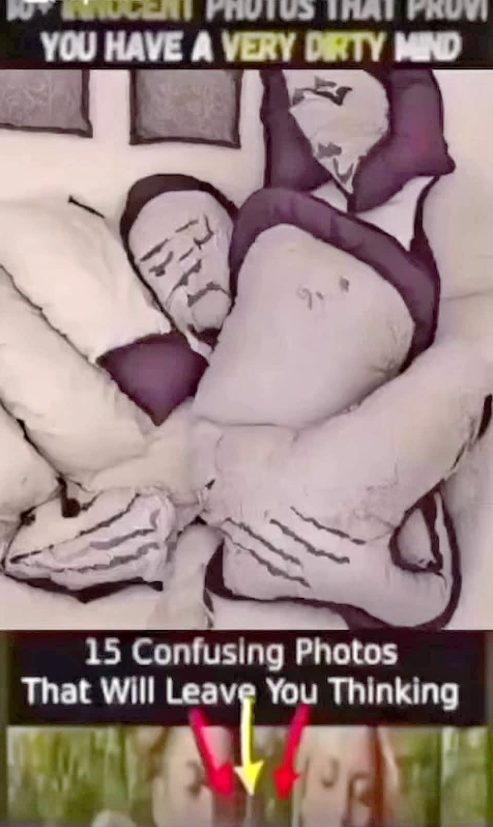
Some photographs capture beautiful sunsets, unforgettable celebrations, or breathtaking landscapes. Others seem to capture something that simply cannot be real. A person appears to have no head, a tiny dog looks enormous, or an ordinary building suddenly seems to defy gravity. The longer you stare, the more confusing the image becomes.
The fascinating thing about these photographs is that most of them do not require special effects, complicated editing, or computer-generated imagery. Instead, they rely on something much simpler: perspective, timing, lighting, reflections, shadows, and the remarkable way the human brain interprets visual information.
Here are some of the kinds of photographs that can completely fool your eyes.
The Floating Person
One of the classic examples of a mind-bending photograph is the person who appears to be floating in midair. At first glance, it can look as though the laws of physics have suddenly stopped working.
In reality, the person may simply be standing on a surface that blends perfectly into the background. A wall, railing, staircase, or hidden platform can disappear from view because of the camera angle.
Your brain automatically tries to construct the missing information. When it cannot find an obvious explanation, it fills in the gap—and suddenly the person appears to be levitating.
A Giant Dog or a Tiny Horse?
Forced perspective can create some hilarious results.
Imagine a dog standing several feet closer to the camera than a horse in the background. Depending on the angle, the dog might appear almost as large as the horse. Move the camera slightly, and the illusion disappears.
Photographers have been using perspective tricks for decades. Movies use similar techniques to make actors appear much taller, smaller, closer, or farther away than they really are.
The difference is that accidental photographs can be even more convincing because the illusion was created naturally.
The Mysterious Disappearing Head
Few things make people stop scrolling faster than a photograph in which someone appears to have lost their head.
Fortunately, the explanation is usually much less frightening.
The person’s head may be hidden behind another person’s shoulder, a sign, a piece of furniture, or an object positioned at exactly the right angle. Because the rest of the body remains visible, the brain immediately assumes something strange has happened.
It takes only a few seconds of careful inspection to discover the truth.
But those first few seconds can be incredibly confusing.
When Reflections Become More Real Than Reality
Mirrors and reflective surfaces are responsible for some of the most impressive visual puzzles.
A perfectly positioned mirror can make a room appear twice as large. A window can reflect a person standing outside while simultaneously showing the interior of a building. A shiny car can create reflections that look like entirely different objects.
The brain normally treats reflections as clues about the environment. When several visual layers overlap, however, those clues can become contradictory.
Suddenly, you are not sure what you are looking at.
The Shadow That Looks Like an Object
Shadows can be surprisingly deceptive.
A tree branch may cast a shadow that looks like an animal. A person standing under unusual lighting may appear to have enormous arms. A bicycle’s shadow might look like a strange mechanical creature.
Because shadows usually have recognizable relationships with the objects creating them, the brain quickly interprets them as part of the scene.
But when the angle of the light changes, those relationships can become distorted.
The result is a photograph that looks almost supernatural.
People With the Wrong Bodies
Timing can create another category of photographic illusion.
Two people standing close together can accidentally appear to have swapped bodies. One person’s legs may seem to belong to another person’s torso, while someone’s arms appear to come from the wrong direction.
The trick is often caused by clothing.
If two people are wearing similar colors, patterns, or styles, their bodies can visually merge. Add the perfect camera angle, and the photograph becomes confusing enough to make viewers stare at it repeatedly.
Once you understand where one person ends and the other begins, the entire image suddenly makes sense.
Buildings That Seem to Bend
Architecture can produce incredible optical illusions.
Curved buildings, unusual staircases, modern glass structures, and narrow streets can look completely different depending on the camera position.
A tall building photographed from directly below may appear to lean dramatically toward the center of the image. A road photographed at an unusual angle can look impossibly steep.
Nothing has actually moved.
The camera has simply changed your perception of space.
This is one reason professional photographers spend so much time experimenting with perspective. A few steps forward or backward can completely transform an ordinary scene.
The Perfectly Timed Photograph
Some of the most unbelievable images are created by timing rather than perspective.
A bird flying behind someone’s head can make it look as though the person has wings. A ball can appear to be perfectly balanced on someone’s finger. A splash of water can freeze in the shape of an animal.
These moments may last less than a second.
The photographer just happens to press the shutter at exactly the right time.
Digital cameras make it easier than ever to capture such moments because photographers can take hundreds of images in rapid succession. Among dozens or even hundreds of ordinary frames, one can contain a nearly impossible-looking moment.
Objects That Look Like Something Else
Another common source of visual confusion is pareidolia—the tendency of the human brain to recognize familiar shapes in random patterns.
A cloud may resemble a face. A rock may look like a sleeping animal. A stain on a wall might resemble a famous celebrity.
The object itself has not changed.
Your brain is simply searching for patterns.
This is why people often see faces in everyday objects. Once the brain identifies two shapes as eyes and another shape as a mouth, the rest of the interpretation happens almost automatically.
When Nature Creates the Illusion
Nature may be the greatest optical illusionist of all.
Mountains can appear to float above clouds. Fog can hide the lower portions of buildings, making them look like enormous towers suspended in the sky. Ice formations can resemble animals or mythical creatures.
Even ordinary trees can create strange silhouettes when photographed against a bright sunset.
The natural world contains countless combinations of light, texture, shadow, and distance. Sometimes all those elements line up perfectly to create a scene that looks almost artificial.
Why Our Brains Get Fooled
The most interesting part of these photographs is not necessarily the image itself. It is the way our brains process what we see.
Human vision does not simply record the world like a camera. The brain constantly interprets visual information, using experience and context to make sense of what is happening.
Usually, this process works incredibly well.
But when a photograph contains unusual perspective, overlapping objects, confusing shadows, or unexpected proportions, the brain can make an incorrect assumption.
That is why some photographs become more confusing the longer you look at them.
Your brain is trying to solve the puzzle.
Look Twice Before You Decide
The next time you see a photograph that seems impossible, do not immediately assume it has been edited.
Look at the background.
Look at the shadows.
Look at where people’s arms and legs connect.
Check reflections and nearby objects.
Sometimes the explanation is surprisingly simple.
And sometimes the photograph really did capture an extraordinary moment.
That is what makes these images so entertaining. They remind us that seeing something and understanding something are not always the same thing.
A single photograph can freeze a fraction of a second, combine several perspectives, and create a visual puzzle that challenges everything we think we know about what is in front of us.
So the next time an image makes you say, “Wait… what am I looking at?” take another look.
Then take a third.
Because the strangest photographs are often the ones that become even more fascinating once you finally discover what is really happening.