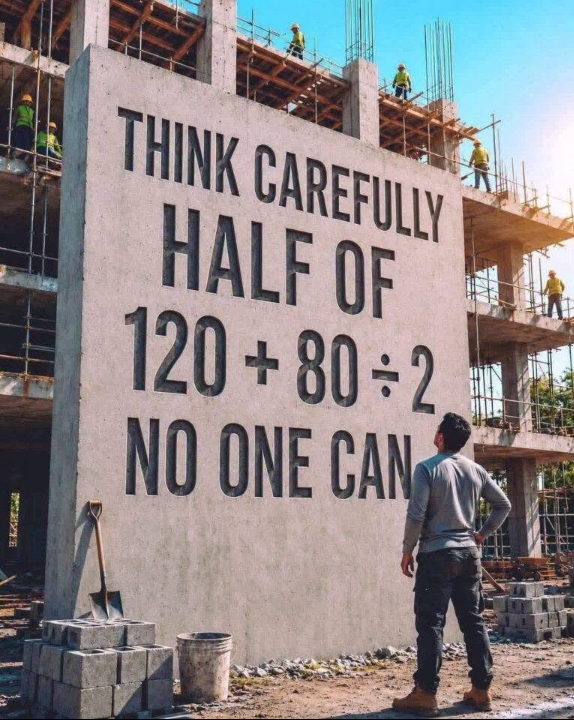
Can You Solve This Math Expression That Half of People Get Wrong? The challenge sounds simple enough at first glance. A few numbers, a handful of mathematical symbols, and one final answer. Yet every year, puzzles like these spread across social media, leaving thousands of people arguing in the comments about which solution is correct. Some insist the answer is obvious, while others are just as confident that everyone else has made a mistake. What makes these problems so fascinating isn’t that they require advanced mathematics. Most of the time, they rely on concepts that students learn in middle school. The real challenge lies in remembering the correct order of operations and resisting the temptation to solve the equation from left to right without thinking carefully.
Imagine seeing an expression such as 8 ÷ 2(2 + 2). Within seconds, hundreds of people will post different answers. Some say the result is 1, while others insist it is 16. Both groups believe they are applying the correct rules. This disagreement has sparked countless debates online, proving that even basic arithmetic can become surprisingly controversial when parentheses and division are involved.
The reason so many people struggle is because our brains naturally want to simplify problems quickly. We recognize familiar patterns and rush toward an answer before carefully checking every step. Mathematics rewards patience rather than speed. A single overlooked rule can completely change the outcome.
The key to solving these puzzles is remembering the order of operations. Many students learn it through the acronym PEMDAS: Parentheses, Exponents, Multiplication and Division, Addition and Subtraction. In some countries, the acronym BODMAS or BIDMAS is used instead. Regardless of the name, the underlying principles remain the same.
First, solve anything inside parentheses. Next, evaluate exponents if they exist. Then perform multiplication and division from left to right because they have equal priority. Finally, complete addition and subtraction, also moving from left to right.
One common misconception is believing that multiplication always comes before division simply because it appears first in the acronym. That is incorrect. Multiplication and division share equal importance. You simply work from left to right as they appear in the expression. The same rule applies to addition and subtraction.
Let’s examine a classic example. Consider the expression:
6 + 2 × 5
Many people incorrectly add 6 and 2 first, getting 8, then multiply by 5 to obtain 40. However, multiplication comes before addition. First calculate 2 × 5 = 10. Then add 6, producing the correct answer of 16.
Now consider another example:
18 ÷ 3 × 2
Some people divide first to obtain 6, then multiply by 2 for a final answer of 12. That is correct because division appears first when reading left to right.
Others mistakenly multiply 3 × 2 first, giving 6, then divide 18 by 6 to obtain 3. Although multiplication and division share equal priority, they must still be completed from left to right. Therefore, 12 is the correct answer.
Parentheses create another opportunity for confusion. Whenever numbers appear inside parentheses, they must be evaluated before anything outside them.
For example:
7 × (5 − 2)
The subtraction inside the parentheses comes first.
5 − 2 = 3
Then multiply:
7 × 3 = 21
Skipping the parentheses would completely change the answer.
Social media puzzles often rely on expressions designed to trigger these common mistakes. They are written in ways that tempt readers into forgetting one small rule. Sometimes the formatting itself contributes to the confusion. Printed textbooks usually present equations clearly, while internet graphics may squeeze symbols together, making multiplication appear ambiguous.
Another factor is overconfidence. People often answer immediately because they recognize the numbers involved and assume the problem is straightforward. Psychologists describe this as intuitive thinking. Our brains prefer quick judgments, especially when something seems familiar. Slowing down to verify each step feels unnecessary—until we discover we were wrong.
Professional mathematicians are not immune to making arithmetic errors either. Even experienced experts occasionally overlook a negative sign or misread a symbol. The difference is that they usually double-check their work before accepting the result.
Mental math is an excellent skill, but it works best when combined with discipline. Rushing through calculations increases the likelihood of mistakes, particularly when several operations appear together.
Teachers frequently encourage students to write each intermediate step rather than trying to solve everything mentally. Although it takes slightly longer, writing each calculation dramatically reduces careless errors. This habit becomes especially valuable in algebra, geometry, calculus, and other advanced subjects where one small mistake can affect an entire page of work.
The popularity of these viral math puzzles also highlights how much people enjoy intellectual challenges. Solving a difficult expression provides a sense of satisfaction. Even when someone gets the wrong answer, discovering the correct reasoning can be rewarding because it strengthens mathematical understanding.
Critical thinking extends far beyond mathematics. The same careful reasoning used to solve equations helps people evaluate news stories, interpret scientific studies, manage finances, and make everyday decisions. Learning to slow down and examine evidence carefully is valuable in nearly every area of life.
Interestingly, many viral expressions are intentionally written in ambiguous ways. Professional mathematical notation has conventions that reduce confusion, but internet memes often ignore those conventions to generate debate and engagement. That’s why discussions sometimes continue even after someone posts the accepted solution.
The next time you encounter one of these puzzles online, resist the urge to answer immediately. Read the entire expression carefully. Identify any parentheses first. Check for exponents. Then perform multiplication and division from left to right, followed by addition and subtraction. Taking just a few extra seconds often makes the difference between a correct answer and a surprisingly embarrassing mistake.
Ultimately, these puzzles remind us that mathematics is not merely about memorizing formulas. It is about applying logical rules consistently and carefully. Every symbol has meaning, every operation follows established principles, and every correct solution depends on respecting those principles step by step.
So, can you solve the math expression that half of people supposedly get wrong? The answer depends less on natural talent than on patience and attention to detail. Whether the puzzle involves fractions, parentheses, multiplication, or division, the winning strategy is always the same: slow down, follow the order of operations, and let logic guide every step. Doing so will not only help you solve viral math challenges but also strengthen the analytical skills that prove useful far beyond the classroom.