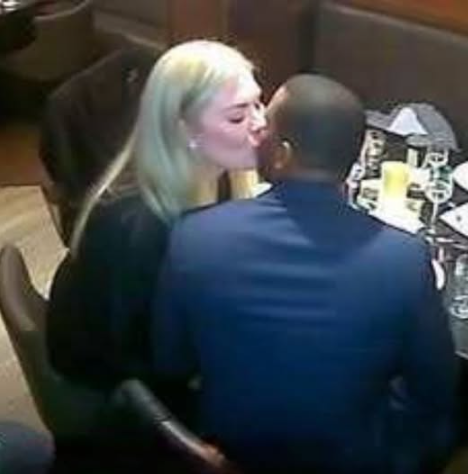
There is no verified “breaking” sighting of Erika Kirk with “another” man from 20 minutes ago—or from any recent window that matches the claim.
Searches across news outlets and recent posts turn up nothing. The phrasing (“Eriika K!rk was seen wi!th anooth…”) is classic low-effort clickbait engineered for rage, curiosity, or algorithmic juice. Similar rumors have circulated before and been directly denied. In May 2026, roughly eight months after Charlie Kirk’s assassination, a claim that Erika had been spotted with Blake Wynn (a friend of her late husband’s) at a Beverly Hills hotel was publicly rejected by both parties. Erika stated the report was a lie, that Charlie’s love would last a lifetime, and that only the Lord could fill the void. Wynn confirmed he was not dating her and was approaching engagement with his longtime girlfriend.
Charlie Kirk was shot and killed on September 10, 2025, while speaking at Utah Valley University. He was 31. Erika, a former Miss Arizona USA, mother of their two young children, and now CEO and chair of Turning Point USA, has spent the intervening months in the dual role of grieving widow and organizational successor. She has appeared at events, introduced speakers including Vice President JD Vance, received the late husband’s posthumous Presidential Medal of Freedom alongside Trump administration figures, and continued the campus and conference work her husband built. Public moments of physical closeness—hand-holding with Second Lady Usha Vance while escorting the casket, embraces with Vance on stage—have been scrutinized, sometimes breathlessly, sometimes with open speculation. Those moments were public, documented, and occurred in the context of mourning and political continuity, not private romance.
The hunger for a new scandal around a high-profile widow is not new. It follows a familiar script. A man dies violently and publicly. His wife inherits both the private devastation and the public machinery he operated. Every subsequent appearance, every photograph, every association is examined for signs that the grief is incomplete, the loyalty insufficient, or the succession too smooth. The same culture that once demanded she remain visible in black and tearful now demands she remain frozen in that posture indefinitely. Any deviation—smiling at an event, accepting institutional roles, maintaining friendships—is converted into evidence of something darker. The “seen with another” rumor is simply the latest iteration of that demand.
What the rumor-mongers rarely acknowledge is the actual arithmetic of the situation. Erika Kirk lost her husband of four years in front of cameras and a national audience. She has two small children who will never again hear their father’s voice in ordinary life. She stepped into leadership of an organization that experienced a surge of interest after the killing and that continues to operate under heightened security concerns. Court proceedings related to the accused shooter, Tyler Robinson, have required her presence and public statements on behalf of the family. Through all of it she has repeatedly framed her response in religious language: Charlie’s love lasting a lifetime, the Lord as the only sufficient presence, the refusal to let the movement die. Those statements are either sincere or they are not; the public has no reliable instrument for measuring the difference. What the public does have is an endless appetite for the simpler story in which the widow moves on too quickly, too strategically, or too carnally.
The mechanics of the rumor are efficient. A vague claim is posted with deliberate misspellings and an urgent timestamp. It requires no photograph, no named witness, no location beyond the implication of secrecy. The reader is invited to complete the sentence—“seen with another…”—in the most lurid direction available. Engagement follows. Denials, when they come, are treated as further evidence of cover-up rather than as the ordinary response of someone whose private life is being colonized for content. The same pattern appeared earlier with fabricated images pairing Erika and the accused shooter; those were debunked as AI-generated. The pattern will appear again.
None of this means public figures are owed silence or uncritical sympathy. Charlie Kirk was a polarizing activist whose work generated intense opposition as well as intense loyalty. His widow’s decision to continue that work places her inside the same arena of scrutiny. Fair examination of Turning Point USA’s direction under her leadership, of her political alliances, of the organization’s claims about growth or influence, is legitimate. Inventing a romantic interlude twenty minutes ago is not examination; it is entertainment that treats a real woman’s residual privacy as raw material.
The deeper pattern is older than any single assassination. Widows of prominent men have long been asked to perform a specific kind of constancy while simultaneously being suspected of failing it. The performance is never quite sufficient. If she withdraws, she is accused of abandoning the cause. If she remains visible, she is accused of exploiting the cause. If she accepts help from political allies, the help is reframed as courtship. If she denies the reframing, the denial is reframed as calculation. The only posture that temporarily satisfies the audience is the one that keeps the woman permanently defined by the absence of the man. Anything else risks the charge that she has already replaced him.
Erika Kirk has stated, more than once, that replacement is not possible and not desired. Whether that statement is true in the private chambers of her life is unknowable to outsiders and, frankly, none of their business. What is knowable is that the public record contains no credible evidence of a new romantic partner as of early August 2026, that earlier specific claims were rejected by the named parties, and that the current “breaking” item fits the established template of unverified provocation rather than verified reporting.
A thousand words can be spent chasing the ghost of a nonexistent sighting, or they can be spent noticing how reliably the ghost is summoned. The latter is more useful. The machinery that turns a widow’s ordinary movements into overnight scandal does not require the scandal to be true. It only requires the audience to prefer the scandal to the quieter, more ordinary facts: a woman raising children, running an organization, attending court, speaking at conferences, and living inside a grief that does not resolve on the timetable of social media. The rumor will fade when a fresher one appears. The underlying demand—that her life remain permanently legible as unfinished mourning—will not. That demand is the real story, and it does not need a fabricated “another” to keep operating.