I Saw My Neighbor’s Wife Having Dinner With Another Man
It started like any other Thursday evening. I had just finished work and decided to stop by a small Italian restaurant across town to grab dinner before heading home. The place wasn’t usually crowded, and I enjoyed sitting by the window with a plate of pasta while watching people come and go.
As I looked around the dining room, someone familiar caught my eye.
It was my neighbor’s wife, Emily.
She wasn’t alone.
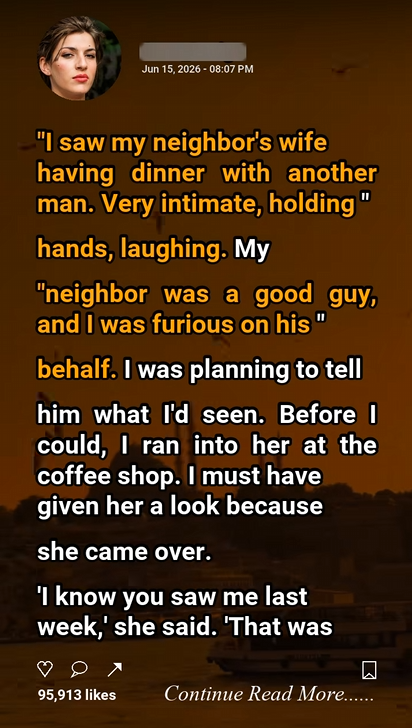
Across the table sat a well-dressed man I had never seen before. They weren’t discussing business or catching up like old friends. They were leaning toward each other, smiling constantly, laughing at every joke, and, at one point, reaching across the table to hold hands.
The gesture wasn’t brief or accidental.
They stayed that way for several moments, looking into each other’s eyes with an unmistakable intimacy.
My stomach tightened.
I had lived next door to Mark and Emily for nearly six years. Mark was one of the kindest people I’d ever met. He helped everyone on the street without expecting anything in return. Whether it was mowing an elderly neighbor’s lawn, fixing someone’s broken fence, or lending tools, Mark was always the first to volunteer.
He adored Emily.
Whenever he talked about her, his face lit up.
Seeing her with another man made me furious—not because it involved me, but because I couldn’t imagine someone treating Mark that way.
I finished my meal quickly, unable to stop thinking about what I’d witnessed.
For the next few days, I wrestled with my conscience.
Should I tell him?
Was it really my place?
Maybe there was an explanation, I told myself.
But every time I remembered them holding hands, any innocent explanation seemed less believable.
I eventually decided that if I were in Mark’s position, I’d want someone to tell me.
Before I had the chance, something unexpected happened.
Saturday morning, I stopped by my favorite coffee shop before running errands.
As I waited in line, someone tapped my shoulder.
I turned around.
It was Emily.
She looked nervous.
“I know you saw me last week,” she said quietly.
I didn’t respond.
She glanced around the room before asking if we could sit for a minute.
Curiosity got the better of me.
We found a small table in the corner.
She wrapped both hands around her coffee cup before speaking.
“I know what it looked like.”
I folded my arms.
“It looked like you were on a date.”
She sighed.
“I understand why you’d think that.”
There was a long silence.
Finally, she said, “The man you saw is my older brother.”
I blinked.
“My brother?”
“Yes.”
I must have looked skeptical because she reached into her purse and pulled out her phone.
She opened a family photo album.
Picture after picture showed the same man standing beside her at birthdays, graduations, holidays, and family vacations dating back decades.
The resemblance was obvious once I looked closely.
Same eyes.
Same smile.
Same dimples.
“I haven’t seen him in almost eight years,” she explained.
“He moved overseas after accepting a medical position. Last week was the first time he’d come home in years.”
I felt my confidence begin to crumble.
“But…you were holding hands.”
Emily smiled sadly.
“Our mother passed away two months ago.”
I looked down.
“He flew back because we finally scattered her ashes together.”
She paused.
“We were remembering her. We cried. We laughed. We held hands.”
Suddenly every assumption I’d made felt painfully foolish.
“I’m sorry,” I said quietly.
She nodded.
“I figured you’d tell Mark.”
“I was planning to.”
“I know.”
She smiled gently.
“I don’t blame you.”
Before leaving, she said something that stayed with me.
“We often create stories from incomplete information.”
Those words echoed in my head for the rest of the day.
Later that evening, Mark walked over while I was watering my flowers.
“Hey,” he said cheerfully.
“My brother-in-law finally made it home.”
I looked at him.
“Emily told me they spent all afternoon reminiscing about her mom.”
There wasn’t a trace of suspicion in his voice.
Only warmth.
Only trust.
I realized he’d known everything all along.
Feeling embarrassed, I admitted the truth.
“I actually saw them together at the restaurant.”
He laughed.
“I figured someone in town would.”
“I almost told you.”
He smiled.
“I appreciate that.”
Then he surprised me.
“But before acting, it’s always good to ask questions.”
He wasn’t angry.
He wasn’t offended.
He understood exactly why someone might jump to conclusions.
Over the following weeks, I couldn’t stop reflecting on the experience.
How many times had I assumed I knew someone’s story based on a single moment?
A stranger crying alone in a park.
Someone arguing loudly on the phone.
A couple sitting silently through dinner.
A parent raising their voice at a child.
Every scene can be interpreted in dozens of different ways depending on the missing pieces we never get to see.
Social media makes this even easier.
A single photograph can convince thousands of people that they know the truth, when in reality they’re seeing only one frozen second out of an entire lifetime.
One image can suggest betrayal.
Another can suggest happiness.
Neither necessarily tells the whole story.
Looking back, I realized my intentions had been good.
I wanted to protect someone I respected.
But good intentions don’t guarantee accurate conclusions.
Sometimes the most responsible thing we can do is pause before assuming the worst.
If someone’s safety is at risk or there is clear evidence of wrongdoing, speaking up may absolutely be the right choice. But when all we have is a brief glimpse of someone else’s life, it’s worth remembering that appearances can be incomplete—or even misleading.
That afternoon at the coffee shop taught me a lesson I’ll never forget.
Not every story is what it seems.
Not every glance tells the truth.
And sometimes, the missing chapter changes everything.