Men Pass On More Dangerous Mutations as They Age—What the Research Actually Says
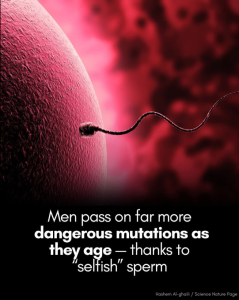
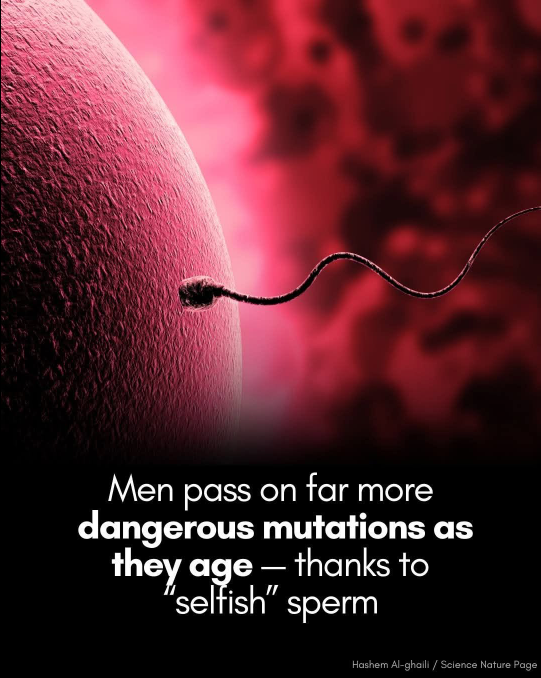
A striking image circulating online claims that “Men pass on far more dangerous mutations as they age—thanks to ‘selfish’ sperm.” While the headline is designed to grab attention, it is based on a real area of scientific research. However, the full story is more nuanced than the headline suggests.
Scientists have spent decades studying how the age of both parents affects reproduction and the health of future children. One of the most consistent findings is that as men grow older, the DNA in sperm accumulates more genetic changes, known as de novo mutations—mutations that are new in a child and were not inherited from previous generations.
Why Do Mutations Increase With Age?
Unlike women, who are born with most of the egg cells they will ever have, men continuously produce new sperm throughout their lives.
Every time sperm-producing cells divide, there is a small chance that an error will occur when copying DNA. Since these cells divide hundreds of times over a man’s lifetime, older fathers naturally tend to have sperm carrying more mutations than younger fathers.
Research estimates that each additional year of a father’s age contributes roughly one or two additional genetic mutations to a child’s genome. Most of these mutations are completely harmless and have no noticeable effect.
What Is “Selfish” Sperm?
The phrase “selfish sperm” can be misleading.
Scientists actually refer to a process called selfish spermatogonial selection. This doesn’t mean sperm are making conscious choices. Instead, certain mutations give sperm-producing stem cells a growth advantage.
These altered stem cells reproduce more quickly than neighboring cells, gradually making up a larger proportion of sperm as a man ages.
As a result, mutations that began in only a tiny number of cells may become increasingly common over time.
Are These Mutations Dangerous?
Not necessarily.
The overwhelming majority of new mutations are either harmless or occur in parts of DNA that don’t affect health.
Only a very small percentage influence important genes, and an even smaller number are linked to medical conditions.
Scientists have associated advanced paternal age with a modest increase in the likelihood of certain rare genetic disorders, including some skeletal conditions and neurodevelopmental disorders. However, even when the relative risk increases, the absolute risk for any individual pregnancy generally remains low.
How Much Does Age Matter?
Age is only one of many factors involved in reproduction.
Overall health, lifestyle, environmental exposures, family history, and simple chance also influence reproductive outcomes.
Many healthy children are born to fathers in their 40s, 50s, and beyond. Likewise, genetic conditions can occur in children of younger parents because mutations sometimes arise randomly.
What Can Prospective Fathers Do?
Although aging itself cannot be stopped, certain healthy habits may support overall reproductive health:
- Avoid smoking and recreational drugs.
- Limit excessive alcohol consumption.
- Maintain a healthy weight.
- Exercise regularly.
- Eat a balanced diet rich in fruits, vegetables, and whole grains.
- Get enough sleep.
- Reduce unnecessary exposure to harmful chemicals and radiation.
- Seek medical advice if planning a family later in life.
While these steps cannot eliminate age-related mutations, they contribute to general health and may improve sperm quality.
Why Headlines Can Be Misleading
Images like this often simplify complex scientific findings into dramatic statements designed to attract clicks and shares.
Saying that older men pass on “far more dangerous mutations” suggests that most mutations are harmful, which isn’t accurate. In reality:
- Most new mutations are biologically neutral.
- Only a small fraction affect health.
- Many children of older fathers are born completely healthy.
- Scientists continue studying how paternal age influences disease risk, but no single factor determines a child’s future health.
Ongoing Research
Genetic technology has advanced rapidly in recent years, allowing researchers to sequence entire genomes and identify tiny DNA changes that were impossible to detect decades ago.
Current studies aim to better understand:
- Which mutations are most likely to cause disease.
- Why certain sperm-producing cells gain a growth advantage.
- Whether environmental factors influence mutation rates.
- How age-related mutations interact with other genetic and environmental influences.
This research may eventually improve genetic counseling, fertility medicine, and our understanding of inherited disease.
The Bottom Line
The claim in the image is rooted in legitimate scientific research but lacks important context. As men age, the number of new genetic mutations in sperm generally increases because sperm-producing cells continue dividing throughout life. A phenomenon known as selfish spermatogonial selection can allow certain mutations to become more common in sperm over time.
However, this does not mean that older fathers are likely to have children with serious genetic disorders. Most mutations are harmless, and the overall chance of having a healthy child remains high. Age is just one of many factors that influence reproductive outcomes, and advances in genetics continue to improve our understanding of these complex biological processes.
Rather than viewing the research as a reason for alarm, experts generally see it as an opportunity to better understand human genetics, improve reproductive medicine, and provide more informed guidance for families planning for the future.