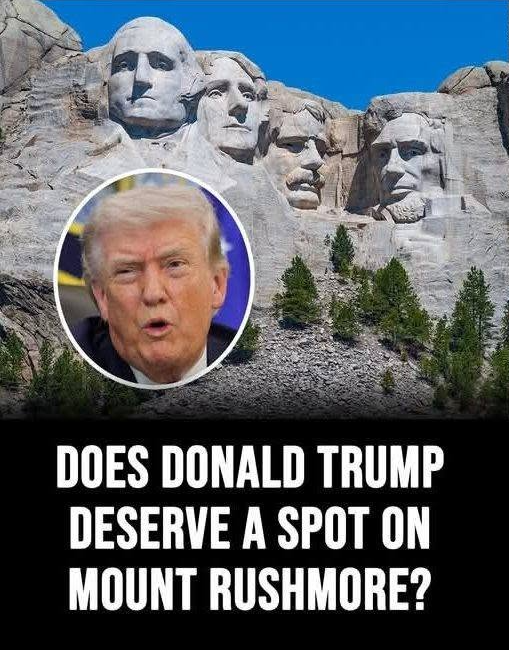
Does Donald Trump Deserve a Spot on Mount Rushmore?
The question of whether Donald Trump deserves a place on Mount Rushmore has become one of the most debated political topics in recent years. Supporters argue that his presidency reshaped American politics, strengthened the economy before the COVID-19 pandemic, and redefined the role of the United States on the global stage. Critics, however, contend that his presidency was marked by deep political division, controversial rhetoric, and events that make such an honor inappropriate. Like many questions involving history, the answer depends largely on perspective, historical evidence, and how future generations evaluate his legacy.
Mount Rushmore, located in the Black Hills of South Dakota, features the carved faces of four U.S. presidents: George Washington, Thomas Jefferson, Theodore Roosevelt, and Abraham Lincoln. Each was chosen because of their significant contributions to the nation’s founding, expansion, preservation, and development. Washington led the country through its birth, Jefferson expanded its territory with the Louisiana Purchase, Lincoln preserved the Union during the Civil War, and Roosevelt championed conservation while strengthening America’s global influence. Their selection was intended to symbolize defining moments in American history rather than simply recognize popular presidents.
Donald Trump served as the 45th president of the United States from 2017 to 2021 and later returned to office after winning the 2024 presidential election, becoming one of only a few presidents to serve non-consecutive terms. His political career has been unlike that of any modern president, generating strong support from millions of Americans while also attracting intense criticism from opponents.
Supporters point to several accomplishments they believe justify historical recognition. Before the COVID-19 pandemic, the United States experienced low unemployment, rising stock markets, and steady economic growth. Tax reform legislation passed in 2017 lowered corporate tax rates and was praised by many businesses for encouraging investment. Supporters also highlight efforts to reduce federal regulations, arguing that these policies stimulated economic activity and encouraged entrepreneurship.
Another achievement frequently cited is Trump’s judicial legacy. During his first term, he appointed three Supreme Court justices and hundreds of federal judges, significantly shaping the American judicial system for decades to come. Many conservatives view these appointments as one of the most enduring accomplishments of his presidency.
Foreign policy is another area where supporters believe Trump made a lasting impact. His administration helped broker the Abraham Accords, agreements that normalized diplomatic relations between Israel and several Arab nations. Many foreign policy analysts viewed these agreements as an important step toward greater regional cooperation in the Middle East.
Immigration was one of Trump’s defining political issues. His administration emphasized stronger border security, increased immigration enforcement, and construction of additional barriers along portions of the U.S.–Mexico border. Supporters argue these measures addressed long-standing concerns about illegal immigration and national security.
Trump also reshaped the Republican Party. His populist approach attracted many working-class voters who had traditionally supported Democrats, changing electoral coalitions in several key states. Even after leaving office following his first term, his influence remained central to Republican politics.
Critics, however, argue that Mount Rushmore should be reserved for presidents whose contributions united and fundamentally strengthened the nation. They contend that Trump’s presidency deepened political polarization, with debates becoming increasingly divisive across American society.
His handling of the COVID-19 pandemic continues to generate debate among historians and public health experts. While supporters note the rapid development of vaccines through Operation Warp Speed, critics argue that public messaging and coordination during the pandemic were inconsistent and contributed to confusion during a national emergency.
The events surrounding January 6, 2021, also remain central to discussions of Trump’s legacy. Following the 2020 election, a mob of his supporters entered the U.S. Capitol while Congress was certifying the Electoral College results. Critics argue that this event significantly damaged democratic institutions and should weigh heavily in historical assessments. Trump and his supporters dispute aspects of the broader political narrative surrounding those events, making the subject one of the most contested chapters in recent American history.
Environmental policy presents another point of disagreement. Trump’s administration rolled back numerous environmental regulations while emphasizing domestic energy production. Supporters viewed these actions as promoting economic growth and energy independence, while opponents argued they weakened environmental protections.
The question of Mount Rushmore also involves practical considerations. The monument itself is considered a completed national memorial, and many historians, preservation experts, and National Park officials have indicated that adding another face would be technically difficult and could damage the existing sculpture. Additionally, the monument’s location in the Black Hills remains a subject of cultural and historical significance, particularly for Native American tribes, who regard the area as sacred land.
History often changes how presidents are remembered. Harry Truman, Dwight Eisenhower, Ronald Reagan, and other presidents experienced changing public opinions long after leaving office. Historical rankings frequently evolve as scholars gain greater perspective over time. It may take decades before there is broad agreement on Trump’s place in American history.
Public opinion about honoring presidents often reflects broader political beliefs. Those who strongly support Trump’s policies may see him as one of the most influential presidents of the modern era. Those who oppose his leadership may believe his presidency falls well short of the standard represented by the four presidents already on Mount Rushmore.
Ultimately, whether Donald Trump deserves a place on Mount Rushmore is not a question with a universally accepted answer. It depends on how one weighs economic performance, judicial appointments, foreign policy achievements, political influence, leadership style, constitutional norms, and national unity. His presidency undoubtedly had a profound impact on American politics, and historians will continue debating its significance for many years.
Regardless of where individuals stand, the discussion highlights how national monuments reflect evolving views of history and leadership. Mount Rushmore symbolizes pivotal moments in the nation’s story, and any proposal to alter it would require not only widespread public support but also careful historical consideration. Trump’s legacy, like that of many presidents before him, will continue to be examined through the lens of time, scholarship, and the changing priorities of future generations