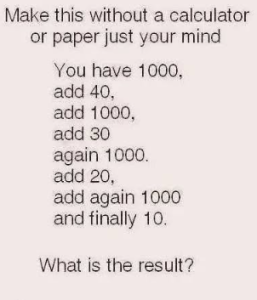
This Apparently Easy Math Problem Continues to Confuse People is a classic example of how seemingly straightforward arithmetic can spark endless online debates, expose gaps in mathematical education, and highlight the importance of precise notation.
These viral puzzles—often shared on Facebook, X (Twitter), Instagram, and Reddit with dramatic headlines—divide comment sections into warring camps. One side insists the answer is obvious; the other calls opponents incompetent. The most famous is the 8 ÷ 2(2 + 2) problem, but variants like 6 ÷ 2(1 + 2), 7 − 2(8 − 4), or 4 × 4 − 4 ÷ 4 + 4 keep resurfacing.
The Infamous Example: 8 ÷ 2(2 + 2)
At first glance, it looks innocent. Many people quickly compute:
- Parentheses first: 2 + 2 = 4 → 8 ÷ 2(4)
- Then left to right: 8 ÷ 2 = 4, 4 × 4 = 16
Others argue the implied multiplication by juxtaposition (2(4)) takes precedence, treating it as 8 ÷ [2 × 4] = 8 ÷ 8 = 1.
Both answers appear in heated threads. Why the split? It boils down to order of operations conventions and ambiguous notation.
PEMDAS/BODMAS Explained
Standard school rules (PEMDAS in the U.S.: Parentheses, Exponents, Multiplication/Division left-to-right, Addition/Subtraction left-to-right; BODMAS elsewhere) suggest 16. Multiplication and division have equal priority and associate left-to-right.
However, in some mathematical contexts—especially algebra, physics, and older textbooks—implied multiplication (juxtaposition) has higher precedence. So 2(4) is treated like a single unit, leading to 1. This convention appears in expressions like 1/2π (meaning 1/(2π), not (1/2)π).
Calculators disagree too: Google and many scientific calculators lean toward 16, while some older or graphing ones might yield 1 depending on input.
Why These Problems Go Viral
- Ambiguity by Design: The lack of explicit symbols (e.g., 8 ÷ 2 × (2 + 2)) creates parsing issues. Real mathematics avoids such ambiguity with proper parentheses or fractions.
- Psychological Trap: Our brains use System 1 (fast, intuitive) thinking for “easy” problems. People skip rigorous application of rules, leading to overconfidence.
- Dunning-Kruger Effect: Beginners think it’s simple; experts recognize the notation flaw. This fuels arguments where each side feels superior.
- Social Media Dynamics: Algorithms reward engagement. Outrage, tribalism (“You failed 3rd grade!”), and “gotcha” replies drive shares.
- Educational Gaps: Many adults vaguely remember PEMDAS but forget nuances. Different countries teach slight variations. Professional mathematicians often say the expression is ill-formed and needs clarification.
Deeper Mathematical Lessons
These puzzles reveal that math is not always as absolute as portrayed. Notation is a language with conventions that evolve. In rigorous contexts:
- Use fractions for clarity: 8 / 2(2+2) can be written as \frac{8}{2(2+2)} = 1 or 8 ÷ (2(2+2)) = 1.
- Explicit operators: 8 ÷ 2 × (2 + 2) clearly equals 16 under standard rules.
Similar debates occur with:
- 7 − 2(8 − 4): Some get 6 (left-to-right after parentheses), others -1 or other values depending on distribution.
- String of operations like 1 + 2 + 3 × 0: Multiplication first yields 1, but careless reading gives 6.
- Viral visuals: Grids, matchstick puzzles, or “only geniuses” problems that rely on lateral thinking.
Historical and Cultural Context
Ambiguous expressions have confused people for decades. Before widespread calculators, textbooks emphasized context. In programming, languages like Python follow strict left-to-right for * and /.
Physicists and engineers often favor implied multiplication precedence for readability (e.g., in formulas like \frac{1}{2}mv^2). The American Mathematical Society and style guides recommend avoiding ambiguity altogether.
Why It Matters Beyond Memes
- Critical Thinking: Learning to spot ambiguity builds analytical skills.
- Education Reform: These virals highlight needs for better teaching of conventions, notation, and mathematical communication.
- AI and Computation: Large language models sometimes stumble on these too, reflecting training data biases.
- Cognitive Bias: Demonstrates how prior knowledge and framing affect problem-solving.
How to Approach Such Problems
- Apply PEMDAS strictly unless context suggests otherwise.
- Add parentheses for clarity in your own work.
- Check with tools: Use Wolfram Alpha, which often explains ambiguities.
- Consider intent: In word problems or physics, interpret based on meaning.
- Enjoy the debate: Math can be fun and social when it sparks discussion rather than division.
Variants That Still Confuse
- 4 × 4 − 4 ÷ 4 + 4: Strict order gives 16 − 1 + 4 = 19. Intuitive grouping might yield other results.
- 6 ÷ 2(1 + 2): The eternal 9 vs. 1 debate.
- Sequences or patterns: “Find the next number” puzzles with multiple logical fits.
These problems persist because they tap into universal experiences: the frustration of “easy” tasks revealing hidden complexity, and the joy of mastering rules that govern the universe.
In an era of information overload, they remind us that precision matters. Next time you see “This Apparently Easy Math Problem Continues to Confuse People,” pause, apply the rules carefully, and remember: the real value isn’t the answer—it’s understanding why people disagree. Clear communication turns confusion into clarity, in math and in life