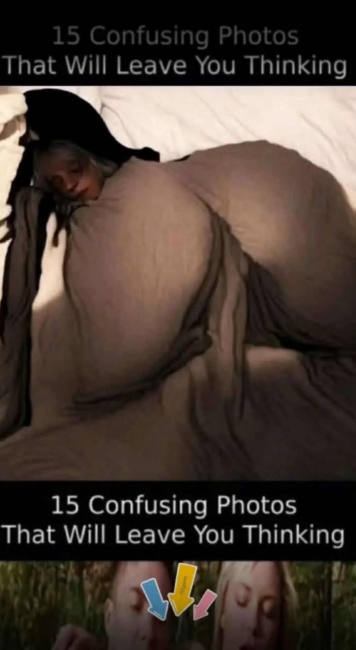
😲 15 Optical Illusions That Will Blow Your Mind
Have you ever looked at a photo and instantly thought, “Wait… what am I actually seeing?” Optical illusions have fascinated people for centuries because they challenge our brains and force us to question what our eyes are telling us. Sometimes the explanation is simple—a clever angle, unusual lighting, or perfect timing—but until you figure it out, the image feels almost impossible to understand. That’s exactly what makes collections like “15 Optical Illusions That Will Blow Your Mind” so entertaining.
Our brains process millions of pieces of visual information every second. To keep up, they constantly make quick assumptions based on patterns, colors, shadows, and perspective. Most of the time these assumptions are accurate, but optical illusions exploit those shortcuts, causing us to see things that aren’t really there—or completely miss what’s right in front of us.
One of the most common types of optical illusion is forced perspective. This happens when objects at different distances appear to interact because they’re perfectly aligned from the camera’s viewpoint. Tourists have been using this trick for years by pretending to hold up famous landmarks, balance the moon on their fingertips, or catch airplanes in their hands. Although everyone knows it’s an illusion, the photographs are still surprisingly convincing.
Another popular illusion involves shadows. A shadow can dramatically change how an object looks, making everyday items appear mysterious or even frightening. Depending on where the light is coming from, a harmless tree branch might resemble a giant monster, or a simple chair may look like something entirely different. Our brains naturally try to identify familiar shapes, even when they don’t actually exist.
Reflections are another source of endless confusion. Mirrors, windows, water, and polished surfaces can create scenes that seem impossible at first glance. A building reflected in a lake may appear upside down in a way that makes it difficult to tell which side is real. Glass windows often produce overlapping reflections that make people appear to float or disappear altogether.
Some of the funniest illusions happen without anyone planning them. Imagine someone standing behind another person at exactly the right angle so it looks like they have four arms. Or perhaps a pet wanders into the frame, making it seem as though someone has an animal’s head. These accidental illusions often become internet sensations because they’re completely natural and impossible to recreate perfectly.
Animals are frequent stars in confusing photo collections. A dog running toward the camera can appear much larger than it really is. Birds spreading their wings behind someone’s shoulders can make them look like they have giant feathers. Cats sitting in unusual positions can appear to have extra legs or oddly shaped bodies. These moments are often the result of perfect timing rather than digital editing.
Perspective also affects the size of objects. A child standing closer to the camera than an adult may appear taller. A small toy placed near the lens can look enormous compared to buildings in the distance. Professional photographers often use these techniques to create imaginative pictures that surprise viewers.
Color plays an important role in how we interpret images. Certain combinations of light and shade can trick the brain into believing an object is moving even when it’s completely still. Other patterns make straight lines appear curved or convince us that two identical colors are actually different. These visual effects reveal just how much our brains rely on context rather than absolute information.
The rise of smartphones has made it easier than ever to capture accidental optical illusions. Since nearly everyone carries a camera throughout the day, extraordinary moments can be photographed instantly. What once required expensive equipment can now be achieved with a quick tap on a phone screen.
Social media has helped these images spread around the world at incredible speed. A confusing photo can receive millions of views within hours as people share it with friends and ask, “Can you figure this out?” Comment sections quickly fill with guesses, debates, and explanations as viewers work together to solve the mystery.
Not every illusion is created naturally. Some photographers intentionally design scenes that challenge perception. By carefully arranging people, objects, lighting, and camera angles, they create photographs that seem to break the laws of physics. The creativity behind these images is just as impressive as the final result.
Of course, digital editing has added another dimension to optical illusions. Modern software allows artists to manipulate images in incredibly realistic ways. While edited photos can be entertaining, many viewers find naturally occurring illusions even more fascinating because they demonstrate how easily reality itself can fool our senses.
Human faces are especially interesting when it comes to visual illusions. Our brains are programmed to recognize faces almost instantly, which is why we sometimes see facial features in clouds, buildings, tree bark, or everyday household objects. This psychological effect is known as pareidolia, and it explains why so many random objects seem to “have a face.”
Architecture often creates stunning illusions as well. Glass skyscrapers reflecting neighboring buildings, staircases disappearing into unusual angles, and geometric designs can all confuse our perception of depth and distance. Cities provide endless opportunities for photographers to capture mind-bending scenes without any editing.
Nature contributes its own incredible optical tricks. Fog can make mountains appear to float. Perfectly still lakes can create mirror-like reflections that blur the line between sky and water. Sunsets sometimes produce dramatic lighting that transforms ordinary landscapes into dreamlike scenes. These natural illusions remind us that the world itself is capable of creating breathtaking visual effects.
The most satisfying part of viewing optical illusion collections is finally understanding the image after staring at it for several moments. That sudden realization often makes people laugh because the answer seems so obvious once it’s discovered. Until then, however, the picture remains a fascinating mystery.
Optical illusions also teach us an important lesson about perception. What we see isn’t always an exact representation of reality. Our brains constantly interpret and simplify visual information, which usually helps us navigate the world efficiently. Occasionally, though, those shortcuts lead us to completely incorrect conclusions.
That’s why these collections continue to attract millions of viewers. They entertain us while also reminding us that appearances can be deceiving. Every confusing photograph encourages us to slow down, examine the details, and keep an open mind before jumping to conclusions.
In the end, “15 Optical Illusions That Will Blow Your Mind” is more than just a collection of strange pictures. It’s a celebration of photography, creativity, psychology, and the incredible way our minds interpret the world around us. Whether the illusions are created by perfect timing, clever perspective, unusual lighting, or simple coincidence, they prove that sometimes the most amazing sights are hiding in ordinary moments. The next time a photo leaves you puzzled, take another look—you might discover that the real magic lies not in the image itself, but in the remarkable way your brain tries to understand it.
