It Was Spotted 35,000 Feet Deep in the Mariana Trench: A Discovery That Serves as a Warning to the World
The Mariana Trench has long captured the imagination of scientists and explorers alike. Stretching across the western Pacific Ocean, it is the deepest known part of Earth’s oceans, with its lowest point—known as Challenger Deep—reaching nearly 36,000 feet (about 11 kilometers) below sea level. At these crushing depths, the pressure is more than 1,000 times greater than the pressure at sea level, temperatures hover just above freezing, and sunlight never penetrates. It is one of the most extreme environments on our planet.
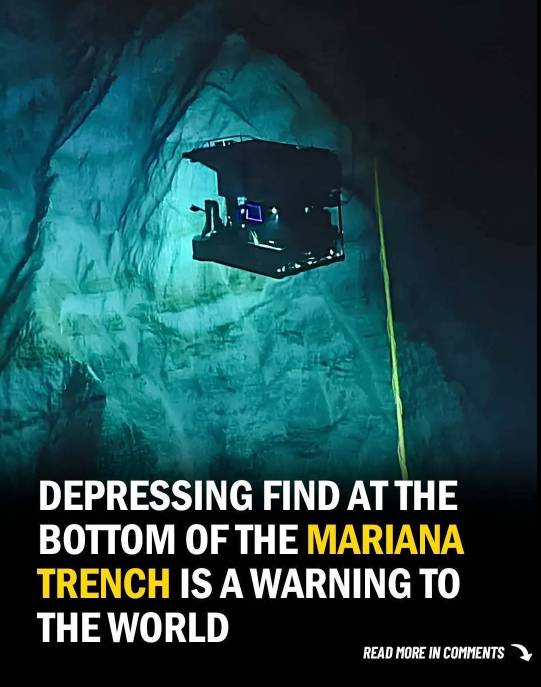
The image circulating online claims that a “depressing find at the bottom of the Mariana Trench is a warning to the world.” While the headline is designed to grab attention, the real story behind discoveries in the trench is both fascinating and concerning.
Scientists exploring the Mariana Trench have made remarkable discoveries over the years. They have found strange species of fish, giant single-celled organisms, translucent sea cucumbers, shrimp-like creatures, and microbes capable of surviving conditions once thought impossible for life. Every expedition reveals that even Earth’s harshest environments are filled with unique ecosystems that researchers are only beginning to understand.
However, one of the most disturbing discoveries has not been an unknown sea creature—it has been human pollution.
During several deep-sea expeditions, remotely operated vehicles and crewed submersibles recorded plastic bags, food wrappers, discarded fishing gear, aluminum cans, glass bottles, and other pieces of human-made debris resting on the ocean floor. Finding this waste at such incredible depths shocked scientists because it demonstrated just how far pollution can travel.
Plastic is especially troublesome because it breaks down very slowly. Instead of disappearing, it gradually fragments into tiny particles known as microplastics. These microscopic pieces have now been detected almost everywhere scientists have looked, from Arctic snow and mountain peaks to deep ocean trenches.
Researchers have also discovered that many deep-sea animals contain microplastics inside their digestive systems. Small crustaceans living in the Mariana Trench have been found with plastic fibers and particles after consuming contaminated food. Since these creatures form part of the deep-sea food web, scientists continue studying how pollution affects entire ecosystems over time.
Plastic is not the only concern. Scientists have detected industrial chemicals known as persistent organic pollutants in some trench-dwelling organisms. These chemicals were used in manufacturing decades ago and have remained in the environment because they degrade very slowly. Ocean currents can carry contaminants across enormous distances before they eventually settle in deep marine environments.
These findings serve as a reminder that no place on Earth is completely isolated from human activity. Even locations that seem unimaginably remote can become repositories for pollution generated thousands of miles away.
Despite these concerns, the Mariana Trench is also a place of scientific hope. Every expedition expands our understanding of biology, geology, and the evolution of life. Some microorganisms discovered there produce unusual enzymes that may eventually contribute to medical or industrial research. Scientists are also studying how deep-sea organisms survive under crushing pressure, hoping these adaptations may inspire new technologies.
Exploring such depths is an engineering challenge unlike any other. Specialized submersibles must withstand pressures exceeding 16,000 pounds per square inch. Thick titanium hulls, powerful lighting systems, advanced navigation equipment, and robotic arms allow researchers to collect samples while protecting both the crew and delicate marine habitats.
Because reaching Challenger Deep requires significant funding and highly specialized equipment, only a small number of expeditions have visited the area. Each mission gathers valuable data about geology, ocean circulation, biodiversity, and climate history hidden beneath layers of sediment.
The trench also plays a role in Earth’s geological processes. It formed where one tectonic plate slides beneath another in a process called subduction. This movement recycles sections of the ocean floor into Earth’s interior while contributing to earthquakes and volcanic activity throughout the Pacific region.
Scientists continue to investigate whether deep ocean trenches may help store carbon over geological timescales. Organic material slowly sinks from the surface into the deep sea, where some becomes buried in sediments. Understanding these processes may improve our knowledge of Earth’s long-term climate system.
The viral headline accompanying images of deep-sea exploration often leaves readers wondering whether a mysterious object was discovered at the bottom of the trench. In reality, many dramatic social media posts exaggerate or oversimplify scientific findings to encourage clicks. While genuine discoveries in the Mariana Trench are extraordinary, they are usually grounded in years of careful research rather than sensational claims.
The real warning from the Mariana Trench is arguably more powerful than any fictional mystery. Human influence extends far beyond cities and coastlines. Materials discarded on land or at sea can eventually reach environments once believed to be untouched. Pollution does not simply disappear—it often travels through rivers, oceans, and food webs before settling in unexpected places.
This realization has prompted growing international efforts to reduce plastic waste, improve recycling systems, develop biodegradable materials, and limit pollution entering waterways. Scientists emphasize that preventing waste from reaching the ocean is generally far easier than attempting to remove it after it has dispersed.
Public awareness also plays an important role. Simple actions such as reducing single-use plastics, properly disposing of waste, participating in community cleanups, and supporting sustainable products can collectively reduce the amount of debris entering marine environments.
Meanwhile, exploration of the Mariana Trench continues. Advances in robotics, underwater imaging, autonomous vehicles, and deep-sea sampling technologies promise even greater discoveries in the years ahead. Researchers hope future missions will reveal new species, improve our understanding of Earth’s geology, and shed light on how life adapts to some of the planet’s harshest conditions.
The Mariana Trench remains one of Earth’s last great frontiers. It is a place of astonishing biodiversity, scientific mystery, and technological achievement. Yet it also reminds us that our actions have consequences that extend to even the most remote corners of the planet.
Rather than focusing solely on sensational headlines, the true lesson from the deepest ocean is clear: protecting the environment requires global responsibility. The discoveries made nearly 35,000 feet beneath the waves show both the resilience of nature and its vulnerability to human activity. That combination makes the Mariana Trench not only one of the world’s greatest natural wonders but also a powerful symbol of why caring for our oceans matters more than ever.