Trump Posted a Picture of Himself as Rocky. No One Knows What to Make of It
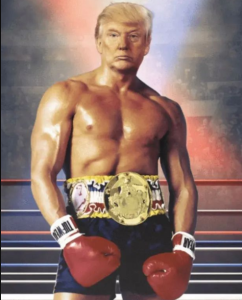
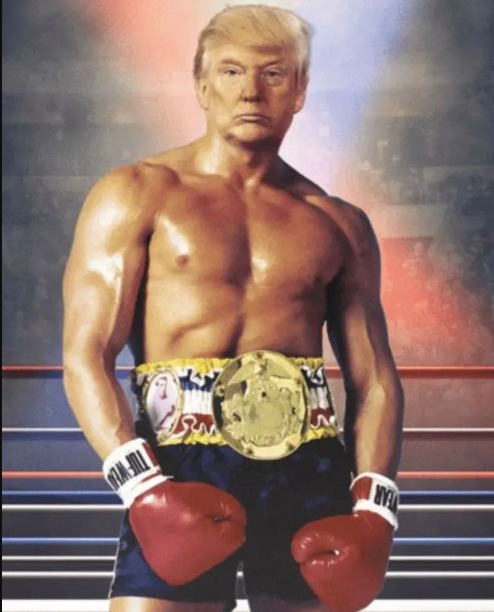
The internet is no stranger to surprises, but even by modern social media standards, one of the latest posts from President Donald Trump managed to leave people scratching their heads. Without much explanation, Trump shared an image depicting himself as Rocky Balboa, the legendary underdog boxer made famous by the Rocky film franchise. The image quickly spread across social media platforms, sparking confusion, amusement, criticism, and endless speculation.
Almost immediately, users began asking the same question: What exactly was the message?
The image portrayed Trump with the muscular physique typically associated with Rocky, standing confidently in a pose that suggested strength, determination, and victory. There was no lengthy caption explaining the meaning behind it. There was no detailed statement. Just the image itself—and the internet was left to fill in the blanks.
For supporters, the symbolism seemed obvious. Rocky Balboa has long represented perseverance against overwhelming odds. Throughout the film series, Rocky repeatedly faces opponents who are stronger, younger, or more heavily favored. Yet he continues to fight, refusing to quit even when victory appears impossible. To many Trump supporters, the image was likely intended to communicate a similar message: resilience in the face of criticism, political opposition, and legal challenges.
Others interpreted it differently.
Critics quickly pointed out what they saw as the absurdity of the comparison. Social media filled with jokes, memes, and sarcastic comments questioning whether the former president truly saw himself as an action-movie boxer. Some users compared the post to other unusual political social media moments, arguing that it reflected the increasingly blurred line between politics, entertainment, and internet culture.
What made the post particularly fascinating was the sheer number of interpretations it generated.
Some observers suggested the image wasn’t meant to be taken literally at all. Instead, they argued, it functioned as a piece of political branding. Modern political communication often relies on symbols rather than detailed explanations. A powerful image can sometimes communicate more effectively than a thousand-word statement. By associating himself with Rocky, Trump may have been trying to reinforce themes of toughness, endurance, and fighting spirit.
Whether one agrees with the message or not, the strategy certainly succeeded in attracting attention.
Within hours, the image became the subject of countless discussions. News outlets covered it. Political commentators analyzed it. Social media users created their own versions, edits, and parodies. Some praised the creativity, while others mocked it relentlessly. Either way, people were talking about it.
That outcome is something Trump has managed to achieve repeatedly throughout his public life.
For decades, Trump has demonstrated an ability to dominate headlines with a single comment, photograph, or social media post. Supporters often describe this as evidence of his unique communication skills. Critics view it as a deliberate effort to generate controversy and distract from other issues. Regardless of one’s perspective, the result is frequently the same: widespread public attention.
The Rocky image fit perfectly into that pattern.
Part of the reason the post generated so much discussion is that Rocky Balboa occupies a unique place in American culture. The character represents more than boxing. He symbolizes grit, determination, and the belief that ordinary people can overcome extraordinary obstacles. The famous training montages, triumphant music, and dramatic fights have made Rocky one of the most recognizable fictional heroes in history.
By placing himself in that role, Trump invited viewers to connect him with those qualities.
Of course, not everyone was willing to make that connection.
Some people argued that comparing a real-world politician to a fictional sports hero oversimplifies complex political realities. Others viewed the image as just another example of modern political figures embracing celebrity-style marketing. Instead of focusing on policies or detailed arguments, critics said, the conversation shifted toward personality and symbolism.
Yet even many critics admitted that the image was undeniably effective at grabbing attention.
The phenomenon also highlighted the growing role of internet culture in politics. In previous generations, politicians primarily communicated through speeches, interviews, press conferences, and campaign advertisements. Today, a single image can spark a global conversation within minutes. Memes, edited photos, and viral posts often travel faster than traditional news stories.
Trump has frequently embraced this reality.
His social media presence has often mixed serious political messages with humor, provocation, and unexpected imagery. To supporters, this makes him appear relatable and entertaining. To detractors, it can seem unconventional or even bizarre. The Rocky image became another example of how digital communication can blur the boundaries between political messaging and online entertainment.
Meanwhile, countless internet users focused on the practical question: Why Rocky?
Some speculated that the character’s reputation as a fighter made him an ideal symbol during a contentious political season. Others suggested that the image reflected Trump’s long-standing appreciation for displays of strength, competition, and winning. A few people simply concluded that the post was intended to be humorous and that observers were overanalyzing it.
That possibility cannot be entirely dismissed.
Social media often encourages reactions before explanations. People rush to interpret, debate, and argue over posts that may have been intended as simple jokes or attention-grabbing content. In the absence of a clear explanation, audiences naturally create their own narratives.
As the discussions continued, one thing became increasingly clear: the image had achieved what many viral posts aim to accomplish. It captured attention.
Whether viewers found it inspiring, confusing, entertaining, or ridiculous, they engaged with it. They shared it. They discussed it. They debated its meaning. In the crowded landscape of modern media, that level of engagement is difficult to achieve.
Perhaps that’s why the image remains so intriguing.
It wasn’t merely a picture of Trump as Rocky. It became a kind of cultural Rorschach test, revealing how different groups perceive both the man and the message. Supporters saw determination. Critics saw self-promotion. Casual observers saw a bizarre but entertaining internet moment.
And maybe that’s the real story.
The image’s significance may have less to do with boxing or politics and more to do with how people interpret symbols in an age dominated by social media. A single picture, posted without much context, managed to generate thousands of reactions and countless interpretations.
So what did Trump mean by posting himself as Rocky?
The honest answer is that no one outside his inner circle can know for certain. But the endless speculation, debate, humor, and commentary that followed suggest one undeniable fact: whatever the intended message was, people noticed.