Jeep Smashes Buggy, Ejects Family of 9 Amish: A Late-Night Crash in Indiana’s Adams County
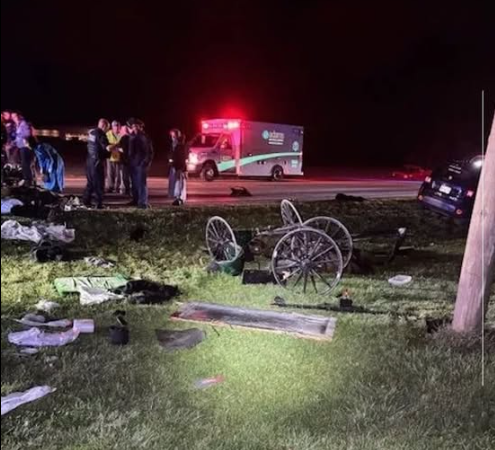
On the night of October 7, 2025, a routine buggy ride home for an Amish family in Berne, Indiana, turned into a scene of chaos and injury. Around 11:20 p.m., a Jeep driven at high speed slammed into the back of a horse-drawn Amish buggy on State Road 218 near County Road 000. The impact was so forceful that the buggy was thrown off the road, shattering into pieces and ejecting all nine occupants— a father, other adults, and seven minors—onto the roadway and surrounding area.
This incident, widely shared on social media with headlines like “Jeep Smashes Buggy, Ejects Family of 9 Amish,” highlights the ongoing challenges of sharing rural roads between modern vehicles and traditional horse-drawn transportation. No fatalities occurred, but the crash left multiple family members seriously injured and raised questions about road safety, driver attention, and cultural coexistence in Amish country.
The Crash Scene
Adams County, home to a significant Amish settlement, features quiet country roads where buggies are a common sight. The family buggy was traveling along SR 218 when the Jeep, operated by 33-year-old Bradley J. Ocilka from Burlington, Kentucky, struck it from behind. According to investigators, the Jeep driver did not slow down or attempt to pass safely. Instead, the vehicle plowed directly into the rear of the buggy.
The force ejected everyone inside. Debris from the destroyed buggy—wooden panels, wheels, and personal belongings—scattered across the road and ditch. First responders from the Adams County Sheriff’s Office and multiple emergency services arrived to find a chaotic scene: injured adults and children, a damaged Jeep in the ditch, and the remnants of the once-functional buggy. One of the horses pulling the buggy was also affected, though specific details on its condition were not widely reported in initial accounts.
The father driving the buggy was among the most severely injured and had to be airlifted to a hospital in Fort Wayne for advanced treatment. Five of the children were transported by ambulance to local medical facilities. Another adult male also required ambulance transport. A woman and her 2-year-old child declined medical treatment at the scene and were able to leave. All nine family members were ejected, underscoring the vulnerability of open buggies compared to enclosed vehicles.
Ocilka, the Jeep driver, reported no injuries. He was taken to a hospital for a blood draw as part of the investigation, but results were not immediately released. No charges had been filed at the time of early reports, and the incident remained under investigation.
Context of Amish Road Travel
Amish communities, like the one in Adams County (Berne), rely on horse-drawn buggies as a core part of their lifestyle, rejecting many modern technologies in favor of simplicity and separation from the world. Buggies are typically black with reflective orange slow-moving vehicle (SMV) signs on the back for visibility. However, at night, especially on unlit rural roads, they can be difficult for faster-moving cars to spot in time.
This crash is not isolated. Amish buggy accidents occur periodically across Pennsylvania, Ohio, Indiana, and other states with large Plain communities. Factors often include:
- Speed differentials (buggies travel at 5-8 mph; cars at highway speeds).
- Driver distraction or impairment.
- Poor visibility conditions.
- Lack of advanced safety features like seatbelts or crumple zones in buggies.
In this case, the late hour (after 11 p.m.) likely contributed to reduced visibility. Social media discussions following the crash included debates about buggy lighting, curfews for horse-drawn vehicles, and calls for greater driver caution in Amish areas. Some commenters noted that multiple buggies traveling together (as sometimes happens with youth groups) can increase risks, though this incident involved a single family buggy.
The Human Impact
For the affected Amish family—reported in some accounts as possibly connected to the Miller surname in similar incidents—the crash represents more than physical injuries. Amish life emphasizes community, family, and resilience in the face of hardship. With six or seven juveniles involved, the emotional toll on parents and children would be significant. Hospital stays, recovery time, and the loss of their primary mode of transportation disrupt daily routines like farming, school, and church attendance.
Amish communities often handle medical costs through mutual aid and church funds rather than insurance, adding financial strain. The father’s airlift and serious injuries likely mean a prolonged recovery, affecting his ability to work the family farm or provide for the household. The children, some as young as 2, face trauma that could linger long after physical healing.
Broader Amish responses to such accidents frequently involve quiet reflection, prayer, and forgiveness. While anger toward the other driver might surface, many in the community focus on acceptance of God’s will and moving forward without litigation. This cultural approach contrasts with typical legal responses in mainstream society.
Road Safety Challenges and Broader Implications
This incident underscores tensions in areas where Amish populations intersect with modern traffic. Indiana has seen multiple buggy-related crashes in recent years, some fatal. For example, other incidents have involved children killed en route to school or women injured in similar collisions.
Advocates for Amish communities sometimes push for better signage, dedicated slow-vehicle lanes, or education campaigns for motorists. Conversely, some residents express frustration with buggies on public roads, calling for restrictions like nighttime curfews. However, the Amish argue that they have a right to use public roads as they have for generations, predating automobiles.
From a safety engineering perspective, experts note that buggies lack the protective structures of cars. Ejection, while terrifying, can sometimes result in fewer crush injuries than being trapped in a vehicle. Still, the open design leaves occupants exposed to impacts, road rash, and being thrown significant distances.
The Jeep driver being from out of state (Kentucky) adds another layer. Visitors or those unfamiliar with local traffic patterns—including the prevalence of buggies—may not anticipate slow-moving vehicles on dark roads. This highlights the need for awareness, especially in tourist or transitional areas near Amish settlements.
Recovery and Community Response
In the days following the October 7 crash, local news outlets like WANE, WZBD, and Amish-focused sites provided updates. Emergency responders were praised for their quick and professional handling of a complex multi-victim scene at night.
For the family, recovery would involve not just medical care but also practical help from their church district—meals, farm assistance, and possibly help building or acquiring a new buggy. Amish values stress mutual support, so neighbors and extended family likely stepped in immediately.
As of the latest available information, full details on long-term injuries were not public, respecting the family’s privacy. The investigation into the Jeep driver continued, with potential charges depending on blood test results and evidence of speeding or inattention.
Reflections on Coexistence
This crash serves as a sobering reminder of the fragility of life and the challenges of cultural diversity on shared infrastructure. Amish families seek to preserve a way of life centered on faith, family, and simplicity, while modern drivers expect high-speed travel. Bridging this gap requires patience, vigilance, and mutual respect.
Motorists in Amish areas are encouraged to slow down, watch for reflective signs, and anticipate buggies around curves or at night. For Plain communities, ongoing discussions about enhanced lighting, reflective materials, or safety education continue internally.
Ultimately, incidents like this affect real people—a father fighting for recovery, children processing trauma, and a family piecing their lives back together. The resilience of the Amish in the face of such adversity often inspires outsiders, even as it prompts reflection on how we all share the road more safely