The Wedding Night Rome Wanted the World to Forget
In the flickering torchlight of 89 CE, under the rule of Emperor Domitian, eighteen-year-old Livia Tersa stepped into her new life as a Roman bride. Her saffron flammeum veil glowed like captured flame, her hair arranged in the traditional sex crines—six locks symbolizing the transition from girl to matron. The wedding procession had been loud and public: friends singing epithalamia, nuts scattered to children to mask any cries from the bedroom, the ritual “kidnapping” from her father’s house complete. She believed the hardest part was over. She was wrong.
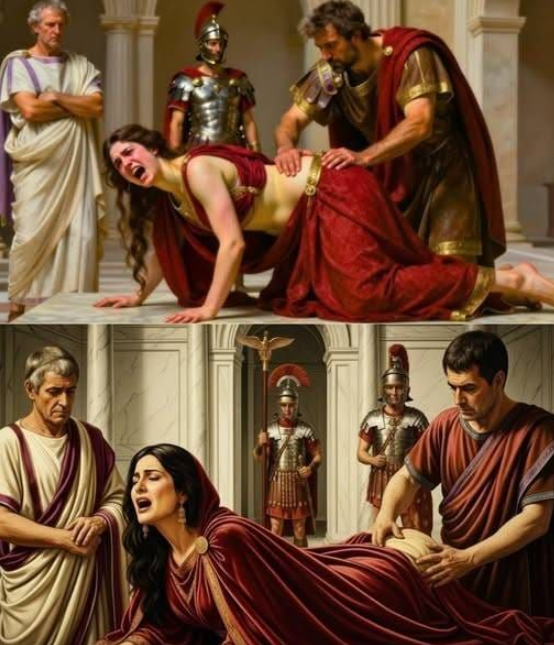
Behind the closed doors of the groom’s domus, away from the revelers, waited something the public ceremonies never mentioned. A room prepared not for romance, but for verification. Witnesses, a pronuba (matron of honor), slaves with basins and cloths, and in some accounts a physician. In the corner, draped under heavy fabric, stood a wooden figure whose purpose would soon become horrifyingly clear: Mutinus Tutinus (or Mutunus Tutunus), the phallic deity of marriage.
Roman marriage was never primarily about love. It was a legal and social contract transferring a woman from one paterfamilias to another, securing property, lineage, and citizenship rights for future children. Virginity mattered intensely because unchallenged paternity ensured legitimate heirs. While sensational retellings amplify the drama, ancient sources hint at rituals designed to ease—and publicly affirm—this transition. Christian writers later highlighted (and condemned) these practices to distance their faith from pagan “obscenity,” contributing to their partial erasure from mainstream memory.
The Ritual of Preparation
Livia’s heart pounded as the pronuba guided her toward the lectus—the special marriage bed. But first came the encounter with the god. According to accounts preserved by Christian apologists like Arnobius, brides were expected to straddle the oversized phallus of Mutinus Tutinus. This was not mere lewdness; it served as symbolic deflowering and preparation. The god “sampled” her shame beforehand so that she would not fear or resist her husband. It taught acceptance of her marital duties and invoked fertility for healthy children.
Imagine the scene: the statue, often crudely carved with exaggerated features, unveiled in the lamplight. The room heavy with incense and the scent of oils. Livia, trembling under the weight of expectation, lowered herself as instructed. The pronuba offered quiet encouragement or firm guidance. This act, shocking to modern sensibilities, was framed in Roman religious logic as pious preparation. By yielding first to the deity, the bride ensured the human union would be fruitful rather than traumatic or barren. Some interpretations suggest it psychologically conditioned young women for consummation, reducing fear of injury.
Roman medical and cultural attitudes reinforced this. Physicians like Soranus of Ephesus wrote on gynecology, discussing preparation for first intercourse. While dramatic narratives invent opium doses or restraints, real practices likely involved oils, advice from older women, and the symbolic (or preparatory) role of the phallic deity. The goal was pragmatic: secure the marriage through successful consummation and potential proof of virginity lost.
Verification and Witnesses
After the ritual with Mutinus, the true consummation followed. The groom, often older and experienced, approached. Roman poetry, such as that of Catullus, could be blunt about the groom’s aggressive passion contrasting the bride’s fear and modesty (pudor). The lectus became the site of the legal union’s physical seal.
In elite or traditional families, elements of observation or verification existed. Witnesses might wait nearby or attest the next morning via stained linens—bloody sheets as public proof. This was not unique to Rome; similar customs appear across ancient cultures. Roman law under conventio in manum (marriage transferring the bride into the husband’s legal control) emphasized documentation and social legitimacy. A physician’s discreet involvement in some cases ensured no immediate harm, though this is more inferred than explicitly detailed in surviving texts. Historians note Roman writers avoided graphic descriptions, leaving fragments for later interpreters.
Livia would have been expected to endure silently. Roman ideals prized the modest, dutiful wife. Cries might be masked by external noise—children scrambling for nuts, or flutes and songs. The next day, celebrations continued with gifts and feasts if all went “well.” Failure—resistance, injury, or doubt—could bring shame, though annulment was possible in theory.
Why Rome Tried to Forget
As Christianity rose, such overtly sexual pagan rites became embarrassing. Arnobius and other apologists used Mutinus Tutinus to mock the old gods’ indecency, while also preserving the details in their critiques. Statues were likely destroyed or hidden. Historians and poets glossed over the intimate mechanics, focusing on processions, veils, and vows. The flammeum veil, the hasta caelibaris spear parting the bride’s hair, and household gods receiving offerings took center stage in sanitized memory.
Yet fragments survived: Festus on bridal attire and knots, Plutarch questioning the spear in hair-parting, Varro and others on customs. Modern scholarship pieces together a picture of a society where female bodies were public property in service of family and state. Virginity was one-third the bride’s, per some literary quips, but two-thirds a matter for husbands and society.
Livia’s night ended with her emerging as matrona, her tunica recta replaced by matronly garb. She would manage the household, bear children, and uphold pudicitia (chastity). Silence was her armor. Speaking of the night’s details would violate decorum. Many such nights passed unrecorded, their full reality fading into rumor and exaggeration.
Echoes in History
This was not universal. Customs varied by class, region, and era. Poorer families likely had simpler, more private nights. By late antiquity, Christian influence shifted emphasis toward mutual consent and spiritual union, though patriarchal control persisted. The sensational “horrifying ritual” of viral stories blends real phallic worship and verification practices with modern embellishments—doctors, full public examinations, heavy sedation—for dramatic effect.
Rome’s wedding night embodied its contradictions: engineering civilization through law and engineering while rooted in primal fertility rites and control. The world “forgot” because victors (Christian chroniclers) rewrote narratives, and because intimacy resists documentation. Yet the fragments reveal how deeply marriage wove personal bodies into the fabric of empire.
Today, we recoil at the lack of privacy and agency. An eighteen-year-old veiled in saffron, confronting a phallic god and marital duty under watchful eyes, highlights how far notions of consent and romance have evolved. But it also reminds us that ancient Romans were not marble statues—they were people navigating power, religion, fear, and hope in the most intimate arena.
Livia Tersa, whoever she truly was, likely never imagined her silent endurance would echo two millennia later. Rome built aqueducts, roads, and laws that shaped the West. It also built marriages on rituals it eventually preferred the world forget—raw, pragmatic, and unromantic as the empire itself. In that forgotten chamber, under the gaze of Mutinus Tutinus, an empire’s future was quite literally conceived