The first emergency call came in at 2:11 a.m.
At first, dispatchers assumed it was a routine report—possibly a small electrical fire or smoke coming from a nearby warehouse district on the edge of the city. But within minutes, additional calls flooded the emergency lines. Residents from several blocks away reported seeing a massive orange glow rising into the night sky.
Something far more serious was happening.
By 2:18 a.m., firefighters arriving at the scene realized the situation had already escalated beyond a standard response. Flames towered above an industrial building near the riverfront, sending thick black smoke rolling across the skyline. Windows exploded outward from the heat, scattering glass onto nearby streets.
Captain Eric Nolan stepped out of Engine 14 and immediately grabbed his radio.
“We need additional units now,” he said firmly. “This fire is spreading fast.”
The building, an aging distribution facility that stored furniture, paper products, and cleaning supplies, had become a dangerous fuel source. Inside, decades of tightly packed materials fed the blaze with terrifying speed.
Nearby residents woke to the sound of sirens echoing through the city.
Some stepped outside still wearing pajamas, staring in disbelief as flames illuminated the darkness several stories high. Others hurried to move vehicles and alert neighbors as police officers began evacuating nearby apartment buildings.
“It looked like the entire block was on fire,” one witness later said. “I’ve never seen anything like it.”
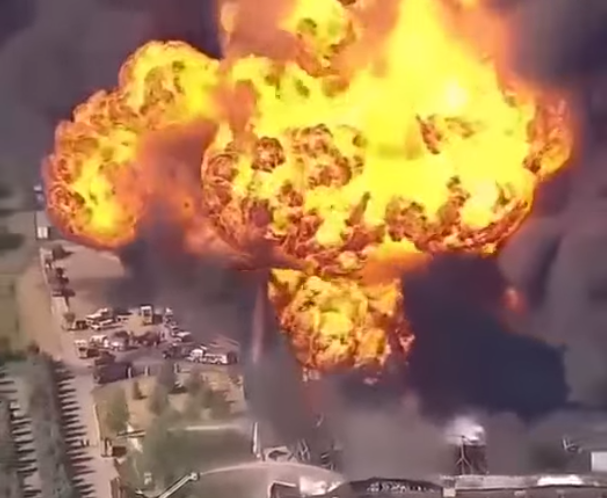
At 2:32 a.m., local news helicopters arrived overhead, broadcasting live footage that quickly spread across television and social media. The images were dramatic: thick smoke clouds twisting into the air while firefighters battled intense heat from every direction.
Inside the command center, officials faced a growing concern.
Strong winds had begun pushing embers toward neighboring structures.
“If this jumps the street, we’ll lose the entire row,” one firefighter warned.
Crews immediately focused on containment, spraying surrounding buildings with water to stop the fire from spreading further. But conditions were becoming increasingly dangerous. The warehouse roof had already begun collapsing inward.
Then came the first explosion.
A loud boom shook the area just after 2:40 a.m., sending a burst of sparks high above the building. Emergency personnel instinctively backed away as flames surged through one side of the structure.
Authorities later confirmed that several pressurized containers stored inside had ignited from the extreme heat.
For nearby residents watching from evacuation zones, the explosion transformed fear into panic.
“I grabbed my kids and ran,” one mother told reporters. “The whole sky lit up.”
Traffic quickly became chaotic as emergency road closures expanded across several blocks. Police urged the public to stay away from the area while ambulances staged nearby in case of injuries.
Fortunately, most employees had left the warehouse hours earlier, limiting the risk of people being trapped inside.
Still, firefighters remained deeply concerned about structural instability.
At 3:05 a.m., Captain Nolan received a grim update from engineers monitoring the building.
“The north wall is failing,” they warned.
Moments later, part of the exterior collapsed into the street with a deafening crash, sending debris and smoke outward. Crews retreated briefly before regrouping from safer positions.
Despite the danger, firefighters continued battling the flames relentlessly.
For hours, rotating teams worked through smoke, exhaustion, and intense heat. Water streamed continuously from multiple ladder trucks while emergency responders coordinated evacuations and medical support nearby.
As dawn approached, the fire still burned fiercely.
Residents across the city woke to emergency alerts on their phones and images spreading rapidly online. Videos filmed from miles away showed towering smoke visible against the morning sky.
By 6:00 a.m., local officials held their first press conference.
“This remains an active and dangerous situation,” the fire chief stated. “We ask residents to avoid the area completely while crews continue suppression efforts.”
When reporters asked about the cause, officials said it was too early to determine exactly how the fire started.
Investigators, however, had already begun examining several possibilities—including electrical failure, equipment malfunction, or accidental ignition from stored materials.
Meanwhile, stories from the scene continued emerging.
One firefighter described conditions inside the building before crews were forced to withdraw.
“The heat was unbelievable,” he said. “You could barely see in front of you. Every second counted.”
Another responder explained how quickly the fire intensified.
“It went from manageable to catastrophic in minutes.”
As the morning progressed, community members began helping displaced residents affected by the evacuations. Churches opened temporary shelters. Restaurants delivered coffee and food to exhausted first responders. Volunteers handed out blankets and bottled water near the emergency perimeter.
In times of disaster, the city’s sense of unity became impossible to ignore.
At 8:17 a.m., firefighters finally achieved a breakthrough.
After nearly six continuous hours, crews managed to contain the main body of the blaze, preventing it from spreading into neighboring residential blocks. Though smaller fires still burned within parts of the collapsed warehouse, the worst danger had passed.
Applause broke out among some of the evacuated residents when the update was announced.
But the damage was devastating.
The warehouse itself was almost completely destroyed. Several nearby businesses suffered smoke and water damage, and portions of surrounding streets remained covered in debris and ash.
Environmental teams also began monitoring air quality due to concerns about chemicals released during the fire.
By afternoon, investigators carefully entered sections of the scene searching for answers.
News coverage continued nonstop. Helicopter footage replayed dramatic moments from overnight—the explosions, collapsing walls, and firefighters silhouetted against massive flames.
Online, millions watched clips of the disaster unfold.
Some praised the bravery of first responders. Others shared stories of neighbors helping neighbors during the evacuation. Many simply expressed shock at how quickly the fire had grown.
Captain Nolan finally removed his helmet nearly twelve hours after first arriving on scene. Soot covered his uniform, and exhaustion showed clearly on his face.
But when reporters asked what mattered most now, his answer was simple.
“We contained it,” he said quietly. “People made it home safely. That’s what matters.”
Behind him, smoke still drifted upward from the ruins of the warehouse as investigators moved carefully through the wreckage.
The official cause of the fire would take days, possibly weeks, to determine.
Yet for those who witnessed the terrifying night firsthand, one thing was already certain:
They would never forget the sight of the city skyline glowing orange against the darkness as emergency sirens echoed through the streets and firefighters risked everything to stop the flames from spreading further.