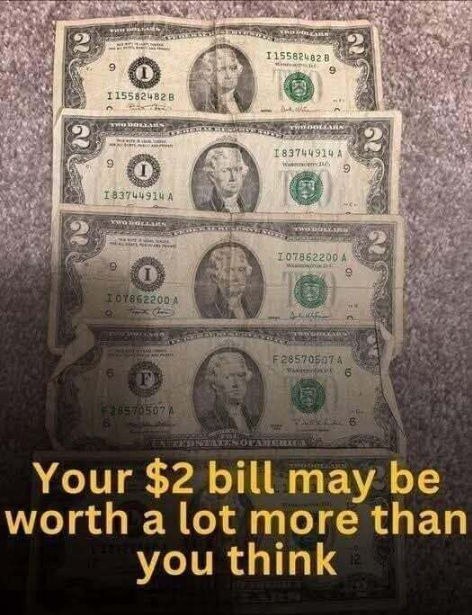
The idea that a simple $2 bill could be worth far more than its face value has a way of grabbing attention. It sounds like one of those hidden-treasure stories—something tucked away in a drawer or slipped between the pages of an old book that turns out to be unexpectedly valuable. And while most $2 bills are still worth exactly two dollars, there are real cases where certain ones can be worth much more. The difference comes down to rarity, condition, and a few specific details that collectors care deeply about.
To understand why, it helps to start with the basics. The $2 bill has always been a bit of an oddity in U.S. currency. First issued in 1862 during the Civil War, it never became as widely used as other denominations. People sometimes viewed it as unusual or even unlucky, which meant fewer were circulated regularly. Because of that, many were saved rather than spent—and that’s part of what fuels today’s curiosity around them.
Modern $2 bills, like the ones you might get from a bank today, usually feature Thomas Jefferson on the front and a depiction of the signing of the Declaration of Independence on the back. These are still printed, though not in large quantities compared to other bills. If you have one of these recent notes, it’s typically only worth face value—unless it has something special about it.
That’s where things get interesting.
Collectors look for specific features that can increase a bill’s value. One of the biggest factors is age. Older $2 bills, especially those printed in the 1800s or early 1900s, can be worth significantly more. For example, notes from the late 19th century—often called “Large Size Notes”—are physically bigger than modern currency and can fetch hundreds or even thousands of dollars depending on their condition.
Another key factor is rarity. Some series of $2 bills were printed in much smaller numbers than others. A bill from a low-production year or with a limited run can be more desirable to collectors. Even within more common years, certain variations—like star notes—can increase value. Star notes are replacement bills printed to substitute for misprints, and they’re marked with a small star next to the serial number.
Speaking of serial numbers, they can make a surprising difference. Bills with unique or unusual serial numbers—like repeating digits (e.g., 77777777), low numbers (like 00000001), or palindromes—are often sought after. These are sometimes called “fancy serial numbers,” and collectors are willing to pay a premium for them.
Condition also plays a huge role. A crisp, uncirculated $2 bill is far more valuable than one that’s been folded, worn, or damaged. In the world of currency collecting, even small imperfections can significantly impact price. A bill that looks almost brand new, with sharp corners and no creases, will always attract more interest.
There are also specific historical issues that stand out. For instance, the 1890 Treasury Note—sometimes referred to as the “Coin Note”—is highly collectible. Bills like these aren’t just currency; they’re pieces of history. Their designs, printing methods, and the stories behind them make them appealing beyond their monetary value.
But here’s the part that often surprises people: most $2 bills you’ll come across today aren’t rare.
The majority of $2 bills in circulation were printed after 1976, when the U.S. reintroduced the denomination as part of the bicentennial celebration. These bills are relatively common. While they might feel unusual because you don’t see them often, they’re not inherently valuable beyond their $2 face value—unless they meet the special criteria mentioned earlier.
That doesn’t stop the myths from spreading.
You’ve probably seen headlines or social media posts claiming that “your $2 bill could be worth thousands!” These messages often leave out the important details, creating the impression that any $2 bill is a hidden jackpot. In reality, only a small percentage have significant collector value.
Still, it’s worth checking.
If you have a $2 bill, take a closer look. Check the year printed on it. Examine the serial number. Look for any unusual markings or signs that it might be older or different from the standard design. Even if it turns out to be a common note, there’s something satisfying about knowing exactly what you have.
And occasionally, people do get lucky.
There are stories of individuals discovering rare notes in old collections, inherited items, or even loose cash. A forgotten envelope or a dusty drawer can sometimes hold something far more valuable than expected. It doesn’t happen often—but it happens enough to keep the curiosity alive.
Beyond value, though, $2 bills carry a certain charm. They stand out. They spark conversation. Hand someone a $2 bill, and chances are they’ll pause for a second, maybe even smile. It’s a small reminder that not everything in everyday life is completely ordinary.
So, should you “hold your hat” before checking?
Maybe not—but it’s definitely worth a look.
Because while most $2 bills won’t make you rich, a few of them just might surprise you.