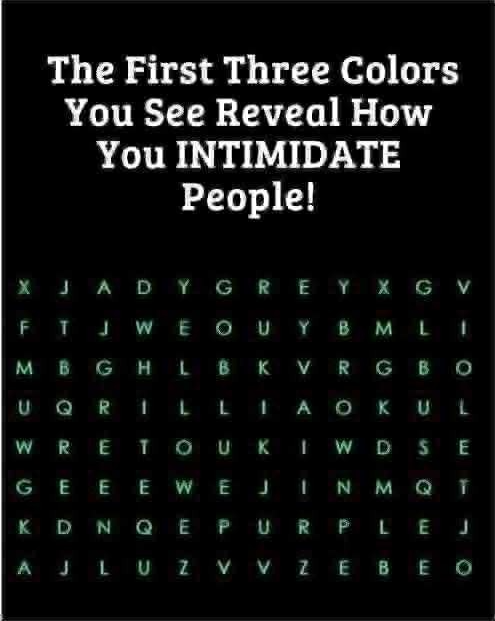
“Color tests” that claim the first color you notice reveals something deep about your personality are popular for a reason—they’re quick, intriguing, and feel oddly personal. But before diving in, it’s important to be clear: these tests aren’t scientifically proven personality assessments. They’re closer to reflective prompts or psychological mirrors than hard diagnostics. What you see first can say something about your current focus, mood, or associations—but it doesn’t define who you are.
Still, that doesn’t mean they’re meaningless. In fact, they can be surprisingly insightful when approached with curiosity rather than certainty.
When you look at a multicolored image and notice one color before the others, your brain is doing a few things at once. It’s filtering visual information, prioritizing contrast, and connecting what you see to your past experiences. The color that “pops” for you might stand out because of brightness or placement—but it can also resonate emotionally or symbolically based on your own life.
Let’s explore what different colors are often associated with psychologically and emotionally—not as fixed truths, but as possibilities for reflection.
If you first notice red, it’s often linked to intensity. Red tends to grab attention because it’s bold and stimulating. People who are drawn to it might be feeling energized, passionate, or even a bit on edge. It can reflect a desire for action, excitement, or strong emotions. At times, it may also signal urgency or heightened awareness.
Seeing blue first is commonly associated with calmness and stability. Blue is often connected to peace, trust, and introspection. If this is the color that stands out to you, it might suggest you’re in a reflective state or value emotional balance. It can also indicate a preference for clarity and steady environments.
If yellow catches your eye first, it’s often linked to optimism and curiosity. Yellow is bright and mentally stimulating, sometimes associated with creativity or a desire to explore ideas. People drawn to yellow might be feeling hopeful, playful, or mentally active—though in some cases, it can also reflect restlessness.
Noticing green first is frequently tied to growth and balance. Green sits in the middle of the color spectrum and is often associated with nature, renewal, and harmony. It might suggest a focus on personal development, healing, or maintaining equilibrium in your life.
If black stands out first, it doesn’t necessarily mean anything negative. Black can represent depth, mystery, or introspection. It might indicate you’re thinking deeply, processing something complex, or drawn to clarity and control. Sometimes it reflects a desire for boundaries or focus.
Seeing white first is often linked to simplicity and openness. White can symbolize clarity, new beginnings, or a clean slate. If it stands out to you, it might suggest you’re seeking peace, organization, or a fresh start in some area of your life.
If purple catches your attention, it’s commonly associated with imagination and individuality. Purple blends the calm of blue and the energy of red, often symbolizing creativity, intuition, or a unique perspective. It might reflect a desire to express yourself or think outside the box.
Noticing orange first is often connected to enthusiasm and social energy. Orange combines the warmth of red and the brightness of yellow, and it can suggest friendliness, excitement, or a desire for connection and fun.
If pink is the first color you see, it’s often linked to warmth, affection, and emotional sensitivity. It might reflect a caring nature, a focus on relationships, or a desire for comfort and kindness.
Now, here’s where it gets more interesting: the meaning of the color isn’t just about general associations—it’s about your associations. For example, if blue reminds you of a peaceful place from your childhood, seeing blue first might reflect a longing for that feeling. If red reminds you of stress or urgency, noticing it first might simply mean your brain is tuned to detect intensity.
Context matters, too. The same person might notice different colors depending on their mood, environment, or even the time of day. Someone feeling relaxed might gravitate toward softer tones, while someone under pressure might immediately pick out bold or contrasting colors.
There’s also a cognitive aspect called “selective attention.” Your brain is constantly filtering information, deciding what’s important in a given moment. The first color you notice could simply be the one that contrasts most sharply with the background or sits in the center of your visual field. That doesn’t make the experience meaningless—it just means it’s influenced by both perception and psychology.
What makes these tests engaging is the moment of recognition. When you read a description and think, “That actually fits,” it feels validating. But it’s important to remember that many of these descriptions are broad enough to apply to a wide range of people. This is sometimes called the Barnum effect—when general statements feel highly personal.
That said, there’s still value in reflection. If a color description resonates with you, it might point to something worth exploring. Not because the test “revealed” it, but because it prompted you to notice it.
Instead of asking, “What does this color say about me?” a more useful question might be, “Why does this interpretation feel accurate—or not?” That shift turns a passive test into an active moment of self-awareness.
In the end, the first color you see isn’t a label or a verdict. It’s a small clue—one shaped by perception, memory, and current state of mind. It doesn’t define your personality, but it can open a window into how you’re feeling or what’s capturing your attention right now.