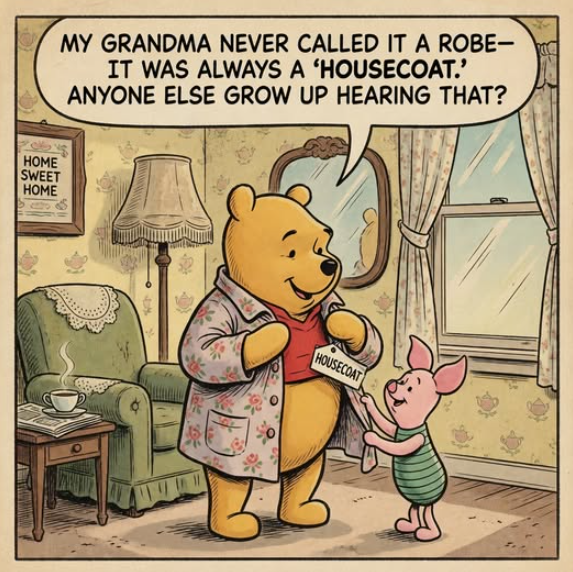
Back when we called it a “housecoat,” it wasn’t just another piece of clothing—it was a quiet symbol of home, routine, and a kind of comfort that feels almost unfamiliar today. The word itself carries a softness, a warmth that “robe” or “loungewear” just doesn’t quite capture. A housecoat wasn’t about fashion trends or social media aesthetics. It was about real life—the kind that happened behind closed doors, in kitchens filled with the smell of coffee, in living rooms where time seemed to move a little slower.
For many people, the housecoat is tied to memory. Not the loud, dramatic kind, but the gentle, everyday moments that somehow stay with you longer than anything else. You might remember your mother tying hers in the early morning, the fabric still slightly wrinkled from the day before. Or your grandmother, moving through the house with quiet purpose, her housecoat swaying as she went about her routine. It was what she wore while making breakfast, while humming softly to herself, while folding laundry that smelled like fresh air and soap.
The housecoat represented a kind of unspoken boundary between the outside world and the private one. Once you stepped into it, you were home—not just physically, but mentally. It signaled a shift: the workday was over, the expectations of the outside world could wait, and you could finally settle into yourself. There was no need to impress anyone, no need to perform. The housecoat was for you.
Unlike today’s carefully curated loungewear, which often feels designed to be seen, the housecoat wasn’t trying to make a statement. It didn’t need to. Its value came from how it was used, not how it looked. It was practical, durable, and familiar. It had pockets that actually held things—recipe cards, clothespins, maybe even a folded note. It was something you reached for without thinking, the same way you might reach for a favorite mug or a well-worn chair.
There’s also something deeply generational about the housecoat. It connects people across time in a way that feels almost invisible until you stop and think about it. The same garment, worn in different decades, carried the same meaning: care, presence, and a kind of steady reliability. It was there during quiet mornings and long afternoons, during conversations that mattered and moments that didn’t seem important at the time but somehow became memories later.
In many homes, the housecoat was tied to acts of care. It was worn while cooking meals that brought everyone to the table, while tending to children, while keeping the household running in ways that often went unnoticed. It became part of the rhythm of daily life, woven into routines so deeply that it almost disappeared into the background. And yet, looking back, it’s one of the details that stands out the most.
There’s a certain honesty to that. The housecoat wasn’t about presentation—it was about presence. It showed up for the real moments, not just the ones worth photographing. It was there when things were messy, when life was ordinary, when there was work to be done. And maybe that’s why it feels so meaningful now. It represents a kind of authenticity that can feel harder to find in a world that often prioritizes appearances.
Over time, the word “housecoat” started to fade. It was replaced by terms that feel more modern, more polished. But in that shift, something subtle was lost. Not the garment itself—you can still find robes and loungewear everywhere—but the feeling behind it. The sense of home as a place of quiet continuity, where the same small rituals repeat day after day, creating a kind of stability that doesn’t need to be announced.
When people look back and talk about housecoats, they’re not really talking about clothing. They’re talking about a way of living. A slower pace. A stronger connection to the spaces we inhabit and the people we share them with. A time when comfort didn’t have to be marketed or styled—it simply existed.
There’s also an emotional layer to it. Seeing a housecoat now can trigger a wave of nostalgia that’s hard to explain. It’s not just about remembering a person—it’s about remembering how that person made a space feel. Safe. Warm. Familiar. The housecoat becomes a kind of shorthand for all of that, a visual cue that brings those feelings rushing back.
And maybe that’s why it still matters.
Even in a world that’s constantly moving forward, there’s something grounding about these small, tangible reminders of the past. They connect us to where we came from, to the people who shaped us, to the routines that once defined our days. They remind us that meaning doesn’t always come from big, dramatic moments—it often lives in the quiet, everyday details.
The housecoat is one of those details.
It may not dominate fashion headlines or trend on social media, but it holds a kind of cultural and emotional weight that’s easy to overlook. It tells a story—not in bold strokes, but in soft, steady lines. A story of home, of care, of presence. A story that doesn’t need to be loud to be lasting.
So when we remember the “housecoat,” we’re really remembering something much bigger than a piece of fabric. We’re remembering a feeling. And in its own quiet way, that feeling still lingers—waiting to be recognized, even if we don’t call it by the same name anymore