It began like so many ordinary illnesses do—with a fever, a cough, and a tired little body that just wanted to be held. Her parents thought it was nothing more than a common virus, the kind most children experience and recover from within days. They kept her comfortable, gave her fluids, and stayed close, expecting that soon she would be back to her playful, energetic self.
But this time was different.
Instead of improving, her condition worsened. The fever lingered. She became unusually weak, barely able to sit up or engage with her favorite toys. Her breathing seemed off, shallow and strained in a way that made her parents uneasy. Trusting their instincts, they rushed her to the hospital—never imagining how dramatically their lives were about to change.
At first, doctors ran routine tests, suspecting a more severe viral infection. But as the hours passed, concern grew. Her heart rate was irregular, and her oxygen levels were fluctuating. A series of urgent scans and evaluations revealed something no parent is ever prepared to hear: the virus had attacked her heart.
She was diagnosed with myocarditis, a rare but serious condition where the heart muscle becomes inflamed, often as a result of a viral infection. In most cases, especially in children, the body can recover with treatment. But in her case, the damage was severe.
Her tiny heart was struggling to pump blood effectively.
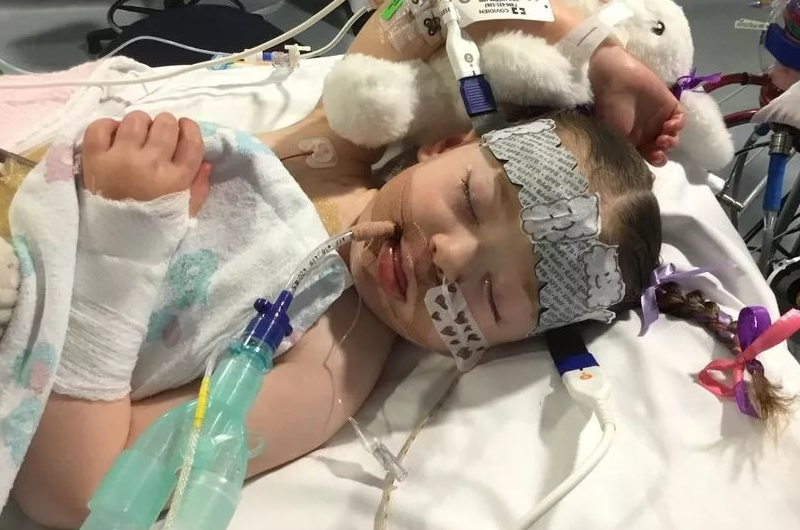
Within days, she was moved to the pediatric intensive care unit. Machines surrounded her bed, each one playing a role in keeping her alive. A ventilator helped her breathe. Medications supported her blood pressure. And eventually, when her heart function declined even further, doctors had to take a more drastic step—placing her on a life-support system known as ECMO, which temporarily takes over the work of the heart and lungs.
For her parents, the experience was overwhelming.
One moment, they had been caring for a child with what seemed like a routine illness. The next, they were standing in a hospital room filled with beeping monitors, holding onto hope while facing the reality that their daughter’s life was in danger.
Doctors worked around the clock, doing everything possible to give her heart a chance to recover. But as days turned into weeks, it became clear that her heart was not healing the way they had hoped.
That’s when the conversation changed.
Her medical team gently explained that she might need a heart transplant to survive. It was a devastating realization. A transplant meant waiting—waiting for a donor, waiting for a match, waiting for a second chance that could come at any moment or take much longer.
She was officially placed on the transplant list.
From that point on, every second mattered.
Her parents rarely left her side. They spoke to her softly, held her hand, and tried to bring a sense of comfort into a situation that felt anything but comforting. Despite the tubes and machines, despite the uncertainty, she remained a symbol of strength—a tiny fighter in the face of something unimaginably big.
Stories like hers highlight the unpredictable nature of conditions like myocarditis. While many viral infections pass without complication, in rare cases they can lead to severe inflammation that weakens the heart. Symptoms can escalate quickly, especially in young children who may not be able to express what they’re feeling.
Signs often include fatigue, difficulty breathing, rapid or irregular heartbeat, and poor appetite. But because these symptoms can overlap with common illnesses, early detection can be challenging.
In the hospital, time seemed to stand still.
Each day brought a mix of hope and fear. Small improvements were celebrated—slightly better numbers, a stable night, a moment where her condition didn’t worsen. But the reality remained: without a new heart, her chances were uncertain.
The transplant waiting list is a complex and emotional system. Organs must match not only blood type, but also size and other medical factors. For children, the challenge can be even greater due to the limited number of suitable donors.
And yet, hope persists.
Her doctors remained cautiously optimistic, explaining that children are often incredibly resilient. If a suitable heart becomes available in time, the chances of recovery can be strong. Advances in pediatric transplant medicine have made outcomes more promising than ever before.
Her parents held onto that hope.
They shared her story, not for sympathy, but to raise awareness. They wanted people to understand how quickly life can change—and how something as seemingly harmless as a virus can lead to life-threatening complications.
They also wanted to remind others of the importance of organ donation.
Behind every transplant is a story—not just of loss, but of life being given a second chance. For families like theirs, it represents hope in its purest form.
As she continues to fight, surrounded by a team of dedicated medical professionals and the unwavering love of her family, her story becomes more than just a medical case. It becomes a reminder of resilience, of the fragility of life, and of the strength that can exist even in the smallest among us.
No one knows exactly what the next chapter will hold.
But for now, she waits.
She waits for healing, for hope, and for the possibility of a new heart that could give her the chance to grow up, to laugh again, and to live the life her family dreams of for her.