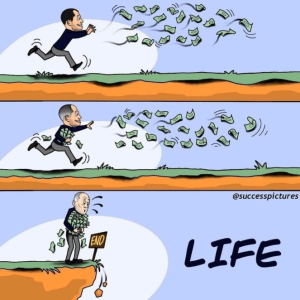
In the first moments of life, everything feels like a race. We run with bright eyes and open hands, chasing dreams that flutter just ahead of us like loose bills in the wind. The world tells us early what to pursue—money, success, status—and so we run faster, believing that if we just move quickly enough, we’ll catch it all before it slips away. The man in the image captures this perfectly: young, energetic, and determined, sprinting after money that dances just beyond his reach.
At this stage, the pursuit feels exciting. There is hope in every step. The wind against his face is not resistance but motivation. Each dollar bill in the air represents possibility—comfort, recognition, freedom. He doesn’t question the chase because everyone else is running too. The world applauds ambition, rewards hustle, and celebrates those who never stop moving. And so he runs harder.
But something subtle begins to change as time passes. In the second frame, the man is no longer empty-handed—he has managed to gather some of the money. Yet the chase hasn’t stopped. If anything, it has intensified. Now he runs not just to gain, but to keep up. The bills still fly ahead of him, just out of reach, as if the finish line keeps shifting further away.
This is the quiet trap of success. What once felt like a goal becomes a moving target. The more we acquire, the more we feel we need. Satisfaction becomes temporary, fleeting, almost imaginary. We tell ourselves, “Just a little more,” believing that the next milestone will finally bring peace. But the wind never settles, and the race never truly ends.
By this point, the man has changed. He’s older now, carrying what he’s collected, but also carrying the weight of the chase itself. His posture is slightly bent, his urgency tinged with fatigue. The joy of the pursuit has been replaced by habit. He runs not because he’s inspired, but because he doesn’t know how to stop.
And then comes the final frame—the moment that no one prepares us for.
The man has reached the edge of a cliff. The sign reads “END,” a stark and unavoidable truth. He is no longer running; he is standing still, clutching the money he spent his entire life chasing. But now, something is different. The wind still blows, and the money begins to slip from his grasp, falling into the void below. He tries to hold on, but he can’t. Gravity, time, and reality all pull it away from him.
In that moment, everything becomes clear.
The money he chased so relentlessly cannot go with him. The years he spent running cannot be reclaimed. The things he may have missed—moments of peace, time with loved ones, simple joys—linger as silent questions in his mind. Was it worth it? Did the chase give him what he truly needed, or did it distract him from what mattered most?
This image is not just about money. It is about the nature of human desire and the illusion of “more.” It reflects a truth many people come to realize too late: that life is not meant to be spent endlessly chasing something that always stays just out of reach.
The tragedy is not that the man worked hard or pursued success. There is nothing wrong with ambition. The tragedy is that he never paused to ask why he was running in the first place. He never questioned whether the direction he was headed was leading him toward fulfillment or simply toward exhaustion.
In our own lives, we often find ourselves in the same race. We measure our worth by what we accumulate—wealth, achievements, recognition—believing these things define success. We postpone happiness, telling ourselves we’ll enjoy life “later,” once we’ve reached a certain point. But “later” has a way of slipping through our fingers, just like the money in the man’s hands.
What this story invites us to consider is a different way of living.
What if we slowed down?
What if, instead of chasing every dollar in the wind, we chose carefully what truly matters to us? What if we defined success not just by what we gain, but by how we live—how we treat others, how we experience each day, how present we are in our own lives?
The wind will always blow. Opportunities will always appear just out of reach. There will always be more to chase. But we don’t have to run endlessly after all of it.
Sometimes, the most powerful choice is to stop.
To look around.
To appreciate what we already have.
To recognize that life is not a race to the edge of a cliff, but a journey meant to be experienced along the way.
The man in the image teaches us a lesson without words. He shows us the cost of a life spent in constant pursuit, and the emptiness that can come when we finally reach the end only to realize we were chasing the wrong things.
But unlike him, we still have time.
Time to pause.
Time to choose differently.
Time to live not just for the future, but for the present.
Because in the end, it’s not the money we hold onto that defines our lives—it’s the moments we truly lived, the connections we built, and the peace we found along the way.