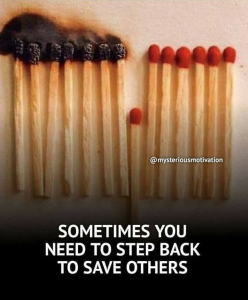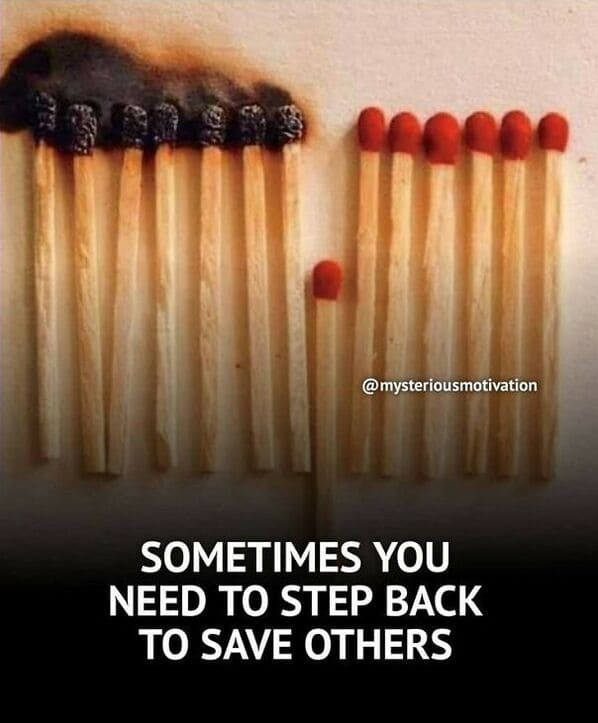
The image presents a simple yet powerful visual metaphor: a row of matches, some already burned and blackened, others still intact. One match stands slightly apart from the rest, unlit, creating a small but crucial gap. Beneath it, the message reads, “Sometimes you need to step back to save others.” At first glance, it may seem like a basic motivational quote paired with a clever arrangement. But when you sit with it, the meaning deepens into something far more profound—something that speaks to boundaries, sacrifice, self-awareness, and the quiet strength it takes to walk away.
In life, we are often taught that staying, enduring, and pushing through are signs of strength. We admire people who hold things together, who sacrifice endlessly for others, who never seem to give up. But what this image suggests is a different kind of strength—one that is less visible but just as important. It’s the strength to step back when your presence, your energy, or your involvement might actually be contributing to harm, whether to yourself or to others.
The burned matches represent how quickly things can spread when there is no interruption. Fire moves from one match to the next without resistance, consuming everything in its path. This can symbolize many things in real life: conflict, stress, negativity, toxic behavior, or even burnout. When one person is overwhelmed, angry, or hurt, those emotions can easily transfer to others if there are no boundaries in place. It becomes a chain reaction, much like the fire moving across the matches.
The single unlit match that has stepped aside becomes the turning point. It doesn’t fight the fire directly. It doesn’t try to control what’s already burning. Instead, it simply creates distance. And that distance is enough to stop the spread. This is a powerful reminder that sometimes, the most effective action is not confrontation or control, but space.
In relationships, this message is especially meaningful. There are moments when emotions run high, when words are said in anger, or when patterns of hurt repeat themselves. In those moments, stepping back can feel counterintuitive. We may want to defend ourselves, fix the situation immediately, or prove a point. But stepping back—taking time to cool down, to reflect, to breathe—can prevent further damage. It allows space for clarity, for understanding, and for healing.
Stepping back is not the same as giving up. It is not abandonment. It is a conscious decision to pause, to protect, and to prevent escalation. It requires self-awareness to recognize when your presence is no longer helpful in that moment. It requires humility to accept that you don’t always have to act immediately. And it requires courage to step away when everything in you wants to stay engaged.
This idea also applies to personal well-being. Many people push themselves to exhaustion, believing that they must keep going no matter what. They take on too much, give too much, and rarely stop to consider their own limits. But just like the matches, if one continues to burn without pause, it will eventually be consumed. Stepping back—whether that means taking a break, saying no, or setting boundaries—is not a sign of weakness. It is an act of preservation.
There is also a deeper layer to this message when we think about influence and responsibility. Sometimes, being part of a group means going along with behaviors or attitudes that may not align with your values. It can be difficult to step away, especially when there is pressure to conform. But the image reminds us that one person choosing to step back can disrupt a negative pattern. It can create a pause, a moment of reflection, and possibly even inspire others to do the same.
Interestingly, the match that steps back does not extinguish the fire that has already started. It doesn’t undo what has happened. But it prevents further damage. This highlights an important truth: we cannot always control outcomes, and we cannot always fix everything. But we can control our own actions and choices. And sometimes, that is enough to make a meaningful difference.
There is a quiet wisdom in knowing when to engage and when to withdraw. In a world that often celebrates constant action and immediate responses, choosing to step back can feel unnatural. But it is often in that space—between reaction and response—that true strength is found.
The message also challenges the idea that being helpful always means being present. Sometimes, the best way to help is to remove yourself from a situation that is escalating. This could mean stepping away from an argument, taking a break from a demanding environment, or distancing yourself from toxic influences. It is not about avoidance, but about intention. It is about recognizing that your absence, in certain moments, can be more beneficial than your presence.
At a broader level, the image speaks to the importance of boundaries in all areas of life. Boundaries are not walls meant to shut others out, but guidelines that protect your well-being and maintain healthy interactions. Without boundaries, it becomes easy for negativity, stress, and conflict to spread unchecked. But with boundaries, there is space for balance, respect, and growth.
Ultimately, the image is a reminder that small actions can have significant impact. The single match that steps back does not seem powerful on its own. It is just one small piece among many. But its decision to create space changes the entire outcome. This speaks to the idea that you do not need to be in control of everything to make a difference. Sometimes, a simple, intentional choice is enough.
In a world that often feels fast-paced and reactive, this message invites us to slow down and be mindful. It encourages us to consider the ripple effects of our actions, to recognize when stepping back is necessary, and to embrace the quiet strength that comes with it.
Sometimes, saving others doesn’t mean rushing in. Sometimes, it means knowing when to step away, creating space where it matters most, and trusting that this pause can stop the fire from spreading any further.