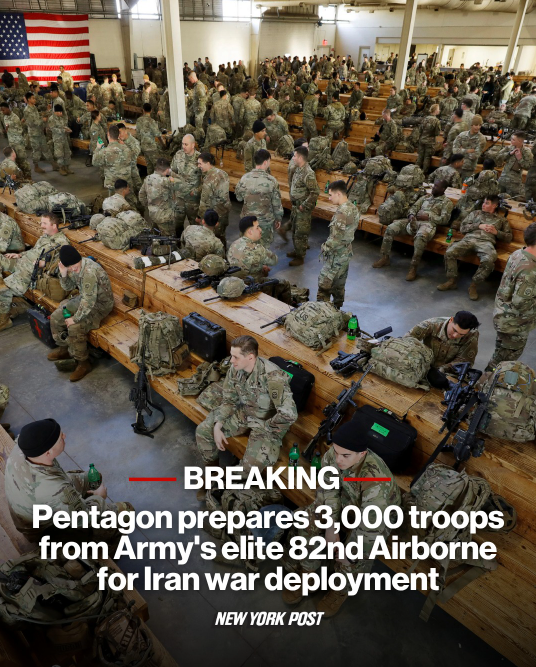
U.S. Prepares to Deploy 3,000 82nd Airborne Soldiers as Iran Tensions Grow
The Pentagon is preparing to dispatch approximately 3,000 soldiers from the Army’s 82nd Airborne Division to the Middle East in response to escalating tensions and conflict with the Islamic Republic of Iran and associated regional instability. This decision reflects a significant escalation in U.S. military posture in the region and comes amid intense geopolitical rivalries involving Iran, the United States, and allied nations.
Officials familiar with the planning say a written deployment order is expected imminently, likely within the next few hours or days, as the U.S. braces for possible new phases of confrontation. The exact timing and destination remain unannounced, and Pentagon leadership has declined to publicly confirm details pending formal orders.
Who the 82nd Airborne Are — and Why They Matter
The 82nd Airborne Division — headquartered at Fort Bragg, North Carolina — is among the U.S. Army’s most elite and versatile rapid‑reaction forces. Its soldiers are trained to deploy on short notice, often within 18 hours or less, and are capable of air assault and parachute operations into contested or unsecured territory.
Because of this capability, the presence of an 82nd Airborne brigade underscores the seriousness of the situation. Unlike routine rotations or advisory deployments, airborne brigades are designed to be flexible, mobile, and combat‑ready, capable of responding rapidly to crises, securing key terrain, or supporting larger coordinated operations.
Broader U.S. Military Build‑Up in the Region
The expected deployment of these paratroopers adds to an already significant U.S. military presence in the Middle East. The United States today maintains tens of thousands of service members in and around the region, including Marines, sailors, airmen, and Army personnel supporting air defense, naval security, and regional cooperation missions.
In recent weeks, the U.S. has also repositioned additional assets, including Marine Expeditionary Units aboard amphibious assault ships such as the USS Boxer, and other naval forces designed to enhance security for critical waterways like the Strait of Hormuz — a chokepoint responsible for a large share of global oil transit.
Why the Deployment Is Happening Now
Multiple factors explain the Pentagon’s decision to prepare this deployment:
• Escalating Conflict With Iran: The United States and its allies have been engaged in a broader confrontation with Iran. This includes airstrikes, drone and missile exchanges, and retaliatory attacks across the region. Tensions have spiked since late February, when U.S. and allied forces escalated military operations targeting Iranian military assets.
• Strategic Security Concerns: U.S. leadership has framed the reinforcement as a deterrent — aimed at preventing further hostile actions by Iran and its proxies, protecting U.S. personnel, and ensuring that key strategic infrastructure remains secure. Areas of strategic interest include the Strait of Hormuz and Kharg Island, a major Iranian oil export hub.
• Flexible Military Options: Deploying an airborne brigade gives commanders a broader set of rapid‑response options. These troops could be used to seize or secure airfields, ports, logistics hubs, defensive positions, or contested terrain should the President authorize such operations.
Despite the preparation, officials caution that no final decision has been made on whether these troops will conduct ground combat inside Iran or elsewhere. The deployment could initially be defensive — focusing on security, deterrence, and rapid response — rather than an immediate combat insertion.
Diplomacy and Mixed Messaging
Interestingly, the troop preparation comes alongside mixed diplomatic signals. While senior officials are planning military options, there have also been comments about continued diplomatic engagement with Tehran, even as Iran publicly denies that substantive talks are underway. Iranian authorities have called such claims “meaningless,” highlighting how contradictory messaging on both sides contributes to uncertainty and strategic tension.
This juxtaposition of military preparedness and diplomatic rhetoric is not unusual in high‑stakes geopolitical crises, but it does underline the complexity of the situation — where nations prepare for the worst while still leaving channels for negotiation open.
Political and Public Reaction
Back in the United States, public opinion remains divided. A recent Reuters/Ipsos poll found that while a significant majority of Americans believe President Donald Trump will eventually send troops into Iran, only a small portion support such a move. Many citizens express concern about the costs, risks, and potential unintended consequences of expanding ground force commitments beyond air and naval operations.
In Congress and among experts, opinions vary widely. Some defense analysts say a robust U.S. military presence is necessary to show resolve and reassure allies. Others warn that an escalation without a clear political strategy could lead to a protracted conflict with unpredictable outcomes.
What the Deployment Could Mean
The preparation to send 3,000 elite paratroopers — even before a formal order has been signed — carries significant strategic implications:
• Signal of Resolve: It shows Washington is willing to reinforce its military posture substantially if the conflict continues.
• Rapid Reaction Capability: These forces could be used to secure key logistical nodes, airfields, or contested areas should conflict spread.
• Escalation Risk: Deploying airborne troops close to Iran increases the risk of unintended clashes or miscalculations, particularly given Iran’s network of proxy forces and defensive systems throughout the region.
• Strategic Flexibility: The airborne division’s deployment enhances the U.S. military’s ability to support not just one objective, but multiple contingencies — from defense to rapid counterattack.
Conclusion: A Situation Still Evolving
Today’s reported preparation signals a noteworthy shift in U.S. military planning amid the widening conflict with Iran. The move to prepare a brigade from the 82nd Airborne Division — one of America’s most capable rapid response units — reflects the seriousness with which the Pentagon views current threats and the need for enhanced operational readiness.
However, at this stage, a formal deployment order is not yet publicly confirmed, and the mission’s ultimate role — whether defensive, deterrent, or offensive — remains to be seen. The coming days will be crucial in watching whether these elite forces are actually dispatched, how Iran responds, and whether diplomatic efforts can reduce the risk of broader conflict.