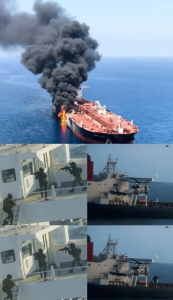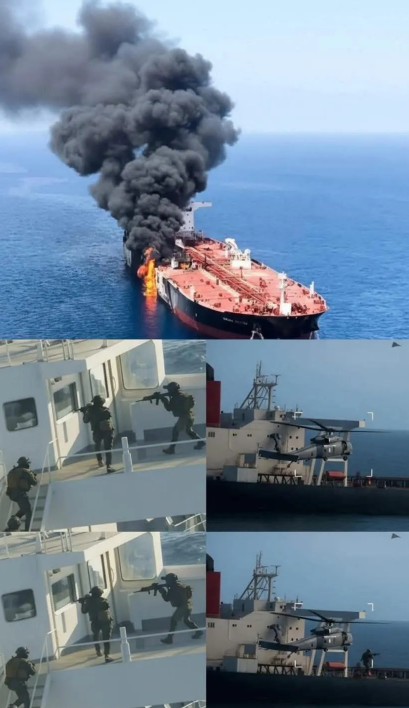
The first alert came just after dawn—short, sharp, and impossible to ignore.
“Unidentified vessel entering restricted waters. No response to hails.”
Captain Elias Turner stood on the deck of the patrol craft, the early morning mist clinging low over the water like a curtain hiding something dangerous. The mission had started as routine surveillance along a volatile stretch of coastline in a region known simply among soldiers as “Ve.” It wasn’t marked clearly on most maps, and that alone made it a place of interest—and concern.
“Bring us closer,” Turner ordered, his voice calm but edged with tension.
The engines rumbled, cutting through the water as the gray silhouette of the unknown boat slowly emerged from the fog. It was larger than expected—a rust-streaked cargo vessel with no visible markings, no flag, and no signs of communication equipment in use.
“That’s not normal,” muttered Sergeant Cole beside him. “Not out here.”
Turner didn’t respond immediately. His eyes scanned the vessel through binoculars. No movement on deck. No crew visible. Just silence.
“Try hailing again,” he said.
Static filled the comms. Then more static. No reply.
That was enough.
“Boarding team, gear up.”
Within minutes, a small unit of U.S. Army soldiers prepared to intercept. Their movements were precise, practiced, but beneath the discipline was something else—unease. Unidentified vessels in restricted zones didn’t just happen. And when they did, they usually meant trouble.
The boarding craft detached and sped toward the looming ship. As they approached, the scale of it became more intimidating. The hull towered above them, streaked with corrosion, as if it had been drifting for years—yet radar showed it had only just entered the area.
“Hooks up!” Cole shouted.
Grappling lines shot upward, securing the team’s path. One by one, the soldiers climbed aboard, boots hitting the metal deck with hollow thuds.
Still nothing.
No crew. No voices. No movement.
“Clear the deck,” Turner ordered as he climbed up last.
The team spread out, weapons raised, scanning every shadow. A loose tarp flapped in the breeze, startling one of the younger soldiers. Another pointed toward the bridge.
“Sir… door’s open.”
Turner nodded. “Move in.”
Inside, the ship was dim, lit only by flickering overhead lights. The air smelled stale—like rust, salt, and something else… something harder to identify.
“Where is everyone?” whispered Private Lewis.
No one answered.
They moved room by room, clearing compartments. Storage holds—empty. Crew quarters—abandoned. Equipment rooms—stripped or non-functional.
“Sir,” Cole called from the far end of the corridor. “You need to see this.”
Turner approached cautiously. The door to the cargo hold was ajar. Cole pushed it open the rest of the way.
What they saw inside made everyone freeze.
Crates.
Dozens of them, stacked in tight rows, each marked with unfamiliar symbols—black geometric patterns painted over dull gray metal. No shipping labels. No origin stamps. Nothing recognizable.
“What the hell is this?” Lewis murmured.
Turner stepped forward slowly. “Don’t touch anything yet.”
But even without touching, something felt off. The air inside the hold was colder, unnaturally so. A faint humming noise pulsed beneath the silence, barely audible but impossible to ignore once noticed.
“Sir, these aren’t standard containers,” Cole said, running a scanner over one. “No readable data. It’s like… they’re not even in our system.”
Turner’s jaw tightened. “Get command on the line.”
Static again. Then a broken signal.
“…Turner… report… interference…”
The comms cut out completely.
“Great timing,” Cole muttered.
Turner looked around the hold again, more carefully this time. The symbols on the crates—there was a pattern. Not random. Repeating. Deliberate.
“Lewis,” Turner said quietly. “You see that?”
The young soldier nodded slowly. “Yeah… it’s like a code or something.”
“Or a warning,” Cole added.
A sudden clang echoed from somewhere above.
Everyone snapped to attention.
“That came from the deck!” one of the soldiers shouted.
“Move!” Turner commanded.
They rushed back up, weapons ready. The deck, once empty, now told a different story.
A rope swayed near the railing—freshly disturbed.
“Someone’s here,” Cole said.
Turner scanned the horizon. Nothing but water and fog.
“Search the ship again. Top to bottom.”
This time, the silence felt heavier. More dangerous.
They split into teams, moving faster now, adrenaline pushing them forward. Every shadow seemed deeper. Every sound sharper.
Then—
A shout.
“In here!”
Turner sprinted toward the voice, arriving at a lower compartment near the engine room. Two soldiers stood over something—someone.
A man.
He was thin, pale, dressed in torn clothing that didn’t match any known military or civilian uniform. His eyes darted wildly as Turner approached.
“Easy,” Turner said, lowering his weapon slightly. “We’re not here to hurt you.”
The man said nothing at first. Just stared.
Then, in a shaky voice, he spoke.
“You shouldn’t have come.”
Turner exchanged a glance with Cole. “Why not?”
The man’s lips trembled. “It’s not cargo.”
Turner’s stomach tightened. “What do you mean?”
The man looked toward the ceiling—as if he could see through the ship to the crates above.
“They’re not containers,” he whispered. “They’re… holding cells.”
A cold silence fell over the room.
“For what?” Cole demanded.
The man’s expression twisted into something between fear and regret.
“Not what,” he said. “Who.”
Before anyone could react, a deep, resonating thud echoed through the ship.
Then another.
And another.
The floor beneath them vibrated.
Turner’s radio crackled back to life—just for a moment.
“…immediate evacuation advised…”
Then it died again.
The thudding grew louder.
From above.
From the cargo hold.
Turner’s voice cut through the rising panic. “All units—fall back to extraction point! Now!”
The team moved fast, but the ship felt different now—alive in a way it hadn’t before. The humming from the cargo hold had intensified, turning into a low, mechanical roar.
As they reached the deck, one final sound stopped them cold.
A metallic crack.
Then—
Something hitting the inside of a crate.
Hard.
Once.
Twice.
Then dozens of impacts, all at once, echoing like a storm trapped in steel.
No one spoke.
No one needed to.
Turner turned toward the evacuation craft. “Move! Move!”
They didn’t wait to see what was inside those crates.
And as their boat sped away from the silent vessel drifting in the mist, one thought lingered in every mind:
Some things aren’t meant to be found.