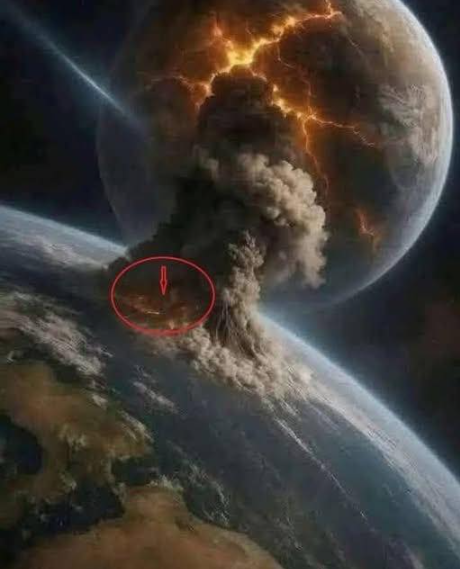
BREAKING NEWS claims have a way of spreading quickly online, especially when they hint at something mysterious or frightening about our planet. Recently, posts circulating on social media have suggested that on March 27th the Earth will begin to undergo a dramatic or catastrophic change. The messages often end with “See more,” encouraging people to click a link or read a long thread. While these posts can sound urgent and convincing, they are a good reminder of how easily misinformation can spread when a headline sparks curiosity or fear.
First, it’s important to understand that no major scientific organization has announced any global event scheduled for March 27th that would fundamentally change the Earth. Institutions such as NASA, the European Space Agency, and the National Oceanic and Atmospheric Administration constantly monitor our planet, the Sun, and objects in space. If something significant were truly about to happen—such as a large asteroid impact, a sudden shift in Earth’s orbit, or a catastrophic solar storm—these agencies would communicate it publicly and clearly. There would be extensive coverage from scientists, researchers, and international governments.
Many viral posts that begin with phrases like “BREAKING NEWS confirms…” rely on dramatic wording to grab attention. The rest of the sentence is often hidden behind a “See more” button, which encourages readers to click and share before they actually verify the information. This tactic is common in misleading content because it creates suspense and emotional reactions. When people feel shock, fear, or excitement, they are more likely to share the message without checking whether it is true.
In reality, Earth operates according to natural cycles that scientists understand very well. Our planet rotates once every 24 hours, orbits the Sun once every 365 days, and experiences predictable phenomena such as seasons, eclipses, and tides. None of these cycles suddenly “begin” on a specific date like March 27th. While natural events do happen—earthquakes, volcanic eruptions, solar storms, or meteor showers—they cannot be predicted to start globally on a specific day in the way viral posts often suggest.
Sometimes these posts are connected to misunderstandings about astronomical events. For example, people occasionally misinterpret reports about meteor showers, solar activity, or planetary alignments. Planetary alignments, where several planets appear in roughly the same region of the sky, occur periodically but have no effect on Earth’s stability or gravity. Likewise, meteor showers happen every year and are usually harmless streaks of light caused by tiny particles burning up in the atmosphere.
Another reason these rumors spread is because people are fascinated by doomsday predictions. Throughout history, there have been many claims that the world would end on a specific date. One famous example involved the supposed apocalypse linked to the end of the Mayan calendar in 2012. Despite widespread speculation, December 21, 2012 passed like any other day. Similar predictions have appeared repeatedly across decades, yet none have come true. Scientists emphasize that Earth has existed for about 4.5 billion years and is remarkably stable on human timescales.
The internet has made it easier than ever for these dramatic claims to circulate. A single post can be shared thousands or even millions of times within hours. Often the original source is unclear, and the message evolves as people repost it. Someone may add extra details, new images, or emotional commentary, which makes the rumor appear more believable even though no credible evidence supports it.
To evaluate claims like the one about March 27th, it helps to follow a few simple steps. First, look for reliable sources. Major scientific announcements typically come from organizations such as NASA or reputable universities. Second, check whether multiple independent news outlets are reporting the same information. If a story is truly global and significant, it will appear across many trustworthy platforms. Third, read beyond the headline. Misleading posts often rely on dramatic titles that don’t match the actual content.
Interestingly, many viral “breaking news” posts turn out to be engagement bait rather than genuine information. The goal is to generate clicks, shares, and comments. Sometimes these posts lead to advertising pages, suspicious websites, or social media accounts seeking attention. By encouraging curiosity—“See more,” “You won’t believe this,” or “Scientists are shocked”—the creators increase the chances that people will interact with the content.
While it’s understandable that dramatic claims capture our imagination, the truth is that Earth is not about to suddenly begin a mysterious transformation on March 27th. Our planet will continue its steady rotation, orbiting the Sun just as it has for billions of years. Scientists will keep observing space, tracking asteroids, and studying our environment, but there is no credible evidence suggesting an imminent global event tied to that date.
In a way, the persistence of these rumors reveals something positive about human nature. People are curious about the universe and eager to understand what might happen next. That curiosity drives science itself. Researchers around the world study everything from distant galaxies to Earth’s climate, constantly expanding our knowledge of how the universe works.
The best response to sensational headlines is healthy skepticism. Instead of reacting immediately, pause and ask where the information came from. Reliable science depends on evidence, peer review, and transparent data—not mysterious posts that end with “See more.”
So if you encounter a viral message claiming that “BREAKING NEWS confirms that March 27th the Earth will begin to…”, remember that it is almost certainly designed to grab attention rather than report verified facts. Earth will continue spinning, the Sun will rise, and life will move forward as usual. And while the universe still holds countless mysteries waiting to be explored, none of them are scheduled to begin with a sudden global event on that particular day.