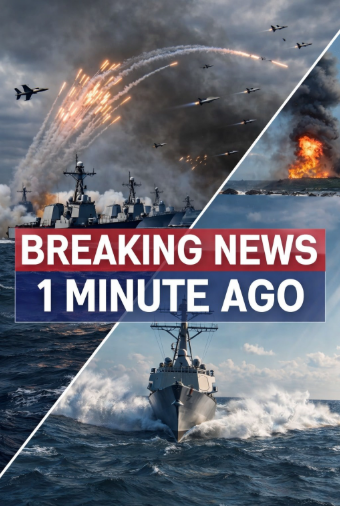
The launch of 36 missiles within just 22 minutes during a clash in the Red Sea has raised serious concerns among military analysts and international observers. The rapid exchange of fire highlights how quickly tensions in the Middle East can escalate and how fragile the current security environment has become. The Red Sea, one of the most important maritime routes in the world, has increasingly become a focal point of geopolitical tension, and incidents like this signal that the region may be entering an even more dangerous phase.
The Red Sea is a vital corridor for global trade. Nearly 15 percent of the world’s maritime commerce passes through the narrow waterways that connect the Mediterranean Sea to the Indian Ocean via the Suez Canal and the Bab el-Mandeb Strait. Because of this strategic importance, any military confrontation in the area immediately attracts international attention. A missile exchange of this scale, even if brief, sends a message that regional conflicts are no longer confined to land but are increasingly spilling into international waters.
The incident reportedly began when naval forces operating in the region detected incoming missile launches from coastal positions. Within minutes, defensive systems aboard warships were activated, intercepting several of the incoming threats. According to early reports from defense sources, dozens of missiles were launched in a coordinated wave designed to overwhelm defensive capabilities. The speed and volume of the attack suggested a carefully planned operation rather than a spontaneous act.
Naval vessels stationed in the Red Sea responded quickly. Modern warships are equipped with layered missile defense systems capable of tracking and intercepting multiple incoming threats simultaneously. Radar systems detected the launches almost immediately, allowing defensive interceptors to be fired within seconds. While several missiles were reportedly destroyed mid-air, the sheer number launched in such a short timeframe created a tense situation for crews on board.
The 22-minute window in which 36 missiles were fired demonstrates the evolving nature of modern naval warfare. In past decades, naval engagements might involve a handful of missiles or artillery exchanges. Today, however, many military doctrines rely on saturation attacks, where large numbers of missiles are launched quickly to overwhelm defenses. Even highly advanced systems can struggle when faced with dozens of simultaneous threats.
Military analysts believe the attack may have been intended as both a tactical strike and a strategic message. The Red Sea has become increasingly militarized due to ongoing regional conflicts and political rivalries. Several nations maintain naval patrols in the area to protect shipping lanes and deter attacks. When missiles are fired in such large numbers, it not only threatens military targets but also commercial vessels traveling through the region.
Commercial shipping companies closely monitor these developments because any escalation in the Red Sea can have immediate economic consequences. Insurance rates for cargo ships often rise sharply when military incidents occur, and shipping companies may reroute vessels around Africa to avoid the region. Such detours add thousands of miles to voyages and significantly increase transportation costs.
Beyond economic concerns, the missile exchange highlights the broader instability affecting the Middle East. Over the past decade, conflicts across the region have become increasingly interconnected. Local disputes often draw in outside powers, creating complex alliances and rivalries. As a result, even a brief clash in one location can quickly trigger reactions from multiple governments.
The use of missile technology has also changed the strategic landscape. Missiles today are faster, more precise, and capable of traveling long distances. Some are designed to fly at low altitudes or maneuver unpredictably, making them harder to intercept. Others travel at extremely high speeds, reducing the time available for defensive responses. When dozens of such weapons are launched in rapid succession, the risk of miscalculation increases dramatically.
Another factor contributing to rising tensions is the growing presence of unmanned systems. Drones, surveillance aircraft, and automated monitoring systems now constantly watch key waterways. While these technologies improve early warning capabilities, they also create situations where rapid decisions must be made based on electronic signals and radar readings. In high-pressure moments, even small misunderstandings can escalate quickly.
International reactions to the missile barrage have been cautious but concerned. Many governments have called for restraint and urged all parties involved to avoid further escalation. Diplomatic channels are often used behind the scenes to prevent conflicts at sea from spiraling into broader confrontations. The Red Sea is simply too important to global trade for prolonged military activity to go unchecked.
Experts warn that incidents like this highlight the importance of maintaining clear communication between military forces operating in crowded waterways. Naval commanders often rely on established protocols designed to prevent accidental clashes. These include communication channels, identification procedures, and safe-distance rules for ships operating near one another.
However, when missiles are launched, those protocols can break down quickly. Defensive systems are designed to react instantly to perceived threats, leaving little time for negotiation or clarification. This is why many analysts believe confidence-building measures between regional powers are more important than ever.
The 36-missile barrage also raises questions about the long-term trajectory of security in the region. If missile exchanges become more frequent, the Red Sea could gradually transform from a commercial lifeline into a militarized zone. Such a shift would have enormous consequences not only for Middle Eastern nations but for the global economy as well.
Despite the alarming nature of the incident, many defense experts emphasize that modern naval forces are trained specifically to handle scenarios like this. Warships deploy with advanced radar systems, missile interceptors, electronic countermeasures, and highly trained crews prepared for rapid response. These capabilities significantly reduce the chances that missile attacks will successfully strike their targets.
Still, the psychological impact of such a confrontation cannot be ignored. When dozens of missiles are fired in less than half an hour, it sends a clear signal that tensions remain dangerously high. For sailors stationed in the region and for the governments monitoring events from afar, the message is unmistakable: the security situation in the Middle East remains volatile.
Ultimately, the Red Sea missile clash serves as a reminder of how quickly modern conflicts can unfold. In just 22 minutes, dozens of missiles transformed a tense geopolitical environment into a potentially explosive military encounter. Whether this incident proves to be an isolated confrontation or a sign of deeper escalation will depend largely on the actions taken by regional and international leaders in the days and weeks ahead.