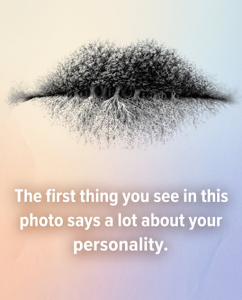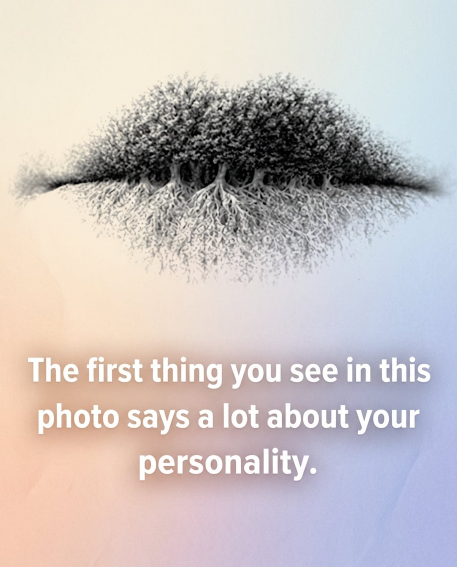
At first glance, the image seems simple. It might look like nothing more than a collection of shapes, shadows, or colors placed together in an interesting pattern. But the moment someone asks a question—“What do you see first?”—the image suddenly becomes much more than a picture. It becomes a small test of perception, attention, and even personality.
Images like these have become incredibly popular across the internet. They invite people to pause for a moment and examine what their eyes naturally notice first. Some viewers might immediately see an animal shape hidden in the design. Others might see a face, a landscape, or a completely different object. What makes these images fascinating is that everyone’s brain processes visual information slightly differently.
When you look at a picture, your brain is not simply recording what is in front of you like a camera. Instead, it is actively interpreting shapes, patterns, and contrasts based on your past experiences, emotions, and habits of attention. Within a fraction of a second, your mind decides what seems most important or recognizable. That is why two people can stare at the same image and notice completely different things.
Psychologists often study this type of perception using what are known as ambiguous images. These are pictures intentionally designed to contain more than one recognizable object or meaning. One famous example shows a drawing that can be interpreted either as a young woman looking away or an older woman facing sideways. Depending on how your brain organizes the shapes, you may see one image before the other.
When people share these types of visual puzzles online, they often suggest that the object you see first reveals something about your personality. For example, if someone sees a bird before anything else, the description might say that the person is imaginative and curious. If another person notices a face first, the explanation might say they are emotionally aware or socially attentive.
While these interpretations are usually meant for fun rather than strict science, they still highlight an interesting truth: perception reflects what our brains are most prepared to notice. People who often focus on details may see small shapes first. People who tend to look at the bigger picture may notice the overall form before anything else.
Consider an example image that contains both a tree and two faces formed by the branches. Some viewers will immediately notice the faces. Others will first recognize the tree itself. The difference may come down to how each person’s brain searches for familiar patterns. Humans are naturally wired to detect faces, but depending on the contrast and layout, another shape may stand out first.
Another example might include an illustration where a fish shape also forms the outline of a human eye. A viewer who is drawn to organic shapes might see the fish instantly. Someone who tends to recognize facial features quickly might notice the eye instead. Both interpretations are correct—the image was designed to allow both possibilities.
This phenomenon relates to a psychological principle called pattern recognition. Our brains constantly try to match what we see with things we already know. This helps us understand our environment quickly. If you walk into a forest, your brain instantly identifies trees, leaves, and paths without needing to analyze every single shape individually.
But when an image deliberately mixes patterns together, the brain has to choose which interpretation feels strongest. That choice happens so quickly that we are rarely aware of the process. Only after someone points out the alternative do we realize there was another way to see the picture.
Another interesting aspect of these visual puzzles is how perception can shift over time. At first you may see only one object. Then, once someone shows you the hidden image, it suddenly becomes impossible not to notice it. Your brain has learned a new pattern, and it now recognizes it immediately.
This ability to switch between interpretations demonstrates the flexibility of human perception. Our minds are constantly adapting, updating, and reorganizing information as new details appear. What once looked like random shapes can suddenly become a meaningful picture once the brain understands how the pieces connect.
In some cases, the object people notice first may also relate to their current mood or mental focus. Someone who is feeling relaxed might take in the whole scene and recognize larger shapes first. Someone who is concentrating intensely may immediately pick out small details hidden within the design.
These images also remind us that seeing is not always believing. What we think we see is influenced by context, expectations, and even suggestions from others. If someone tells you that an image contains a hidden animal, your brain will start searching for animal shapes, even if you did not notice them before.
Because of this, visual perception tests are often used in psychology classes and experiments. Researchers use them to explore how people organize information, how attention works, and how expectations influence what we notice.
However, the personality descriptions attached to many online versions of these tests should be taken lightly. They are usually written for entertainment rather than scientific accuracy. Still, they can spark interesting conversations and encourage people to reflect on how they see the world.
In a broader sense, these images highlight how unique every person’s perspective can be. Two people may stand in the same place, look at the same scene, and yet focus on entirely different details. One person might notice colors and light. Another might notice movement or shapes.
The same principle applies beyond pictures. In daily life, people often interpret events differently based on their experiences and expectations. Just as an ambiguous image can have multiple meanings, many real-life situations can be viewed from more than one perspective.
That is part of what makes human perception so fascinating. Our brains are powerful pattern detectors, constantly searching for meaning in the visual world around us. Yet they are also flexible enough to reinterpret what they see when new information appears.
So when someone asks “What do you see first?”, the question is not only about the image in front of you. It is also about how your mind works—what patterns stand out, what details catch your attention, and how your brain organizes the world.
In the end, the beauty of these simple images lies in their ability to reveal just how complex perception really is. A single picture can hold multiple realities at once, waiting for each viewer to discover them in their own way. And sometimes, the most surprising part is realizing that what you saw first was only one of many possibilities hidden in plain sigh