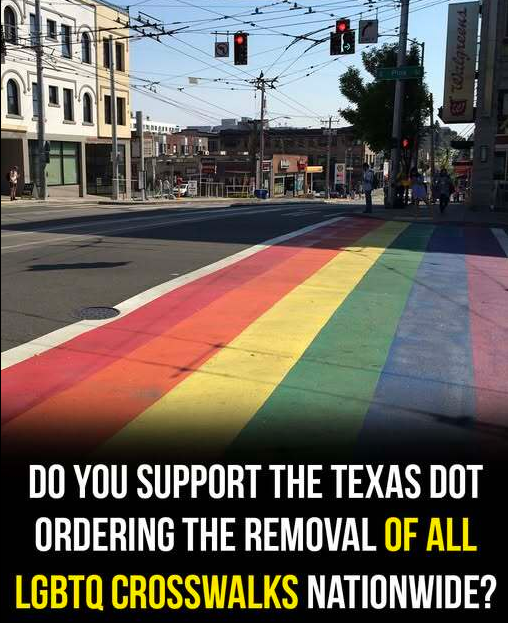
The debate over public space, identity, and infrastructure took a new turn when the Texas Department of Transportation (TxDOT) signaled efforts to remove LGBTQ Pride crosswalks across parts of the state. The decision, framed officially as a matter of road safety and compliance with uniform traffic standards, has sparked a broader conversation about visibility, inclusion, and the role of government in shaping shared civic environments.
At the center of the issue is a tension that has surfaced repeatedly in recent years: how to balance symbolic expressions of community identity with standardized public safety regulations. Pride crosswalks—often painted in rainbow colors to represent LGBTQ identity and solidarity—have appeared in cities across the United States, from small towns to major urban centers. For many, they are more than decorative street markings; they are symbols of recognition, acceptance, and progress.
However, TxDOT has argued that such crosswalks deviate from guidelines established in the Federal Highway Administration’s Manual on Uniform Traffic Control Devices (MUTCD), which governs road markings nationwide. According to these standards, crosswalks are intended to be highly visible, consistent, and easily understood by drivers and pedestrians alike. Officials maintain that introducing non-standard designs—no matter how meaningful—could create confusion or reduce the effectiveness of safety markings.
Supporters of the move emphasize that transportation infrastructure should prioritize clarity above all else. They argue that even small variations in road design can have unintended consequences, especially in high-traffic areas. From this perspective, uniformity is not about limiting expression but about ensuring that every driver, regardless of location, can instantly recognize and respond to road cues.
Critics, however, see the decision as part of a broader pattern of restricting LGBTQ visibility in public life. Advocacy groups contend that Pride crosswalks have not been shown to increase accidents or reduce safety. Instead, they argue, these crosswalks often serve as focal points for community engagement, tourism, and local pride. In cities where they have been installed, such as in Austin or Dallas, they are frequently maintained in partnership with local governments and have become landmarks in their own right.
The controversy also reflects the complex relationship between state authority and local governance. Many Pride crosswalks have been initiated by city councils or community organizations, raising questions about whether a state agency should override local decisions. For municipalities that view these installations as expressions of their values, the removal effort can feel like a top-down imposition that disregards local autonomy.
Legal experts note that while states generally have authority over roadway standards, conflicts can arise when local initiatives intersect with state or federal regulations. The outcome of such disputes often depends on how strictly standards like the MUTCD are interpreted and enforced. In some cases, cities have sought creative compromises—such as placing Pride colors adjacent to, rather than within, official crosswalk markings—to comply with regulations while preserving symbolic elements.
Beyond the legal and technical arguments, the issue has a deeply human dimension. For many LGBTQ individuals, public symbols of inclusion can carry significant emotional weight. A rainbow crosswalk is not just paint on asphalt; it can represent safety, belonging, and acknowledgment in spaces where such feelings have historically been absent. Removing these symbols, therefore, can be experienced as more than a bureaucratic adjustment—it can feel like a step backward.
At the same time, not everyone agrees on the role of public infrastructure as a platform for social expression. Some residents argue that streets and sidewalks should remain neutral, focusing solely on their functional purpose. They contend that allowing one form of expression could open the door to many others, potentially leading to a patchwork of designs that complicate navigation and maintenance.
The discussion is further complicated by the broader national context. Across the United States, debates over LGBTQ rights and visibility have intensified in recent years, touching on issues ranging from education to healthcare to public accommodations. The controversy over crosswalks, while seemingly narrow, is part of this larger cultural and political landscape.
In Texas, a state known for its diversity as well as its political contrasts, reactions have been particularly pronounced. Urban centers with more progressive constituencies have pushed back strongly against the proposed removals, while some state leaders and residents support the emphasis on uniform standards. The result is a microcosm of the broader national dialogue, playing out at the level of painted lines on city streets.
Looking ahead, the outcome of this issue may depend on negotiation and compromise. Some cities may seek alternative ways to celebrate LGBTQ identity that do not conflict with roadway regulations—such as murals on sidewalks, public art installations, or designated community spaces. Others may challenge the state’s interpretation of safety standards, potentially leading to legal battles that could set precedents for similar cases nationwide.
What remains clear is that the debate is not just about crosswalks. It is about how communities define themselves, how governments balance competing priorities, and how public spaces reflect—or fail to reflect—the people who use them. Whether one views Pride crosswalks as essential symbols of inclusion or as inappropriate deviations from safety norms, the conversation they have sparked underscores the evolving nature of public life in the United States.
In the end, the question may not be simply whether these crosswalks should stay or go, but how society can create spaces that are both safe and inclusive. Achieving that balance will require thoughtful dialogue, respect for differing perspectives, and a willingness to find solutions that honor both practical needs and human values.