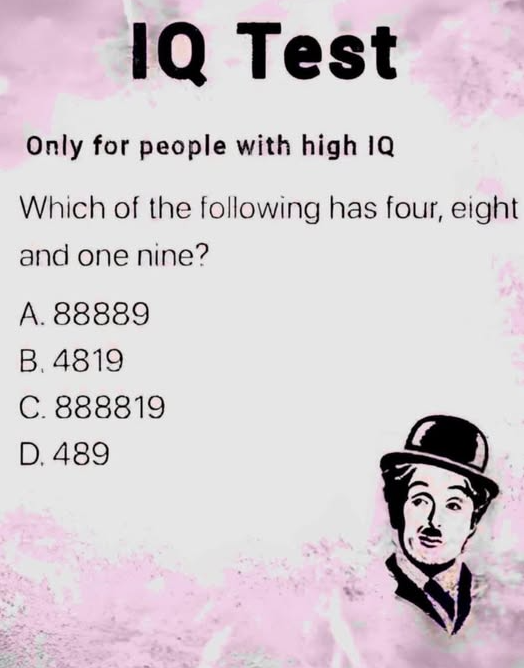
At first glance, this “IQ test” looks like a straightforward numbers puzzle, but its trick lies in how the question is phrased. It reads: “Which of the following has four, eight and one nine?” The key to solving it is not rushing to count digits blindly, but instead carefully interpreting the wording.
Most people initially assume the question is asking: “Which option contains four 8s and one 9?” That interpretation leads you to scan each option and count how many times the digit 8 appears, along with whether there is a 9. If you follow that logic, option A (88889) looks promising because it clearly has four 8s and one 9. That’s why many people stop there and choose A quickly.
However, that’s exactly where the trick lies. The sentence doesn’t say “four eights and one nine.” It says “four, eight and one nine.” This subtle difference changes the meaning completely. Instead of counting how many 8s are present, the question is actually asking for a number that contains the digits 4, 8, 1, and 9.
Once you reinterpret the question correctly, the puzzle becomes much simpler. Now you just need to find which option includes all four digits: 4, 8, 1, and 9.
Let’s go through each option carefully:
Option A: 88889
This number contains multiple 8s and a 9, but it does not contain a 4 or a 1. So it does not satisfy the condition.
Option B: 4819
This number contains 4, 8, 1, and 9 exactly once each. That matches the requirement perfectly.
Option C: 888819
This number includes several 8s, along with a 1 and a 9. However, it does not contain a 4. So it fails the condition.
Option D: 489
This number contains 4, 8, and 9, but it is missing 1. Therefore, it is also incorrect.
With that analysis, the correct answer is clearly B: 4819.
What makes this puzzle interesting is not the math itself, but the way it tests attention to language. It’s a classic example of how our brains tend to jump to conclusions based on patterns we expect to see. When people see numbers and a phrase like “four, eight and one nine,” they often subconsciously convert it into “four eights and one nine,” because that feels like a more familiar structure.
This type of puzzle is often called a “trick question,” but it’s not really about tricking you in a malicious way. Instead, it highlights how important it is to slow down and read carefully. Many mistakes in problem-solving—whether in school, work, or everyday life—come from misinterpreting instructions rather than lacking ability.
Another interesting aspect is how the brain processes numbers versus words. When numbers are written as digits, we tend to scan them visually and quickly. But when instructions are written in words, especially in a slightly unusual phrasing, they require more deliberate interpretation. The mismatch between these two processing styles is what creates the confusion.
This puzzle also demonstrates a broader principle in critical thinking: always question your first assumption. Your initial interpretation might feel obvious, but that doesn’t mean it’s correct. Taking a moment to reconsider the wording can completely change the outcome.
In real-world situations, this kind of careful reading can be extremely valuable. For example, misunderstandings in contracts, instructions, or even conversations often happen because people assume meaning instead of verifying it. Training yourself to pause and double-check can help avoid errors.
It’s also worth noting that puzzles like this are not actually measuring IQ in any scientific sense. Despite being labeled as an “IQ test,” this is more of a brain teaser or attention test. True IQ assessments are much more complex and involve a wide range of cognitive skills, including reasoning, memory, spatial awareness, and problem-solving under controlled conditions.
Still, puzzles like this are fun because they challenge your thinking habits. They remind you that intelligence is not just about knowing facts or doing calculations—it’s also about how you approach problems, how carefully you read, and how willing you are to question your assumptions.
In conclusion, the correct answer is B (4819) because it is the only option that contains the digits 4, 8, 1, and 9 as specified by the question. The real challenge of the puzzle lies in interpreting the wording correctly rather than performing any complicated calculation