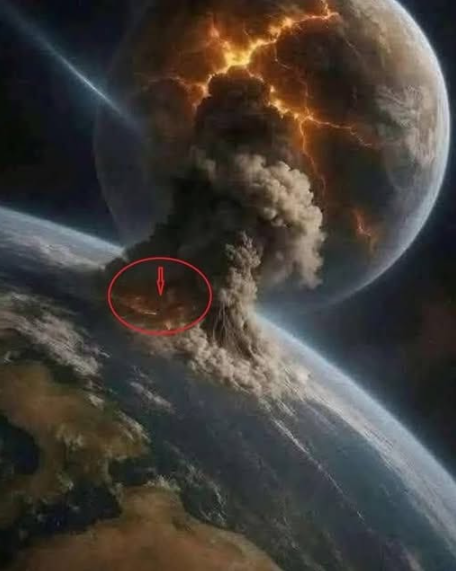
Headlines that begin with “BREAKING NEWS confirms that DEC 27th the Earth will begin to…” are designed to trigger urgency and curiosity. They often suggest something dramatic — the Earth stopping its rotation, a massive asteroid impact, a magnetic pole reversal, a global blackout, or some other catastrophic event. But when you look closely, these claims almost always turn out to be exaggerated, misinterpreted, or completely false.
Let’s break this down calmly and logically.
First, any event that would dramatically change Earth’s behavior — such as stopping its rotation, shifting its orbit, or flipping its poles overnight — would not be a secret. Organizations like NASA, European Space Agency, and observatories around the world constantly monitor our planet and near-Earth space. Data from satellites, telescopes, and ground stations is shared globally among scientists. If a major planetary event were scheduled for a specific date like December 27th, it would dominate international news, scientific journals, and official government briefings.
One common viral rumor claims that Earth will stop rotating for a short period. Scientifically, this is impossible without catastrophic consequences. Earth rotates at roughly 1,000 miles per hour at the equator. If it suddenly stopped, oceans would surge across continents, structures would collapse, and the atmosphere would continue moving at high speed. Life as we know it would not survive such an event. There is no scientific evidence suggesting anything remotely close to this happening.
Another frequent rumor involves an asteroid impact. While it’s true that space rocks pass near Earth regularly, most are small and burn up in the atmosphere. Larger near-Earth objects are tracked years — sometimes decades — in advance. NASA maintains a public database of potentially hazardous objects. If there were a confirmed impact risk for December 27th, official alerts would be widely published, not hidden behind vague social media posts that say “See more.”
Sometimes the rumor claims a “3 days of darkness” event caused by planetary alignment. This idea often misuses real astronomy terms. Planetary alignments do occur, but they are visual alignments from our perspective — not physical collisions or energy events. Even during rare alignments, the gravitational effects on Earth are extremely small. They do not shut down sunlight, electricity, or global systems.
Magnetic pole reversal is another topic often twisted into dramatic predictions. Earth’s magnetic poles have reversed many times in geological history, but this process takes thousands of years — not a single day. It does not instantly flip like a light switch. Scientists study magnetic field behavior carefully, and while minor shifts are ongoing, there is no evidence of a sudden global catastrophe scheduled for a specific date.
Why, then, do these December 27th headlines spread so quickly?
The answer lies in psychology and social media design. Urgency grabs attention. A specific date makes a claim feel more real. Words like “confirmed,” “breaking,” and “official” create a sense of authority, even when no credible source is cited. Many posts intentionally cut off mid-sentence — “the Earth will begin to…” — to force users to click for more details. This tactic increases engagement, shares, and advertising revenue.
Historically, doomsday predictions tied to exact dates have appeared repeatedly. In 2012, rumors about the Mayan calendar predicted the end of the world. In other years, solar eclipses, comets, or planetary alignments were framed as apocalyptic signs. Each time, the date passes normally, and life continues.
It’s important to understand that Earth does experience real natural events — earthquakes, volcanic eruptions, solar storms, and climate changes. However, these are studied through measurable data, not mysterious countdowns. Solar activity, for example, follows approximately 11-year cycles. Scientists can predict increased solar flare probability, but not an exact catastrophic shutdown on a specific random date.
When evaluating any “breaking news” claim, ask a few simple questions:
-
Is the source credible and verifiable?
-
Are major scientific organizations reporting the same information?
-
Is there peer-reviewed evidence?
-
Does the claim rely on emotional language rather than data?
If the answer to those questions is unclear, the safest assumption is that the story is misleading.
Another reason such rumors gain traction is uncertainty in the world. When people feel anxious about global events — economic shifts, climate change, political tension — they may be more likely to believe dramatic predictions. A fixed date can strangely feel comforting because it gives uncertainty a defined timeline.
But science does not operate on vague viral headlines. Planetary physics follows consistent laws. Earth’s orbit around the Sun, governed by gravity, is stable. Its rotation gradually slows over millions of years by milliseconds per century — not overnight. Any measurable shift would be detected well in advance.
December 27th, like any other date, will most likely be an ordinary day: the Earth rotating steadily, the Sun rising and setting, tides moving predictably due to the Moon’s gravitational pull. Life will continue with normal challenges and routines.
That doesn’t mean we ignore real global issues. Climate change, space debris, and near-Earth object monitoring are serious scientific topics. But they are ongoing processes studied carefully with transparency, not sudden secret events revealed in half-finished sentences online.
The best defense against viral misinformation is critical thinking. Instead of reacting with fear, pause. Look for confirmation from established institutions. Avoid sharing unverified claims, even if they seem dramatic or urgent.
In the end, sensational “BREAKING NEWS” posts often reveal more about internet culture than about Earth itself. They show how quickly fear spreads when curiosity is triggered. But they also remind us of the importance of scientific literacy and calm reasoning.
So if you see a headline claiming that on December 27th the Earth will begin to “shift,” “stop,” “tilt,” or “enter darkness,” remember: extraordinary claims require extraordinary evidence. And as of now, there is no verified scientific evidence suggesting that December 27th will bring any planet-altering event.