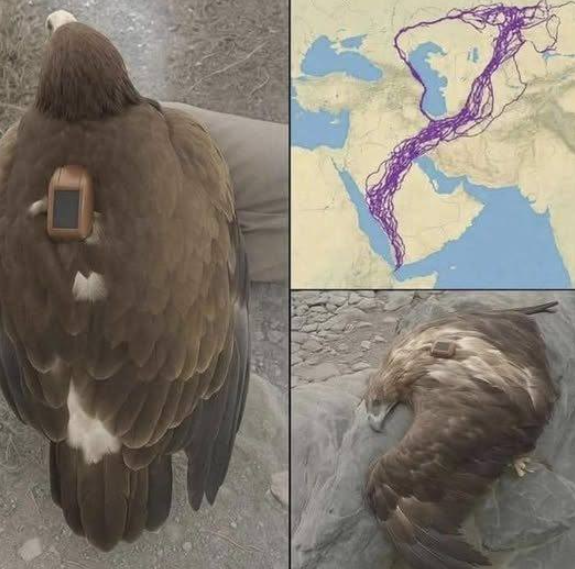
For 20 years, an eagle equipped with GPS puzzled scientists: the data simply didn’t make sense.
The project began in the early 2000s, when a team of researchers from the Smithsonian Institution partnered with conservation biologists in Mongolia to study the migration of the Golden Eagle. At the time, GPS tracking technology was still relatively new in wildlife research. The goal was straightforward: understand migration routes, breeding grounds, and survival rates to better protect the species.
One eagle in particular — tagged as GE-21 — would soon become the most mysterious bird in the study.
GE-21 was fitted with a lightweight solar-powered GPS transmitter near the Altai Mountains. The device was designed to record location data every few hours and transmit it via satellite. The expectation was that the eagle would follow predictable seasonal patterns: north in the spring, south in the winter.
But from the very first year, GE-21 refused to follow expectations.
While other tagged eagles migrated in relatively consistent arcs across Central Asia, GE-21’s movements were erratic. Instead of taking established flyways, the eagle veered hundreds of miles off course, sometimes doubling back on its own path. It crossed into remote stretches of Russia, dipped unexpectedly toward western China, and once transmitted a signal from a location so isolated that researchers initially suspected a device malfunction.
They recalibrated the data.
They checked for satellite error.
They even considered the possibility that the transmitter had detached and was being carried by another animal or human.
But the signal kept moving — and always in patterns that suggested intentional flight.
Over the next several years, GE-21 became something of a legend within the research team. Graduate students wrote theses attempting to decode its routes. Some theorized that the eagle was avoiding competition. Others speculated that it had imprinted on an unusual early-life migration path and simply never corrected course.
The strangest pattern emerged in year five.
Every autumn, GE-21 paused for nearly three weeks in the same remote valley — a place far from known feeding grounds and with little recorded eagle activity. Satellite imagery revealed sparse vegetation and rugged cliffs, but nothing that obviously explained the repeated stop.
Was there an undiscovered food source? A microclimate? An uncharted nesting site?
Researchers organized an expedition.
Reaching the valley was not easy. The terrain was harsh, accessible only by horseback and days of hiking. When the team finally arrived, they found no obvious signs of large prey populations or eagle colonies. But they did notice something remarkable: the cliffs were etched with ancient petroglyphs, and scattered nearby were the remains of old hunting camps used by nomadic herders.
It was a place where humans and eagles had intersected for centuries.
In Mongolia’s traditional practice of eagle hunting, golden eagles are trained to hunt foxes and other small mammals. The bond between hunter and bird is deep and highly respected. Although GE-21 showed no signs of captivity, researchers began to wonder whether its migration path followed historical human routes rather than purely ecological ones.
Over time, the eagle’s path revealed something subtle.
When mapped against historical trade and nomadic routes — including segments of the ancient Silk Road — GE-21’s irregular loops began to align with valleys and passes long used by travelers. It was as though the bird was navigating corridors shaped by geography and history rather than modern conservation maps.
For two decades, GE-21 survived harsh winters, shifting climates, and expanding human development. Other tagged eagles disappeared from the dataset — victims of natural causes, poaching, or transmitter failure. But GE-21 kept transmitting.
Year after year.
Its consistency in longevity was as puzzling as its routes. Golden eagles can live long lives in the wild, but surviving two decades while traveling such unpredictable distances was extraordinary.
In year fifteen, the data showed something unexpected.
GE-21 began mentoring.
Not literally, of course — but its GPS track overlapped repeatedly with that of a younger tagged eagle introduced into the study. The younger bird initially followed more conventional migration routes. Then, gradually, its path began to mirror GE-21’s unusual detours.
Scientists debated whether this was coincidence or evidence of social learning. While golden eagles are typically solitary, younger birds sometimes observe and adapt behaviors from experienced individuals. Could GE-21’s knowledge of remote valleys and hidden thermals be influencing a new generation?
The final breakthrough came not from fieldwork, but from improved technology.
Advancements in satellite imaging allowed researchers to analyze wind currents and thermal updrafts in unprecedented detail. When GE-21’s routes were overlaid with decades of atmospheric data, a pattern emerged: the eagle’s “erratic” movements closely followed optimal wind corridors — invisible highways of rising warm air that minimized energy expenditure.
What had appeared random was, in fact, brilliant efficiency.
GE-21 wasn’t lost.
It was conserving energy in ways scientists hadn’t yet understood when the study began.
The repeated autumn stop in the remote valley also made sense. The cliffs created consistent thermals even during seasonal transitions, offering a reliable resting point before longer flights.
After 20 years, the once-puzzling data became a testament to adaptability.
In the twentieth year of tracking, GE-21’s transmitter finally fell silent. No dramatic final spiral, no abrupt anomaly — just a gradual cessation of signals in the Altai region where the story had begun.
Researchers never recovered the device. They assume the eagle likely reached the end of its natural lifespan.
Today, GE-21’s dataset remains one of the most studied in avian migration research. It reshaped how scientists understand flight efficiency, habitat use, and the subtle interplay between geography, climate, and instinct.
More than that, it reminded researchers of something humbling: nature often operates with a logic we don’t immediately recognize.
For two decades, an eagle puzzled scientists.
In the end, it wasn’t the bird that was unpredictable.