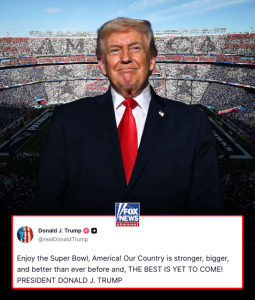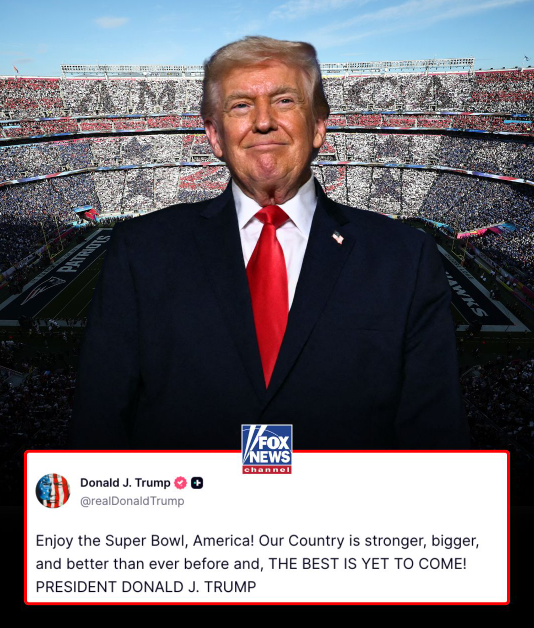
San Francisco / National Desk — In a widely-seen social media statement tied to Super Bowl LX, President Donald Trump offered a patriotic message celebrating the United States and expressing optimism for the nation’s future — even as he chose not to attend the championship game in person.
As millions of Americans tuned in to watch the Seattle Seahawks and New England Patriots face off at Levi’s Stadium in Santa Clara, California, Trump took to his platform Truth Social to urge viewers to “Enjoy the Super Bowl, America!” and emphasized national strength and promise. In the message, he said the United States is “stronger, bigger, and better than ever before,” and that “the best is yet to come.”
This statement came shortly before kickoff of Super Bowl LX — one of the most-watched sporting events of the year — and was shared widely across social media platforms in real time. It reflects a deliberate shift to highlight unity and national pride during a unifying cultural moment for many Americans.
A Message of American Strength and Optimism
Trump’s message linked the Super Bowl — often described as a uniquely American tradition — with broader themes of national resilience and optimism. Although the NFL title game is first and foremost a sports spectacle, presidents often use major cultural events to place themselves within national narratives. Trump’s message underscored themes familiar from his political rhetoric: economic success, national prominence on the global stage, and faith in American potential.
By declaring the U.S. stronger and better than ever, he echoed language seen in previous public remarks and speeches in which he emphasized national pride and future optimism. His phrase “the best is yet to come” has also appeared in earlier political messaging from Trump and his supporters, reinforcing a narrative of forward momentum.
Context: Trump Skips the Game, Critiques the Halftime Show
While the president offered a broadly affirming message to viewers, he also made headlines for what he didn’t do: attend the Super Bowl. Trump had publicly said he would not be traveling to the event, which drew attention given that previous presidents have sometimes attended in person.
Instead, Trump used his platform to also criticize the Super Bowl’s halftime performance — a major cultural moment within the broadcast — particularly focusing on Bad Bunny’s set, which he described as “absolutely terrible” and “a slap in the face to America.” Those sharp comments contrasted with the positive tone of his Super Bowl message and sparked widespread discussion on social media.
His dual approach — praising the country while critiquing parts of the event — illustrates the sometimes-polarizing way political leaders engage with national cultural institutions like the NFL and its flagship championship.
Public and Political Reaction
Reactions to Trump’s statement have varied widely. Supporters echoed his message of national pride and optimism, sharing the message as an example of presidential leadership and forward-looking confidence. Many highlighted the celebration of American institutions and the unity of tens of millions watching together.
Critics, however, focused on the juxtaposition of praise for the country with the attacks on the halftime show and media. Some commentators argued that the negative commentary detracted from the more positive elements of his message, while others noted it contributed to ongoing cultural debates around language, representation, and what constitutes American identity.
Meanwhile, former President Barack Obama — who was not in attendance either — issued his own congratulatory remarks following the Seahawks victory, framing the game results in terms of competitive achievement and community spirit rather than political commentary.
Why the Super Bowl Matters Politically
The Super Bowl is more than a football game in American culture; it’s a social phenomenon that draws attention to broader themes such as community, entertainment economics, and national identity. Presidents from both parties have historically used big-stage events — from Thanksgiving parades to championship games — as opportunities to communicate with wide audiences. Trump’s message is no exception: by aligning himself with national pride and future optimism, he entered a cultural conversation extending beyond sports.
His remarks tapped into long-standing themes in American political rhetoric — strength, greatness, and confidence in the nation’s trajectory — while also engaging in a cultural debate about art, performance, and representation that played out alongside the game itself.
Looking Ahead
As the nation continues to digest the outcomes of Super Bowl LX and the conversations it spawned, Trump’s message — with its blend of affirmation and critique — is likely to remain a focal point of political and cultural discussion. Whether supporters see it as a rallying message about national vitality or critics view it as politically charged commentary, the statement reflects how major cultural moments like the Super Bowl can serve as a broad platform for leaders to connect with the public and shape narratives about the country’s present and future.
Summary:
President Trump used the Super Bowl platform to deliver a message celebrating American strength and expressing optimism about the future, while also engaging in cultural critique of the halftime show. This combined approach drew praise from supporters and criticism from opponents, illustrating the ongoing intersection of politics, culture, and national identity