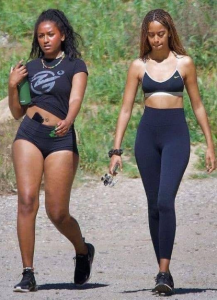
Malia and Sasha Obama, Drake, and the Internet’s Favorite Kind of Story: What Really Happens When Politics, Celebrity, and Youth Culture Collide
Every few months, the internet lights up with a familiar kind of headline: “So-and-so’s kids spotted partying with famous rapper.” When the names involved are Malia and Sasha Obama—and the rapper is Drake—the story spreads even faster. It hits all the buttons: fame, power, youth, music, and curiosity about how the daughters of a former U.S. president live their lives now that they’re adults.
But behind the clickbait tone and breathless posts, there’s a more interesting—and more human—story about growing up in public, navigating freedom after an extraordinary childhood, and what it really means when young adults move through celebrity spaces.
From the White House to the Real World
Malia and Sasha Obama didn’t have a normal upbringing. From the time they were 10 and 7 years old, their home was the White House. Their backyard was the South Lawn. Their dad was the most powerful man in the world. Their every move was watched, documented, and debated.
And yet, their parents were deliberate about giving them as much normalcy as possible. They went to school. They had friends. They did chores. They were told “no.” They were kept mostly out of the spotlight—no flashy social media presences, no child-star branding, no forced public personas.
So when people see photos or hear stories about Malia and Sasha in adult spaces—concerts, clubs, private parties—it can feel shocking. Not because they’re doing anything wrong, but because people still picture them as “the Obama girls” in matching coats on Inauguration Day.
In reality, they’re just… women in their twenties now.
The Drake Angle: Why It Went Viral
Drake is one of the most recognizable artists on the planet. He’s known not just for music, but for his presence in elite social circles: athletes, models, fashion figures, Hollywood actors, and yes—people with political connections.
So when rumors or sightings circulate suggesting Malia and Sasha were at the same party or event as Drake, the internet goes wild. Not because there’s necessarily anything meaningful about it, but because it feels like worlds colliding:
• The White House meets hip-hop
• Politics meets pop culture
• Presidential daughters meet global rap star
It’s irresistible to social media.
But “partying with” in internet language often means something very loose. It might mean:
• Being at the same event
• Attending the same after-party
• Being in the same VIP area
• Existing in the same room
Not necessarily dancing together, hanging out one-on-one, or having any kind of relationship at all.
In celebrity culture, proximity gets exaggerated into connection.
Growing Up Means Claiming Your Own Identity
One of the hardest things for public figures’ children is this: you don’t get to grow into yourself privately.
Every step Malia and Sasha take is interpreted symbolically:
• What they wear becomes a statement
• Who they’re seen with becomes a headline
• Where they go becomes a judgment
But the truth is, part of becoming an adult is experimenting with environments, culture, and social spaces. College. Music. Fashion. Nightlife. Art scenes. None of that is radical. It’s normal.
What’s unusual is that for them, “normal” gets framed as news.
So if Malia and Sasha attend a party where Drake is present, it doesn’t mean they’ve entered some scandalous world. It means they’re living in cities like Los Angeles and New York, where music, film, fashion, and politics overlap constantly.
That’s not rebellion. That’s geography.
Why People Care So Much
There’s a strange emotional attachment many Americans still have to the Obama family. For some, they symbolize hope. For others, controversy. For many, nostalgia. So seeing Malia and Sasha as adults feels personal to people who watched them grow up on TV.
They want them to be:
• “Classy”
• “Role models”
• “Different”
• “Above” celebrity culture
But that’s an unfair burden to put on anyone—especially two women who never asked to be symbols.
They didn’t choose their father’s job.
They didn’t choose global visibility.
They didn’t choose to represent anything beyond themselves.
Yet every photo of them gets interpreted as either proof they’re “doing great” or “going astray.” As if there’s no room for them to simply… live.
Drake as a Cultural Bridge
Drake’s presence in these stories isn’t accidental. He represents something specific in modern culture: crossover.
He’s not just a rapper. He’s:
• Mainstream but edgy
• Emotional but powerful
• Commercial but respected
• Hip-hop but global
So when his name is linked to political figures’ kids, people read it as symbolic. It feels like a sign that culture has shifted—that the lines between “establishment” and “pop culture” are blurrier than ever.
In reality, those lines disappeared a long time ago.
Presidents listen to music.
Artists talk politics.
Actors become activists.
Politicians appear on podcasts.
And yes—politicians’ kids go to parties where artists are.
That’s not scandal. That’s modern life.
The Double Standard for Young Women
There’s another layer here: gender.
When young women are seen in nightlife spaces, the tone shifts fast. Words like:
• “Partying”
• “Wild”
• “Out of control”
• “Reckless”
get used in ways they rarely do for men.
If a former president’s son was seen at a party with a famous artist, it would probably be framed as:
• Networking
• Being cool
• Living his life
For Malia and Sasha, it becomes:
• Are they okay?
• Are they being influenced?
• Are they losing their values?
That’s not about them. That’s about society’s discomfort with women having autonomy.
What the Story Really Is
So what’s the real story behind “Malia and Sasha Obama party with Drake”?
It’s not scandal.
It’s not rebellion.
It’s not political.
It’s not moral decline.
It’s this:
Two young women who grew up under the most intense public microscope imaginable are now adults, living their own lives, in cities where art, fame, and politics naturally overlap.
And sometimes, that means being in the same room as Drake.
That’s it.
No deeper conspiracy.
No shocking transformation.
No betrayal of anything.
Just people existing in the world they’re actually part of—not the one people still imagine them frozen in from 2009.
Let Them Be Human
Malia and Sasha Obama don’t need to be perfect.
They don’t need to be symbols.
They don’t need to represent anyone’s fantasy of what presidential daughters “should” be.
They’re allowed to:
• Go out
• Have fun
• Be young
• Make mistakes
• Enjoy music
• Move through culture like anyone else their age
And if that includes being at the same party as one of the biggest artists in the world, that’s not news.