THIS MORNING: China Challenged the U.S. Navy in the Contested Waters of Southeast Asia — And Learned a Brutal Lesson
In the strategically vital waters of the South China Sea, a simmering confrontation between China and the United States escalated into a high-stakes naval encounter that reverberated throughout the region and across global capitals. What began as routine patrols and freedom-of-navigation operations turned into a stark demonstration of maritime power, diplomatic resolve, and the limits of unilateral assertions.
The Setting: A Contested Maritime Theater
The South China Sea is one of the most geopolitically sensitive bodies of water on the planet. It is traversed by trillions of dollars in global trade annually, and multiple nations lay overlapping claims to its islands, reefs, and maritime zones. China asserts sweeping sovereignty over nearly the entire sea under its “nine-dash line” claim, a position rejected by international arbitration but still enforced aggressively by Beijing. Neighboring claimant states include the Philippines, Vietnam, Malaysia, Brunei, Taiwan, and Indonesia, each with competing rights under international law.
Within this environment, the United States conducts so-called freedom-of-navigation operations (FONOPs) to challenge what it sees as excessive maritime claims and to assert the right of all nations to operate in accordance with international law. These missions are not new — the U.S. has routinely sailed warships and flown aircraft throughout the region for decades — but the stakes have grown as China’s military capabilities have rapidly expanded.
What Happened: A Close Encounter at Sea
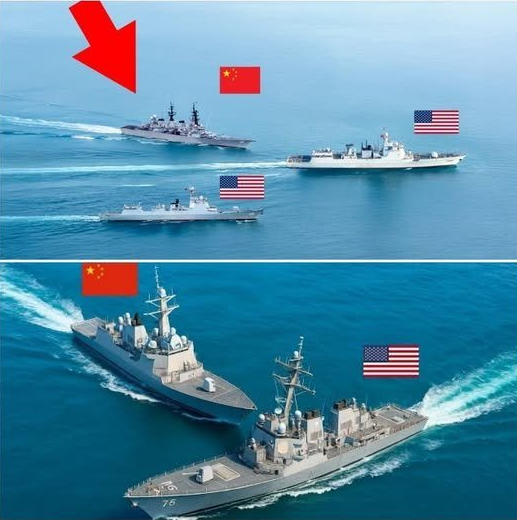
In mid-August 2025, a pair of U.S. Navy warships — the guided-missile destroyer USS Higgins and the littoral combat ship USS Cincinnati — sailed within roughly 30 nautical miles of Scarborough Shoal, a disputed maritime feature off the northwest Philippines. This proximity followed a highly visible incident in which two Chinese vessels collided with each other while attempting to block a smaller Philippine Coast Guard ship near the same shoal.
China’s Southern Theater Command claimed its forces had “tracked, monitored, issued warnings, and expelled” the U.S. destroyer, accusing the American ships of violating Chinese sovereignty. Beijing’s state media published footage and commentary asserting that the U.S. had been driven away from waters it considers its own.
The U.S. Navy, however, denied these claims, stating that the operations were lawful, consistent with international maritime rights, and aimed at upholding navigational freedoms. It also emphasized that China’s characterization of the events was false and that the movement of American vessels was lawful.
A Collision of Forces — And Narratives
This encounter involved not just ships but also competing narratives about who has authority in these waters.
From China’s perspective:
-
The operation was a violation of its claimed territorial waters.
-
Beijing framed the U.S. presence as coercive and destabilizing.
-
Chinese official commentary accused the U.S. of “provocation” and alleged that America was leveraging international law for geopolitical advantage.
From the U.S. view:
-
China’s territorial assertions lack basis under widely accepted international law, particularly the 1982 United Nations Convention on the Law of the Sea (UNCLOS).
-
Freedom-of-navigation patrols are necessary to ensure that no country can unilaterally restrict lawful maritime activity.
-
The U.S. reaffirmed its commitment to defend treaty allies in the region, particularly the Philippines under the Mutual Defense Treaty, which includes obligations if Philippine forces are attacked.
The clash did not erupt into full-blown combat, but the strategic tension and close maneuvers — including the risk of collisions and miscalculations — made the encounter one of the most perilous in recent years.
Why China’s Challenge Was a Strategic Miscalculation
Analysts argue that China learned hard lessons from the episode — not just about military confrontation on the water but also about diplomacy, credibility, and regional alliances.
1. Overplaying Maritime Assertiveness Can Backfire
China’s attempt to assert control over contested areas resulted in a collision between Chinese ships — an embarrassing mishap that highlighted the risks of aggressive maneuvers at sea. A China Coast Guard cutter and a People’s Liberation Army Navy warship reportedly collided while pursuing a Philippine patrol vessel.
This incident exposed the dangers inherent in overt pressure tactics and confirmed to regional observers that Beijing’s assertive posture could be counterproductive.
2. Reinforcing U.S. Alliances Instead of Deterring Them
Rather than deterring U.S. involvement, China’s assertiveness has strengthened alliances between the U.S., the Philippines, Japan, and other Indo-Pacific partners. Joint naval drills, task forces, and security commitments have deepened cooperation among these states, designed to bolster deterrence against coercive actions.
The U.S., by deploying warships and affirming its right to operate, signaled its readiness to stand by allies and uphold international norms — a message that resonated with ASEAN member states watching the developments closely.
Military Readiness vs. Diplomatic Risks
China’s military also faces the challenge of balancing power projection with risk management. While Beijing has expanded its navy and aircraft carriers, the South China Sea remains a complex operational environment with high risks for accidents, miscommunication, and unintended escalation. Independent commentary from Chinese experts suggested that repeated high-intensity operations could strain U.S. capabilities — a narrative aimed at turning mishaps into strategic arguments — but such claims also reflect broader anxieties about sustained naval operations in contested spaces.
Meanwhile, incidents like the collision and close encounters at sea heighten the potential for miscalculation — a dangerous scenario given that both sides operate large, sophisticated fleets with overlapping missions in a congested maritime environment.
Economic Stakes and Strategic Posturing
The South China Sea is not just a geopolitical flashpoint — it’s a critical artery of global commerce. Shipping lanes through the region carry about a third of global maritime traffic, and the sea is thought to harbor vast reserves of oil and natural gas. Control over these waters would bolster any nation’s geopolitical influence significantly.
That’s why both China and the U.S. see the region as pivotal — for China’s rise as a regional power and for the U.S. to maintain a free and open Indo-Pacific.
Lessons Learned — For China and the Region
Lesson 1: Assertiveness Has Limits
China’s naval challenge did not deter U.S. operations; it highlighted that outward shows of force do not necessarily translate into strategic gains, especially when faced with coordinated regional partners.
Lesson 2: Missteps Amplify Rival Narratives
Operational errors — like the collision between Chinese vessels — create openings for rival interpretations and weaken the perception of disciplined command at sea.
Lesson 3: Regional Alliances Strengthen in Response
Rather than isolating U.S. presence, Beijing’s actions have underscored the value of alliances and cooperative security frameworks among regional states.
Lesson 4: Legal and Diplomatic Frameworks Still Matter
International law, particularly UNCLOS and freedom-of-navigation principles, remains a critical reference point in these disputes, shaping how actions are perceived internationally and legally.
Conclusion: A Watershed Moment in Maritime Competition
This recent South China Sea encounter was more than a naval standoff — it was a lesson in the limits of force, the power of alliances, and the complexities of modern maritime strategy. China’s challenge to the U.S. Navy did not yield the diplomatic or strategic gains Beijing may have sought. Instead, it reaffirmed the presence and resolve of the U.S. and its partners in contested waters where the rules of navigation, the rights of nations, and the future of regional stability continue to collide.