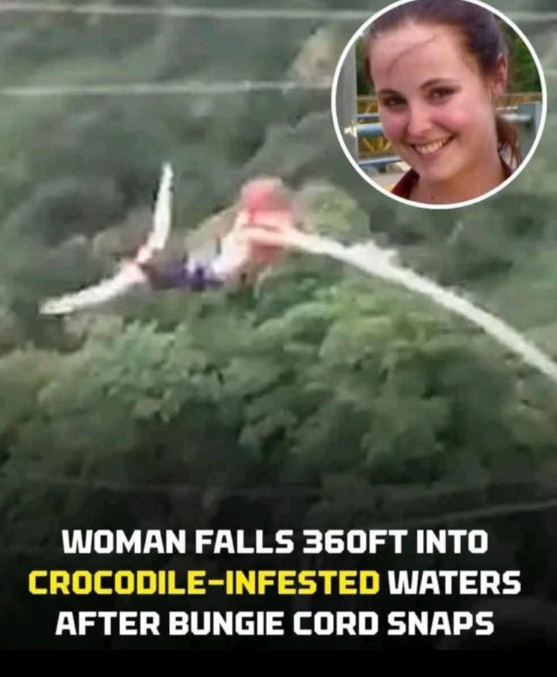
Woman Falls 360 Feet Into Crocodile-Infested Waters After Bungee Cord Snaps
What began as an adrenaline-fueled adventure turned into a nightmare when a young woman plunged an estimated 360 feet into a crocodile-infested river after her bungee cord snapped mid-jump. The shocking incident has reignited global conversations about extreme sports safety, risk management, and the thin line between thrill and tragedy.
The woman, traveling as part of a tour group, had signed up for a bungee jump marketed as one of the highest in the region. The platform towered above a wide, muddy river known to be home to large crocodiles. For many thrill-seekers, that setting only heightens the excitement: the sense of standing at the edge of the world, heart pounding, wind rushing past your ears, with nothing but a cord and gravity to guide you back.
Witnesses say she appeared calm as staff secured her harness and attached the bungee cord. She took a deep breath, leaned forward, and jumped.
Seconds later, disaster struck.
Instead of the familiar snap-and-rebound of a successful bungee jump, the cord failed. The woman continued to fall—far beyond what anyone expected—until she slammed into the river below. Spectators froze. For a brief moment, there was stunned silence, followed by screams as people realized what had just happened.
Falling 360 feet is not just a drop—it’s a near free-fall at lethal speed. Impacting water from that height can feel like hitting concrete. The fact that she survived at all is astonishing.
A Fight for Survival
After hitting the water, the woman was reportedly unconscious for several seconds. When she came to, she found herself injured, disoriented, and floating in a river notorious for crocodiles. Her survival instincts kicked in.
With broken bones, deep bruises, and possibly internal injuries, she began to swim—slowly and painfully—toward the riverbank. Witnesses on the platform shouted and pointed, urging her to keep moving. Some reportedly saw crocodiles in the distance, though none approached her during the ordeal.
Every stroke she took was a battle against pain, shock, and fear.
Eventually, she reached the shore, where bystanders and staff rushed to help her out of the water. Emergency services were called immediately. She was transported to a hospital with serious but non-life-threatening injuries. Doctors later said her survival was “nothing short of miraculous.”
How Could the Cord Snap?
The central question after any such incident is: How did this happen?
Bungee cords are designed with extreme stress tolerances. They are tested, inspected, and rated to hold far more weight than a single jumper exerts. A failure like this usually points to one—or a combination—of the following:
-
Equipment Defect:
The cord may have had internal damage not visible from the outside. Over time, wear, moisture, UV exposure, and repeated stretching can weaken fibers. -
Improper Maintenance:
If safety gear isn’t regularly inspected, logged, and replaced on schedule, even small flaws can become catastrophic. -
Human Error:
Mistakes in attaching the cord, miscalculating length, or failing to double-check connections can be fatal. -
Operational Negligence:
In some cases, companies cut corners to save money—reusing cords too long or skipping safety checks.
Investigators reportedly seized the equipment and suspended operations at the site while authorities reviewed safety protocols.
The Psychology of Extreme Risk
Why do people sign up for things like this?
For many, bungee jumping isn’t about recklessness—it’s about conquering fear. Standing on a platform hundreds of feet above the ground forces you to confront the most primal instinct: don’t fall. Jumping anyway feels like winning a battle against your own mind.
But thrill culture often hides how dependent these experiences are on flawless systems. The illusion is that you’re risking your life. The reality is that you’re trusting strangers, machines, and procedures with it.
When one link in that chain breaks, the risk becomes very real.
The Aftermath
In the days following the incident, social media exploded with reactions. Some praised the woman’s courage and resilience. Others questioned why jumps over crocodile-infested rivers are allowed at all. Many demanded stricter regulation of adventure tourism companies.
Legal action is likely. In similar past cases, victims have sued operators for negligence, unsafe practices, and emotional trauma. Even when companies require waivers, those documents rarely protect them if gross negligence is proven.
The woman herself has not given a detailed public statement yet, but friends say she is grateful to be alive and still processing what happened.
A Wake-Up Call for Adventure Tourism
This story isn’t just about one terrifying fall—it’s about the growing industry of extreme experiences sold to travelers around the world. From skydiving to cliff jumping to cage diving with sharks, these activities promise unforgettable memories. And they often deliver.
But they also demand something non-negotiable: absolute commitment to safety.
That means:
• Certified equipment
• Daily inspections
• Transparent maintenance logs
• Highly trained staff
• Clear emergency protocols
When profit outweighs precaution, accidents stop being “freak” and start being predictable.
Final Thoughts
The image of a woman plunging 360 feet into crocodile-infested water because a single cord failed is haunting. It reminds us how quickly thrill can turn into terror—and how survival sometimes depends on nothing more than luck and sheer willpower.
She jumped for the rush.
She fell into a fight for her life.
And against all odds, she lived to tell the story.