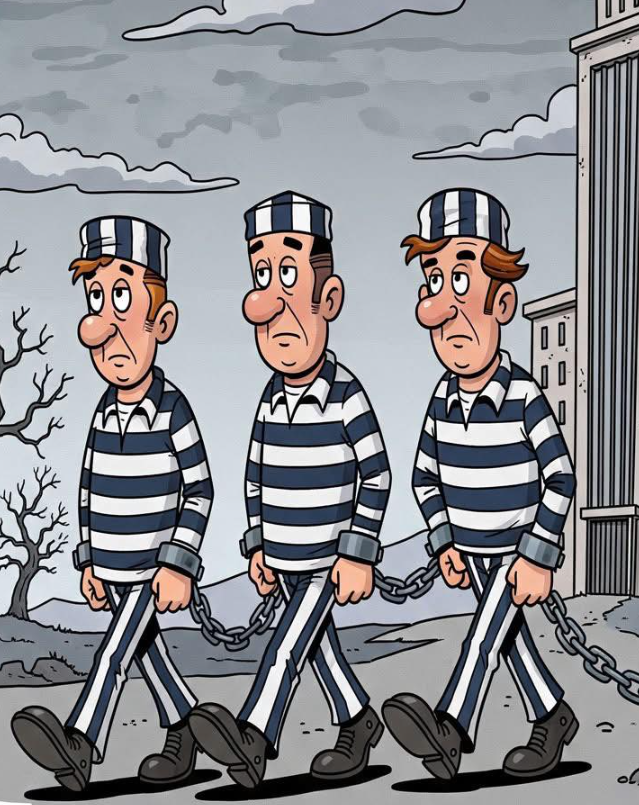
 Three Convicts Were on the Way to Prison
The prison transport van moved slowly along the narrow highway, its tires humming against the cracked asphalt as the sun climbed higher in the sky. Inside the metal cage sat three convicts, each bound by handcuffs, each lost in his own thoughts. Though they shared the same destination, their paths to this moment could not have been more different.
The first was Marcus Hale, a man in his early forties with tired eyes and graying stubble. He stared through the small barred window, watching fields blur past. Marcus had once been a respected construction supervisor, a father of two, and a man known for his quiet reliability. But one bad decision—cutting corners to meet deadlines—had led to a fatal accident at a worksite. The court called it criminal negligence. Marcus called it a mistake he would replay in his mind for the rest of his life.
Next to him sat Eli Brooks, only twenty-two, his leg bouncing nervously as the van rattled forward. Eli had grown up in and out of foster homes, learning early that survival often meant bending rules. What began as petty theft escalated into armed robbery when desperation outweighed fear. No one was physically harmed, but the judge made an example of him. Eli clenched his jaw, wondering if prison would finish what the streets had started—or finally force him to grow up.
The third man was Raymond “Red” Collins, a seasoned criminal with deep wrinkles carved into his face like old road maps. Red had been in and out of prison since the 1980s. He carried himself with a calm confidence, as if prison were merely another stop along a familiar route. He leaned back against the van wall, eyes half-closed, humming softly.
“First timers?” Red asked casually, breaking the silence.
Marcus didn’t answer. Eli nodded once.
“Figured,” Red said. “You can smell fear before it speaks.”
Eli bristled. “I ain’t scared.”
Red smiled without humor. “Everyone is. The smart ones just don’t lie about it.”
The van hit a bump, jolting them forward. The guard in front didn’t turn around. To him, they were cargo—paperwork with pulses.
Miles passed. Heat built inside the vehicle, thick and suffocating. Sweat rolled down Marcus’s neck, and memories flooded his mind: his wife’s face in the courtroom, his daughter crying, his son refusing to look at him. Prison wasn’t just a sentence—it was separation from everything that made life meaningful.
Eli’s thoughts raced differently. He wondered what kind of man he would be when he came out—if he ever did. Prison felt like a giant pause button, except life outside wouldn’t wait for him. Friends would move on. Streets would change. He feared becoming irrelevant, forgotten.
Red, on the other hand, remembered prisons like landmarks. Each one had taught him something—who to trust, who to avoid, how silence could be a weapon. Yet even Red felt something unfamiliar that day. He was older now. His body didn’t heal like it used to. He wondered if this sentence would be his last ride.
Suddenly, the van slowed.
Up ahead, traffic had stopped. An accident blocked the road—twisted metal, flashing lights, sirens screaming in the distance. The driver cursed under his breath. The guard radioed in for instructions.
Minutes stretched into an hour.
Inside the van, tension grew.
“This ain’t normal,” Eli muttered.
Red opened his eyes fully now. “Nothing ever is.”
As they waited, Marcus noticed something strange. One of his cuffs felt loose. He shifted slightly, testing it. The metal slid more than it should. His heart pounded. Was this a mistake? A chance?
He looked at the others. Eli noticed too.
“You feel that?” Eli whispered.
Red’s eyes narrowed. He glanced down, then smirked. “Well I’ll be damned.”
For a moment, the idea hung in the air—escape.
The van doors were locked, guards alert, and helicopters circled overhead from the crash site. Any attempt would likely end badly. Marcus swallowed hard.
“I can’t,” he said quietly. “I did wrong. I need to pay.”
Eli hesitated. Freedom called to him like a siren. But Red shook his head.
“Running just adds years,” Red said. “Trust me. I’ve done the math.”
The moment passed. Marcus adjusted the cuff back into place, forcing it tighter. Eli exhaled, his shoulders slumping.
Soon, traffic cleared. The van rolled forward again, carrying them closer to concrete walls and steel doors.
When the prison finally came into view, looming and gray against the sky, silence returned.
As the doors opened and guards ordered them out, Marcus straightened his back. Eli lifted his chin. Red stepped forward calmly.
Three convicts. One destination. Three lives forever changed—not just by the crimes they committed, but by the choices they made even after the sentence was handed down.
Sometimes, the real prison isn’t the place you’re sent to.