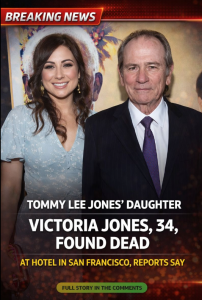
When a Headline Creates Panic Before Truth Exists
In recent years, sensational headlines involving celebrities and their families have exploded across social platforms. They often follow the same formula:
-
A recognizable name
-
A tragic implication
-
A cut-off sentence (“was found dead on…”)
-
No source, no date, no confirmation
By the time readers click, share, or comment, the emotional damage is already done — even if the story turns out to be false.
In this case, no major news outlet, law enforcement agency, medical examiner, or family representative has confirmed such an event involving Victoria Jones. That absence is critical. When a death involving a public figure’s immediate family occurs, it does not remain hidden.
Why These Stories Feel So Believable
Tommy Lee Jones is a globally recognized actor, known for intense, emotionally grounded performances. Because audiences associate him with gravity and seriousness, a tragic headline involving his family feels plausible — even without evidence.
But plausibility is not proof.
Social media algorithms reward shock, not accuracy. A tragic claim involving a famous name spreads faster than a correction ever could.
The Human Cost of Viral Falsehoods
False death reports are not harmless gossip.
They cause real harm:
-
Families receive calls, messages, and condolences for something that never happened
-
Individuals are forced to prove they’re alive
-
Emotional distress spreads to friends, fans, and loved ones
-
Reputations are dragged into fabricated tragedy
In some cases, people have learned they were “dead” through Twitter before hearing from a relative.
That is not journalism — it’s digital recklessness.
How to Tell If a Tragic Celebrity Story Is Real
Before believing or sharing a headline like this, check for these signals:
-
Source clarity
Is the report coming from a recognized outlet (AP, Reuters, major newspapers), or a faceless page? -
Specifics
Real reports include dates, locations, official statements, and named authorities. -
Multiple confirmations
Major tragedies are reported by more than one credible source. -
Language tone
Phrases like “See more,” “You won’t believe,” “This is shocking,” are red flags.
In this case, none of the credibility markers are present.
The Responsibility of Readers
The internet has turned every user into a distributor. Sharing an unverified tragedy — even “just in case” — contributes to harm.
Pausing is powerful.
Asking “Who confirmed this?” matters.
Refusing to amplify uncertainty protects real people from manufactured grief.
What We Actually Know
-
Tommy Lee Jones is alive
-
There is no verified reporting confirming the death of his daughter
-
No official statements exist
-
No law enforcement records support the claim
-
No reputable media outlet has published such a report
Until those facts change — and there is no indication they have — the story should be treated as false or unverified rumor, not reality.
Why This Pattern Keeps Repeating
These headlines thrive because they exploit three things:
-
Emotional vulnerability
-
Familiar names
-
Algorithm-driven outrage
They are designed to bypass reason and hit instinct.
The more dramatic the claim, the less likely people are to verify — and the more likely they are to share.
Final Thought
Tragedy deserves truth.
Real loss deserves dignity.
And people — famous or not — deserve not to wake up to the internet declaring them or their loved ones dead without evidence.