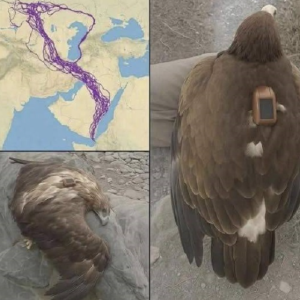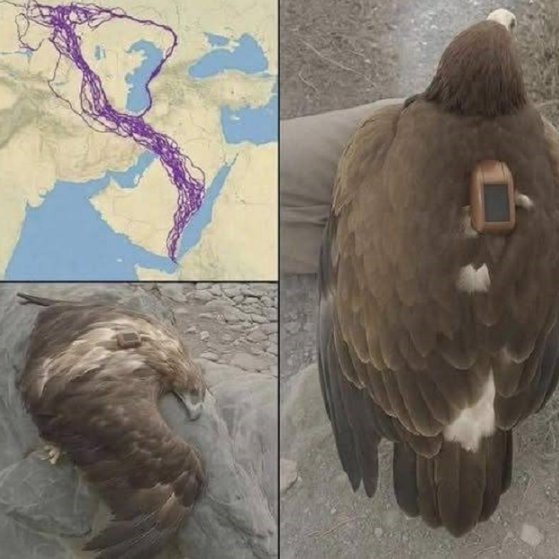
For nearly two decades, a single eagle fitted with a GPS tracker confounded scientists, redrew assumptions about migration, and quietly reshaped how researchers understand the secret lives of large raptors. What began as a routine tagging effort—one bird among many—turned into a long-running mystery that spanned continents, challenged models, and reminded biologists that even with satellites overhead, nature still keeps its own counsel.
A Routine Tag Becomes an Anomaly
The eagle was captured as part of a long-term monitoring program designed to answer straightforward questions: Where do eagles go when they migrate? How consistent are their routes? How do weather, food availability, and human activity affect their movements? The GPS unit—lightweight, solar-assisted, and designed to transmit precise locations—was expected to produce a neat line on a map, tracing familiar flyways and seasonal loops.
Instead, the data arrived looking wrong.
At first, the bird appeared to ignore established migration corridors. Rather than following the predictable north–south rhythm seen in most of its species, the eagle’s path zigzagged across regions scientists didn’t expect, lingering in places thought to be unsuitable and bypassing known feeding grounds altogether. Researchers double-checked the system. Was the unit malfunctioning? Were the timestamps corrupted? Was another bird carrying the transmitter?
Everything checked out.
Patterns That Refused to Behave
As years passed, the eagle’s movements grew even more perplexing. Some seasons it migrated early; others, it barely moved at all. One year it crossed vast distances in a matter of days, riding thermal currents with astonishing efficiency. Another year it remained almost sedentary, despite environmental cues—shortening days, dropping temperatures—that typically trigger migration.
The bird also showed an uncanny ability to exploit microclimates. When storms swept through a region, the GPS trace suggested the eagle slipped around the worst weather, threading between systems with a precision that seemed almost predictive. It would pause at odd locations—remote ridgelines, isolated wetlands—then depart suddenly, as if responding to opportunities invisible to human observers.
For scientists trained to find averages and general rules, this individual refused to cooperate.
A Window Into Individual Intelligence
Over time, the research team began to suspect that the puzzle wasn’t an error in the data but a feature of the bird itself. Eagles, it turns out, are not just instinct-driven migrants; they are learners. They remember landscapes, experiment with routes, and refine strategies across years. This eagle appeared to be an extreme case: an innovator.
By comparing its movements with weather records, prey surveys, and satellite imagery, scientists noticed correlations. The bird often arrived at feeding areas just as prey populations peaked. It seemed to anticipate seasonal pulses—fish runs, rodent booms, waterfowl congregations—arriving not by chance but by learned timing. Rather than following the crowd, it followed opportunity.
This behavior challenged a long-standing assumption in migration ecology: that individuals of a species behave more or less the same way. The eagle suggested otherwise. Individual experience could matter as much as species-level instinct.
Twenty Years of Survival
Perhaps the most astonishing aspect of the story was longevity. Eagles in the wild face countless risks—collisions, poisoning, habitat loss, severe weather. Yet this bird survived year after year, navigating changing landscapes and an increasingly human-dominated world. Its survival lent weight to the idea that its unconventional strategies were not reckless but adaptive.
As habitats shifted due to climate change, the eagle adjusted. When traditional stopover sites degraded, it found alternatives. When warming temperatures altered prey distributions, it altered its timing. The GPS data became a living record of resilience in an era of rapid environmental change.
Technology Meets Humility
The case also forced scientists to confront the limits of their tools. GPS trackers provide location, speed, and altitude, but they cannot tell us what an animal sees, hears, or decides in the moment. They cannot capture memory, curiosity, or learning. The elegant lines on a map, it turned out, were only shadows of a much richer internal process.
Researchers began to reanalyze older datasets with fresh eyes, looking for other “outliers” that might not be errors at all. In doing so, they uncovered hints that many animals—birds, mammals, even fish—may harbor far more individual variation than previously acknowledged.
Conservation Lessons Hidden in the Data
The eagle’s story carried practical implications. Conservation plans often rely on protecting key migration corridors and breeding grounds identified from average movements. But what about the innovators—the individuals that explore new routes and discover new habitats? These pioneers may be crucial for species survival in changing climates, leading populations to safer or more productive areas.
By highlighting the value of behavioral diversity, the GPS-tracked eagle underscored the need for flexible conservation strategies. Protecting only the “known” places may not be enough. The unknown, the unconventional, and the unexpected may matter just as much.
The End of the Mystery—and the Beginning of Insight
After nearly 20 years, the GPS signal finally fell silent. Whether the unit failed or the eagle’s long life came to a natural end, the data stream concluded as quietly as it had begun. Yet by then, the bird had already left an indelible mark on science.
What once seemed like a malfunction became a masterclass in humility. The eagle taught researchers that even with the most advanced technology, nature resists simplification. Patterns exist, but so do exceptions—and sometimes the exceptions are the key to understanding the whole.
In the end, the puzzling eagle did more than defy expectations. It expanded them, reminding us that wild animals are not just subjects of study but active agents, thinking, learning, and adapting in ways we are only beginning to appreciate