The Moment Anthony Joshua Knocked Out Jake Paul
The arena was already buzzing long before the opening bell, but there was a different kind of electricity in the air that night—an uneasy mix of spectacle and seriousness, hype and history. On one side stood Jake Paul, the social-media star turned prizefighter, confident, controversial, and fueled by a belief that he could bend the boxing world to his will. On the other stood Anthony Joshua, a former two-time heavyweight world champion, a man forged by Olympic gold, championship rounds, and the unforgiving reality of elite boxing. When they finally shared the ring, it felt less like an exhibition and more like a collision between two eras of the sport.
From the opening seconds, the contrast was impossible to miss. Joshua moved with calm efficiency, his posture relaxed but purposeful, eyes locked forward, reading every twitch and feint. Paul, by contrast, bounced with nervous energy, shoulders tight, chin tucked, clearly aware that this was not another step up—it was a leap into the deep end of boxing’s most dangerous waters.
The first round unfolded cautiously. Paul circled, pumping out a jab more to measure distance than to cause damage. Joshua barely reacted, parrying shots with minimal movement, conserving energy, letting the moment come to him. Each time Joshua stepped forward, the crowd roared, sensing the imbalance in power and experience. Paul landed a couple of glancing blows that did little more than brush Joshua’s guard, but they were enough to briefly ignite his confidence.
In the second round, Joshua began to close the distance. He didn’t rush. He never rushed. Instead, he applied pressure the way only a seasoned heavyweight can—cutting off the ring, forcing Paul toward the ropes, making him work harder for every inch of space. Paul’s breathing became more noticeable, his footwork less fluid. The gap between influencer boxing and championship boxing was widening in real time.
Then came the moment that changed everything.
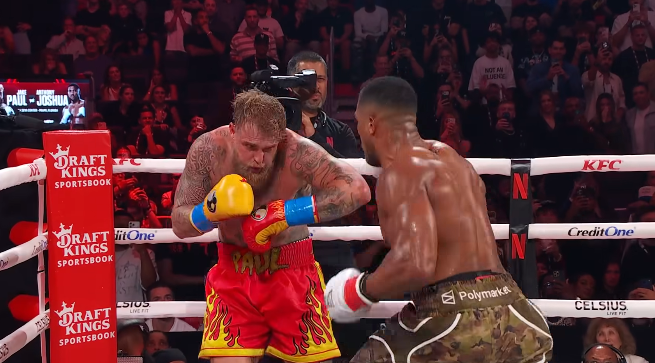
Midway through the round, Paul threw a looping right hand, hoping to catch Joshua off guard. It was the kind of punch that might work against less disciplined opponents—but Joshua saw it coming a mile away. He slipped just enough to avoid the full impact and fired back with a short, brutal counter left hook. The sound echoed through the arena like a gunshot.
Paul staggered.
For a split second, the world seemed to slow down. Paul’s knees dipped, his balance betrayed him, and the bravado that had carried him into the ring evaporated. Joshua didn’t celebrate. He didn’t rush wildly. He stepped in with cold precision, unleashing a combination that belonged to another level of boxing entirely—a straight right hand followed by a crushing uppercut that snapped Paul’s head back.
The referee watched closely as Paul tried to retreat, but there was nowhere left to go. His back brushed the ropes, his guard rose too late, and then it happened: Joshua’s right hand landed flush, perfectly timed, perfectly placed. Paul collapsed to the canvas, the impact sending a shockwave through the crowd.
The arena exploded.
Fans leapt to their feet in disbelief and awe as Paul lay on the mat, eyes unfocused, chest heaving as he struggled to process what had just happened. The referee immediately stepped in, waving off the fight. It was over. No count was needed. The message was clear.
Anthony Joshua stood in the center of the ring, breathing steadily, his expression composed—not triumphant, not cruel, just professional. He had done what champions do when faced with hype: he answered it with reality.
Medical staff rushed to Paul’s side as the crowd buzzed with mixed reactions. Some cheered loudly, vindicated in their belief that elite boxing cannot be shortcut. Others watched in stunned silence, realizing they had just witnessed the brutal difference between entertainment and elite competition. Paul eventually sat up, dazed but conscious, nodding slowly as he acknowledged the crowd. For all the controversy surrounding him, it took courage to step into that ring—and it took humility to face the outcome.
As Joshua raised his gloves briefly in acknowledgment, the symbolism of the moment settled in. This wasn’t just a knockout. It was a line drawn in the sand. A reminder that boxing, at its highest level, is unforgiving. That experience, discipline, and years of hard-earned lessons cannot be replaced by confidence alone.
In the post-fight atmosphere, analysts would debate what the fight meant—about crossover boxing, about celebrity influence, about the future of the sport. But in that single, decisive moment, none of that mattered. What mattered was what everyone had seen with their own eyes.