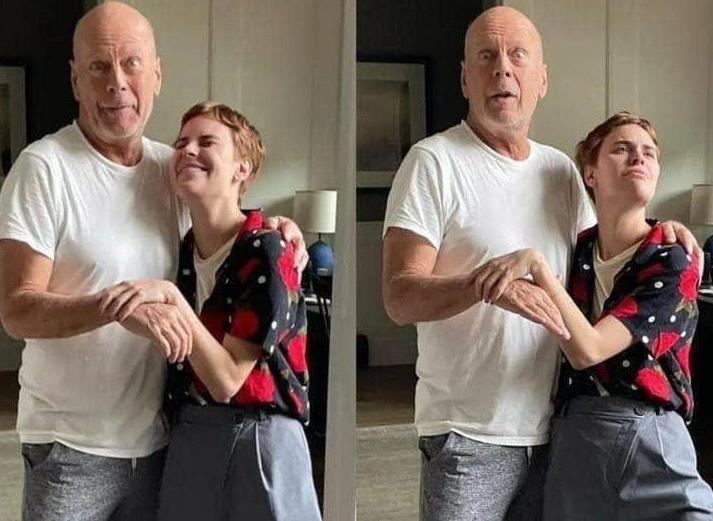
Bruce Willis Is No Longer Able to Communicate Verbally: Understanding His Condition and the Meaning Behind the Silence
For decades, Bruce Willis was known for his unmistakable voice — sharp, confident, and instantly recognizable. Whether delivering iconic one-liners in Die Hard, showing emotional depth in The Sixth Sense, or bringing quiet vulnerability to later roles, his voice was central to his presence as an actor. That is why recent updates about his health, particularly reports that he is no longer able to communicate verbally in the way he once did, have deeply moved fans around the world.
Bruce Willis’s health journey has been shared publicly by his family with honesty and care. While details are understandably limited, they have confirmed that his condition has progressed, and with that progression has come significant challenges with language and communication.
A Diagnosis That Changed Everything
In 2022, Bruce Willis’s family announced that he had been diagnosed with aphasia, a neurological condition that affects the brain’s ability to process language. Aphasia can impair speaking, understanding speech, reading, and writing. At the time, the diagnosis explained why Willis had been struggling with dialogue and communication during his final acting roles.
In early 2023, the family provided a more specific and devastating update: Bruce Willis had been diagnosed with frontotemporal dementia (FTD) — a rare and aggressive form of dementia that affects the frontal and temporal lobes of the brain. These regions control behavior, personality, decision-making, and language.
Unlike Alzheimer’s disease, which often begins with memory loss, FTD frequently begins with changes in speech, communication, and behavior. For many patients, language abilities decline early and progressively.
What “No Longer Able to Communicate Verbally” Really Means
When reports state that Bruce Willis is no longer able to communicate verbally, it does not mean sudden silence or total absence of awareness. Rather, it reflects the heartbreaking reality that spoken language — forming words, expressing thoughts aloud, or engaging in conversation — has become extremely limited or unavailable.
In frontotemporal dementia, the brain slowly loses its ability to organize language. Words may no longer come easily. Sentences may become fragmented. Eventually, speech may fade almost entirely. This is not because the person has nothing to say, but because the brain can no longer translate thoughts into words.
Importantly, family members and medical experts emphasize that nonverbal communication can still exist. Facial expressions, eye contact, touch, and emotional responses often remain meaningful long after speech declines.
The Emotional Impact on Family and Loved Ones
For Bruce Willis’s wife, Emma Heming Willis, and his daughters, the loss of verbal communication is not just a medical milestone — it is an emotional one. Conversation is how families connect, reminisce, joke, and express love. Losing that ability reshapes relationships in profound ways.
Emma has spoken openly about the grief that accompanies dementia — not just the grief of eventual loss, but the ongoing grief of watching someone you love slowly change. Each stage brings a new adjustment, a new heartbreak, and a new way of learning how to connect.
Despite this, the family has consistently emphasized love, presence, and dignity. They have made it clear that Bruce is surrounded by care, stability, and deep affection.
Why the Family Shares Updates at All
Bruce Willis’s family has chosen transparency not for attention, but for awareness. Frontotemporal dementia is far less understood than other forms of dementia, and many families face it in isolation.
By sharing Bruce’s journey, they have helped:
-
Educate the public about FTD
-
Reduce stigma around cognitive and communication disorders
-
Encourage compassion for caregivers
-
Show that even the strongest, most iconic figures are vulnerable to neurological illness
Their openness has allowed fans to grieve alongside them — and to better understand what dementia truly looks like beyond the headlines.
A Career That Speaks for Itself
Though Bruce Willis may no longer communicate verbally, his voice has not disappeared from the world. It lives on through decades of films, interviews, and performances that continue to resonate.
His career spanned action, drama, comedy, and science fiction. He played heroes, anti-heroes, broken men, and ordinary people caught in extraordinary circumstances. His performances were defined not just by dialogue, but by presence, expression, and emotional truth — qualities that transcend words.
In a profound way, his body of work now speaks for him.
Understanding Frontotemporal Dementia
FTD is currently incurable. Treatments focus on comfort, safety, and quality of life. The disease progresses differently for each person, but language decline is a common and particularly painful aspect.
Patients may:
-
Lose the ability to speak fluently
-
Struggle to understand spoken words
-
Withdraw socially due to communication barriers
-
Rely increasingly on caregivers
Caregiving for someone with FTD is emotionally and physically demanding. It requires patience, adaptability, and immense love.
A New Way of Listening
When someone can no longer speak, the world must learn to listen differently. Communication becomes slower, quieter, and more subtle. A look, a squeeze of the hand, a shared moment of calm can carry more meaning than words ever did.
Bruce Willis’s story reminds us that human connection is not limited to language. Presence, care, and love endure even when speech fades.
Final Reflection
Bruce Willis may no longer communicate verbally as he once did, but his life, legacy, and humanity remain powerfully present. His journey with frontotemporal dementia has brought awareness to a devastating illness and reminded the world of the fragility we all share.
In the silence left by lost words, there is still dignity. There is still love. And there is still a story being told — not through speech, but through the unwavering devotion of family and the lasting impact of a life well lived.