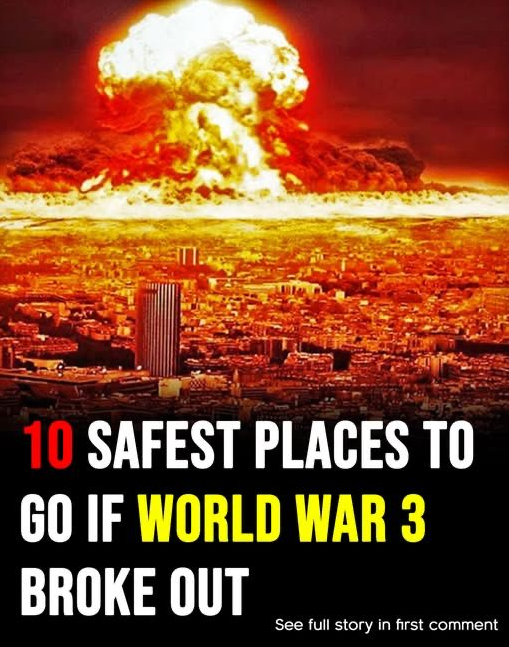
The Safest Places in the World if World War III Broke Out: A Comprehensive Guide
When whispers of a potential global conflict begin rattling through news broadcasts, online debates, and late-night conversations, the question quietly forms in people’s minds: If World War III ever happened, where would the safest places be? Though the thought is unsettling, exploring it through a fictional analytical lens can provide both perspective and imagination. This guide examines the regions that—based purely on geography, political neutrality, resource stability, and isolation—might stand the best chance of remaining safe in a hypothetical worldwide conflict.
1. New Zealand: The Sanctuary at the End of the Earth
Tucked deep in the South Pacific, far from major military powers, New Zealand is often portrayed as the ultimate refuge. Its isolation becomes its greatest asset. In global conflicts, nations prioritize strategic targets such as ports, borders, and industrial centers—none of which New Zealand hosts in a threatening manner.
The country’s long-standing political neutrality and balanced diplomacy give it the reputation of a peaceful mediator rather than a military player. Its geographic advantages also include access to fresh water, stable agriculture, and a low population density. If a global crisis erupted, its self-sufficiency in food production could help communities sustain themselves without immediate external support.
Of course, no place is completely immune in a world intertwined by technology and global alliances, but New Zealand stands out as one of the most naturally shielded.
2. Switzerland: The Fortress of Neutrality
For centuries, Switzerland has perfected the role of neutrality—so much so that it becomes almost synonymous with the word. In a Third World War scenario, that neutrality could once again serve as protection.
Geographically, Switzerland is surrounded by the Alps, which have historically acted as a natural defense. The country has robust underground infrastructure, self-sufficient energy systems, and highly organized civil defense plans.
But Switzerland’s greatest asset is its political stance. Even during the most turbulent eras in European history, it avoided invasion through a combination of diplomacy, deterrence, and strategic positioning. In a global conflict, it would likely emphasize humanitarian roles, offering medical aid and negotiations rather than involvement in combat.
Switzerland’s stability, combined with its mountainous isolation, places it high on any list of hypothetical safe zones.
3. Iceland: An Island of Ice—and Isolation
With a population smaller than many global cities and a location tucked far into the North Atlantic, Iceland’s remoteness is unmatched. In a World War III scenario, its lack of strategic military importance could spare it from direct engagement.
Iceland has no land borders, no major natural resources that would make it an invasion target, and a culture emphasizing peace and diplomacy. Its volcanic terrain and rugged coastline naturally limit large-scale military operations.
Perhaps Iceland’s greatest advantage is its self-reliance on geothermal energy. During a global disruption, the country could continue powering itself with heat harvested from the earth’s core—something few nations can claim. This gives Iceland a unique resilience rarely seen in global systems.
4. Bhutan: Hidden in the Himalayas
Known for measuring Gross National Happiness rather than GDP, Bhutan remains one of the world’s most secluded countries. Perched high in the Himalayas between India and China, its extreme terrain acts as a natural barrier. Historically, Bhutan has avoided conflict by remaining small, peaceful, and deliberately disconnected.
The country lacks major industrial targets and operates under strict environmental and cultural preservation policies. Access to the nation is limited, with only a few guarded passes connecting it to neighboring regions. In a global war scenario, the physical isolation of Bhutan could serve as a major advantage—not as a fortress, but as a quietly overlooked corner of the world.
Although its proximity to large powers could be concerning, its lack of strategic value might keep it safely off the global stage.
5. Norway’s Remote Arctic Regions
While Norway is part of NATO and would likely be involved in international politics, its far northern regions—Svalbard, Tromsø, and isolated Arctic settlements—tell a different story.
These areas are so remote, sparsely populated, and challenging to access that they become unlikely targets. Their harsh climate, while difficult, provides natural protection. In a world where urban centers and strategic facilities become conflict zones, an isolated Arctic landscape offers distance from chaos.
Furthermore, Norway’s well-maintained emergency infrastructure, survival training traditions, and stable governance could help remote communities endure disruptions better than many other countries.
6. Canada’s Northern Wilderness
Canada is a major Western nation, but its remote northern regions remain so vast and untouched that they function almost like a separate world. These territories—Nunavut, Yukon, Northwest Territories—stretch across millions of acres of forests, tundra, and lakes.
During a hypothetical world conflict, the extreme remoteness and lack of industrial targets could make these areas relatively safe. The environment is challenging but rich in freshwater, wildlife, and natural shelter. Indigenous communities have thrived there for thousands of years, relying on deep knowledge of the land.
Canada’s strong humanitarian values and stable governance would further help maintain internal order in crises.
7. The Falkland Islands: The Silent Archipelago
Located far off the coast of South America, the Falkland Islands are one of the world’s most isolated inhabited regions. With a population of just a few thousand, the area holds little global strategic significance beyond maritime territory.
Its distance from global powers, coupled with the vastness of the South Atlantic, creates a natural buffer. Should World War III erupt, the Falklands’ remoteness could make them a forgotten dot on the map, shielded by sheer isolation.
Life there might be quiet, cold, and rugged—but safe.
8. Antarctica: The World’s Final Frontier
As a fictional thought experiment, Antarctica often appears at the top of “ultimate refuge” lists. Governed by the Antarctic Treaty, owned by no single nation, and devoid of permanent military bases, it stands as humanity’s most unclaimed territory.
In reality, survival there requires extreme preparation, and only research stations host people year-round. Still, its isolation from global conflict makes it symbolically the safest place—untouched, unreachable, and irrelevant to global politics.
Antarctica represents the idea of safety by distance, not practicality.
Conclusion: Peace Over Panic
While imagining safe zones during a hypothetical World War III can feel intense, such thought experiments often remind us of something important: the safest world is one where diplomacy prevails, conflicts are resolved peacefully, and no such war ever occurs.
In the end, the most important lesson isn’t about finding a distant refuge—it’s about valuing stability, encouraging international cooperation, and preserving peace before crises ever arise.