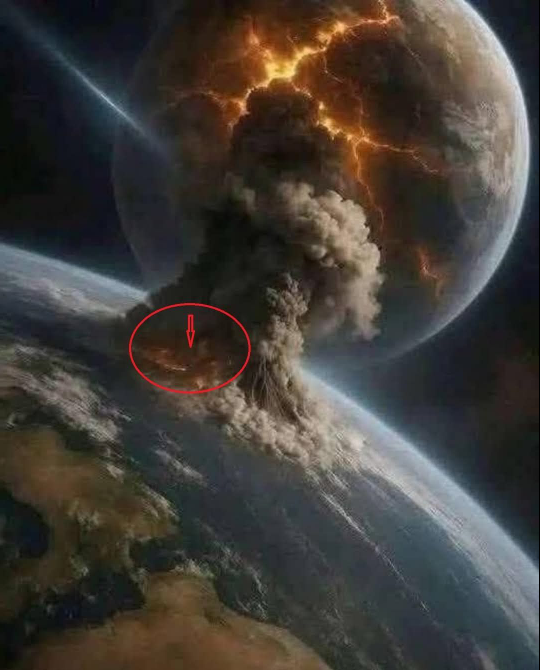
BREAKING NEWS – FICTIONAL STORY
“August 5th: The Day the Earth Was Predicted to Change Forever”
On the evening of August 4th, televisions around the world flickered with an urgent red banner: GLOBAL ALERT — EMERGENCY ADDRESS AT MIDNIGHT UTC. At first, most people ignored it. Alerts came often, warnings came daily, and the world had grown numb to the constant background noise of crises. But this time was different. This time, the announcement came directly from the newly formed International Planetary Observation Council, an organization established only months earlier after several unexplained cosmic events unsettled scientists worldwide.
As clocks struck midnight UTC, households, airports, hospitals, and city streets fell still. A man appeared on screens—Dr. Elias Wexler, the world’s leading geophysicist, a reserved and notoriously cautious scientist never known for dramatic statements. His voice trembled slightly as he began.
“On August 5th, the Earth will begin to experience a planetary shift unlike anything in recorded history.”
The world froze.
“We have confirmed,” he continued, “that a rare cosmic alignment will trigger a chain reaction deep within the Earth’s mantle. This event is not an extinction-level threat, but it will temporarily alter global weather patterns, magnetic fields, and possibly even communication systems.”
The words rolled through every living room like thunder. Some gasped. Some prayed. Others immediately ran to social media to share their panic.
Dr. Wexler explained further: Over the past six months, satellites had detected unusual fluctuations in the Earth’s magnetic field—fluctuations that didn’t match any known pattern. At first, scientists blamed equipment malfunctions. But by late July, instruments all over the world confirmed the same anomalies. Something massive was happening beneath the crust.
He ended the address with a message that shocked everyone:
“This will begin on August 5th at precisely 14:07 UTC. Prepare, stay calm, and trust the process. We believe humanity will not only survive this—but learn from it.”
The screen went black.
THE HOURS BEFORE
By dawn, chaos simmered beneath a thin layer of order. Cities buzzed with anxious energy. Grocery stores filled instantly. Fuel stations had lines stretching into highways. People rushed to call loved ones.
In New York, the usually loud Manhattan streets felt unnervingly quiet. Sarah Bennett, a 28-year-old paramedic, stood outside her ambulance listening to the soft hum of the city. “It’s like the whole world stopped breathing,” she whispered to her partner.
Across the ocean, in Nairobi, a schoolteacher named Daniel Njoroge gathered his students in the courtyard. Instead of panic, he encouraged the children to write letters to their future selves—“for after the shift,” he told them with a hopeful smile.
Not everyone reacted with fear. Some gathered in parks. Some hugged strangers. Some finally said the words they had always avoided. The threat, while not apocalyptic, reminded humanity of its fragility.
AUGUST 5TH — 14:07 UTC
The moment arrived.
People everywhere paused—drivers pulled over, children looked to teachers, dogs stopped barking as if sensing the tension.
Then it happened.
A low, deep vibration rolled through the Earth. Not loud—more like the sound of a massive engine turning somewhere beneath the crust. Windows trembled. Birds lifted from trees in unison. Rivers rippled even without wind.
In Reykjavik, Iceland, where the crust is thin and volcanic activity is common, the ground glowed faintly with natural geothermal light. Scientists watched in awe as harmless blue-white auroras danced just above the horizon—auroras appearing at ground level.
In the Pacific, sailors reported that the ocean seemed to “breathe,” rising and falling in perfect smooth rhythm rather than in waves.
In South America, compasses spun momentarily, then steadied again as the magnetic field shifted and rebalanced itself.
It wasn’t destruction. It was transformation.
The Earth itself seemed to be adjusting, stretching, and settling—like a living creature awakening from a long sleep.
THE GLOBAL EFFECTS
Over the next three hours, small but significant changes unfolded:
1. The Skies Changed Color
Sunlight refracted differently through the temporarily altered magnetic field. In some places, the sky turned a gentle peach color. In others, it shimmered with green undertones like a permanent, soft aurora.
2. Communication Waves Wavered
Phones dropped service for a few minutes. Satellites reset automatically. Airplanes were temporarily grounded, not for danger but for precaution.
3. Weather Systems Realigned
Storms forming over the Atlantic dissolved instantly, as if the atmosphere itself was being rearranged. Meanwhile, desert winds in the Middle East cooled, carrying moisture farther inland than ever recorded.
4. Wildlife Reacted First
Whales altered travel routes. Birds migrated early. Herd animals gathered calmly rather than fleeing. It was as if nature understood the shift better than humans ever could.
The extraordinary part was this:
Despite panic, despite tension, nothing catastrophic happened.
Instead, something remarkable unfolded.
AFTER THE SHIFT
Over the next 48 hours, new data astonished scientists:
-
Earth’s magnetic field strengthened by 3%.
-
Heat pockets beneath the crust distributed more evenly, reducing earthquake and volcanic risk in certain regions.
-
Rainfall patterns projected for the next decade shifted in ways that could potentially end droughts in multiple countries.
The event scientists feared might disrupt civilization had somehow aligned in humanity’s favor.
Dr. Wexler later appeared again, visibly relieved.
“Today,” he said, “we witnessed something extraordinary: a natural planetary correction. The Earth stabilized itself. We feared the worst, but this planet… it protects its own.”
People around the world breathed again.
In the days that followed, a strange thing happened: people were kinder. Neighbors who rarely spoke now greeted each other. Families who hadn’t connected in years began calling. Strangers shared food, water, blankets, laughter.
For the first time in a long time, humanity felt united—not by tragedy, but by shared awe.
CONCLUSION
August 5th was supposed to be the day everything changed. In a way, it was. But not through destruction—not through fear. Instead, it reminded people that the Earth is alive, dynamic, powerful, and capable of renewal.
It reminded them of how small human worries were.
How interconnected humanity truly is.
How fragile—and yet how resilient—life can be.