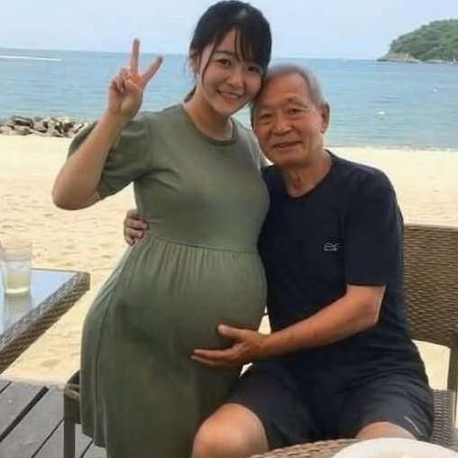
THE SAD GIRL MARRIES A 70-YEAR-OLD
No one in the village ever forgot the day Lina walked down the aisle in a pale pink dress, her face hidden behind a veil too heavy for her small frame. She was only twenty-one—quiet, fragile, and known by everyone as the sad girl. Her eyes always carried the weight of something unspoken, something dark. And when she appeared beside Mr. Harland, the wealthy seventy-year-old widower she was suddenly engaged to, people stared in stunned silence.
Whispers flew like falling leaves.
“Why him?”
“Where are her parents?”
“Did she choose this?”
But no one had answers, not even Lina herself.
THE WEDDING THAT SHOCKED THE TOWN
The ceremony was small but elegant—Mr. Harland insisted. He stood at the altar in a perfectly tailored suit, silver hair neatly combed, posture straight despite his age. His weathered face showed neither excitement nor guilt. If anything, he looked relieved, as though securing Lina as his bride solved a problem he’d carried for too long.
Lina walked the aisle slowly, each step a quiet plea for escape. Her hands trembled around the bouquet. She felt eyes on her, hundreds of them, burning through the veil. Some looked curious, others judgmental, many disapproving. But none knew what she knew—what forced her into this moment.
As the vows were spoken, Lina’s voice barely left her throat. The ring felt heavy on her finger. When the officiant said you may kiss the bride, she shuddered slightly, but Harland only brushed his lips against her cheek and smiled as though he had won something priceless.
She felt the walls closing in.
THE REASON BEHIND THE MARRIAGE
Three months earlier, Lina’s life had been simple. She worked at a small tailor shop, earning little but enough to support her younger brother, Milo. Since their parents died, she had become both sister and guardian. Though they lived in poverty, her heart found strength in the laughter of the twelve-year-old boy who depended on her.
But everything changed the day Milo fell gravely ill.
His body weakened overnight. Doctors discovered a tumor that required immediate surgery—expensive, urgent, and far beyond Lina’s means. She tried everything: borrowing from neighbors, pleading for help at charities, even selling the only furniture they had. But the money barely reached ten percent of what was needed.
One evening, as she cried outside the hospital, Mr. Harland approached her. He had known her parents long ago. He was wealthy, powerful, respected—and lonely after his wife died five years before. He spoke softly, as though offering salvation.
“I can pay for Milo’s surgery, Lina. I can save him. But I need someone to care for me as I grow older. Someone gentle. Someone like you.”
She froze, confused.
“Are you saying…?”
He didn’t hesitate.
“Marry me. And your brother will live.”
Her heart dropped.
It felt like a cage closing.
But Milo’s life depended on her. She agreed.
In less than a week, Harland had paid the hospital, arranged everything, and announced the engagement. The village was stunned. Lina withdrew into herself, ashamed yet determined to save her brother.
Milo survived the surgery. His bright smile returned. And Lina kept her promise.
A HOUSE TOO QUIET
After the wedding, Lina moved into Harland’s enormous mansion. Everything felt cold: marble floors, echoing hallways, portraits of people she didn’t know. The silence was suffocating, broken only by the ticking of antique clocks.
Harland wasn’t cruel, but he was distant. He expected perfection—meals at specific hours, company during his reading time, and her presence at business dinners where she sat silently beside him. He forbade her from working and insisted she dress in clothes he chose.
He never raised his voice. His rules were gentle but absolute.
“Lina, this house has order.”
“Lina, do not worry about the outside world now.”
“Lina, I saved your brother. Let me shape your future.”
His kindness trapped her more deeply than cruelty ever could.
At night, she cried silently into her pillow, wondering when she stopped being Lina and became someone else—someone owned.
THE MANSION’S SECRET
One stormy evening, two months into the marriage, Lina couldn’t sleep. She wandered the mansion and found an old storage room with boxes stacked to the ceiling. Most were filled with books, journals, and photographs.
She opened one labeled “Clara.”
Harland’s late wife.
Inside were pictures of a beautiful woman with sad eyes, not unlike Lina’s. Letters tied with ribbon. A diary. As Lina read the first page, her blood froze.
“Harland is kind, but I feel like a bird whose wings have been clipped.”
“Every day I lose a piece of myself.”
“I do not know who I am anymore.”
“If I disappear, it will be inside this house, not outside it.”
Clara’s writings mirrored Lina’s deepest fears. The more she read, the more she felt the walls tighten around her. The diary ended abruptly six weeks before Clara’s death—an event documented as a “heart failure,” though Clara had been only in her forties.
Lina’s hands shook.
Was Clara’s sadness a coincidence?
Or had Harland’s “kindness” silently trapped her too?
She slammed the box shut, breath ragged.
THE TURNING POINT
The next morning, Harland found her sitting in the garden, pale and distant. She expected anger, but he only placed a hand on her shoulder.
“I know this is an adjustment,” he said softly. “But time will help. I’ve given you a safe life.”
Lina turned to him, eyes filled with quiet fire.
“A safe life is not always a free one.”
Harland’s expression hardened for the first time. But he said nothing and walked away.
From that day, something changed.
Lina no longer drifted quietly through the mansion. She fought back in small ways: she visited Milo more often, demanded space, rediscovered her sewing, even sold small embroidered pieces to neighbors in secret.
The mansion no longer swallowed her whole.
She began taking back pieces of herself.
A NEW BEGINNING
One cold morning, Harland collapsed during breakfast. Age finally caught up with him. Lina rushed to help him, and as the doctors arrived, he held her wrist weakly.
“I wanted companionship,” he whispered. “I didn’t mean to cage you. I just didn’t want to be alone again.”
Her heart softened—not out of love, but out of understanding.
Loneliness had shaped him just as poverty shaped her.
Harland survived but grew quieter, gentler, less controlling.
He saw Lina’s strength and slowly released his grip on her life.
And in that shift, something unexpected happened.
She found her voice.
He found his humility.
And in the quiet space between them, not love—but respect—began to grow.
THE SAD GIRL NO MORE
Years later, people still talked about the girl who married the seventy-year-old man. Some whispered pity, others judgment, but those who truly knew Lina saw the transformation.
She was no longer the sad girl.
She became a woman who sacrificed for love, fought for her freedom, and learned to rebuild herself piece by piece.
Her life wasn’t a fairy tale.
It wasn’t perfect.
But it was hers.
And that made all the difference.