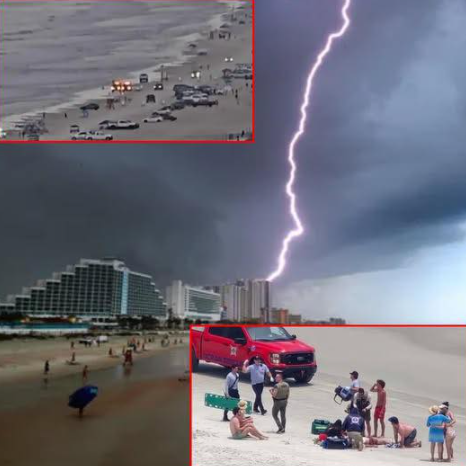
A 29-year-old man visiting Central Florida on his delayed honeymoon has died after being struck by lightning while standing in ankle-deep water at New Smyrna Beach during a bout of severe weather. Officials confirmed his death on Monday, three days after the strike, which occurred on Friday afternoon.
The victim, Jake Rosencranz of Colorado, had traveled to Florida with his wife to celebrate their marriage. According to the Volusia County Beach Safety division, Rosencranz was in shallow water near the 27th Avenue beach access when the lightning bolt struck around 12:30 p.m. Witnesses said the weather appeared deceptively calm at the time. The sky was partly cloudy with no storm cell directly overhead. This made the incident all the more shocking, as it was an example of what meteorologists call a “blue-sky lightning strike,” when a bolt can travel many miles from its originating storm and strike under what looks like clear conditions.
The force of the strike knocked Rosencranz unconscious. Lifeguards and nearby beachgoers rushed to his aid, performing CPR on the sand while emergency services were called. He was transported in critical condition to a nearby hospital, where he remained overnight. Tragically, he passed away on Saturday morning. His death was officially confirmed by authorities on Monday.
Sheriff Mike Chitwood of Volusia County described the incident as a heartbreaking reminder of nature’s unpredictability. “This was a young man in the prime of his life, on his honeymoon, doing what thousands of people do every day in Florida—standing on the shoreline. A storm miles away ended his life in a second,” the sheriff said during a press briefing.
Officials explained that lightning strikes can occur up to 20 miles away from the center of a thunderstorm. Many people mistakenly believe lightning danger exists only when dark storm clouds are directly overhead. In reality, the first strike can happen before the storm reaches the beach, giving people little to no warning if they aren’t paying attention to weather alerts.
The day of the incident saw more than 170 lightning strikes recorded across Central Florida. Two golfers at the Venetian Bay Golf Course, also in New Smyrna Beach, were indirectly struck by lightning the same day. They experienced shock and pain but did not require hospitalization. Volusia County Beach Safety officials said storms were moving rapidly through the area, and beach warning systems were activated shortly after the strike.
Tammy Malphurs, director of Volusia County Beach Safety, said the lightning was “rare and unpredictable.” She added, “There was no storm overhead at the exact moment, but there were storms in the area. Lightning can travel long distances, and that’s exactly what happened here.”
Jake Rosencranz was remembered by family and friends as a kind, adventurous, and hardworking man who loved the outdoors. Originally from Colorado, he graduated from the University of Denver and worked as a project manager. His colleagues at Behm Consulting Group described him as “the kind of person who made every room better” and expressed their heartbreak over his death. A fundraising page was set up to support his wife as she navigates the aftermath of the tragedy.
Friends shared that Jake and his wife had planned their honeymoon months earlier but had postponed it to align with their work schedules. Their trip to Florida was meant to be a joyful celebration. Instead, it ended in unimaginable grief. “It’s surreal,” one close friend said. “You don’t think something like this can happen on a sunny day at the beach.”
Lightning fatalities are relatively rare in the United States, but Florida consistently records the highest number of strikes and lightning-related deaths each year. Its subtropical climate and frequent afternoon thunderstorms make it the lightning capital of the country. On average, 20 to 30 people in the U.S. die annually from lightning strikes, and many more suffer serious injuries. Florida alone often accounts for a significant portion of those cases.
Experts emphasize that lightning safety requires understanding that distance doesn’t equal safety. If thunder can be heard, even faintly, lightning is close enough to strike. The National Weather Service recommends the simple rule: “When thunder roars, go indoors.” Safe shelter includes fully enclosed buildings with wiring and plumbing or metal-topped vehicles with the windows rolled up. Open structures like beach pavilions or tents do not provide protection.
Standing in or near water is especially dangerous during a storm. Water conducts electricity, meaning that even if a person is not struck directly, a nearby strike can send current through the water and into their body. In Rosencranz’s case, he was standing in ankle-deep water when the bolt hit nearby, and the energy traveled through the water to him. This can result in cardiac arrest, severe burns, or fatal internal injuries in a matter of seconds.
Volusia County officials say they routinely monitor weather patterns and issue warnings to clear the beach when lightning threats are detected. But they also acknowledge that not every storm behaves predictably, and lightning can strike before warnings are fully activated. “The best protection is personal awareness,” said Malphurs. “If there are storms in the area, even far away, get off the beach.”
Blue-sky lightning strikes, like the one that killed Rosencranz, are uncommon but not unheard of. Meteorologists say that bolts from the blue are typically more powerful than regular lightning strikes because they originate from the upper regions of a thunderstorm and travel farther. They can reach areas where no rain is falling and skies may appear deceptively clear. This element of surprise makes them especially deadly.
The tragedy has sparked renewed calls for public education about lightning safety, especially in high-risk states like Florida. Some local officials are exploring additional signage and public alert systems to warn beachgoers earlier, even when storms are miles away. The Volusia County Beach Safety division also urged residents and visitors to download weather alert apps and to seek shelter at the first sign of approaching storms.
Friends of Rosencranz say he was an experienced outdoorsman who respected nature. They described the incident as a cruel twist of fate, not the result of recklessness. “Jake was a smart, careful person,” one friend said. “This shows how fast and unpredictable lightning can be. You can do everything right and still get caught.”
National experts echoed the sentiment. John Jensenius, a lightning safety specialist with the National Weather Service, has long emphasized that “lightning can strike out of a clear blue sky,” and that Florida’s beaches are especially vulnerable because of how fast storms form in the afternoons. He advises everyone to plan outdoor activities around the forecast and have an exit strategy ready.
Authorities are reminding beachgoers that if they hear thunder, they should immediately leave the water and the sand, and seek shelter in a sturdy building or a vehicle. They also caution against waiting for visible lightning or heavy rain to begin, as the first strike can often be the deadliest.
As the community mourns the loss of Jake Rosencranz, many are reflecting on how fragile life can be and how nature’s beauty can turn dangerous without warning. His story is a heartbreaking reminder of the need for vigilance, even during moments that seem peaceful and safe.
A candlelight vigil was planned in his hometown in Colorado, where friends and family will gather to honor his memory. His wife, who was with him at the beach, has asked for privacy during this time. Messages of condolences have poured in from across the country, including from those who never knew him but were moved by the tragedy.
Lightning is unpredictable, and it doesn’t discriminate. Rosencranz’s death serves as a painful lesson that awareness and caution can mean the difference between life and death. Storms in Florida are common, but the danger they carry is often underestimated. Experts hope this tragedy will save lives by encouraging people to take lightning seriously, even when the sky looks calm.