🕯️ A TRAGEDY THAT CHANGED AVIATION FOREVER: AMERICAN AIRLINES FLIGHT 191
On May 25, 1979, Chicago became the scene of one of the deadliest aviation disasters in American history. American Airlines Flight 191, a McDonnell Douglas DC-10, was preparing to leave Chicago O’Hare International Airport when a catastrophic mechanical failure occurred during takeoff.
The aircraft was carrying 271 people—258 passengers and 13 crew members. All 271 people aboard were killed. Two people on the ground also lost their lives, bringing the total number of fatalities to 273.
The tragedy unfolded in only seconds.
Flight 191 was scheduled to depart Chicago for Los Angeles. The weather that afternoon was clear, with excellent visibility. There was nothing about the weather conditions that suggested an extraordinary danger. The aircraft began its takeoff normally, accelerating along the runway.
Then, during rotation, the aircraft’s left engine and pylon assembly separated from the wing.
The engine did not simply fall away. According to the National Transportation Safety Board’s investigation, the separation also took approximately three feet of the wing’s leading edge with it. The engine and pylon assembly traveled over the wing before falling onto the runway.
Inside the cockpit, the pilots were faced with an emergency that was almost impossible to fully understand in the few seconds available to them.
The aircraft continued climbing.
It reached approximately 325 feet above the ground, but the loss of the engine and damage to the wing had created a much more complicated problem than a conventional engine failure. The separation damaged hydraulic lines and caused the outboard leading-edge slats on the left wing to retract.
The slats were critically important during low-speed flight.
With the aircraft configured for takeoff, the left wing was no longer aerodynamically symmetrical. The airplane’s systems also suffered significant damage. The loss of electrical power from the separated engine affected several instruments and warning systems, including the left stall-warning system and the slat-disagreement warning.
The crew therefore had to respond to a rapidly developing emergency while some of the information they would normally rely upon was unavailable.
The aircraft began rolling toward the left.
The bank angle increased dramatically.
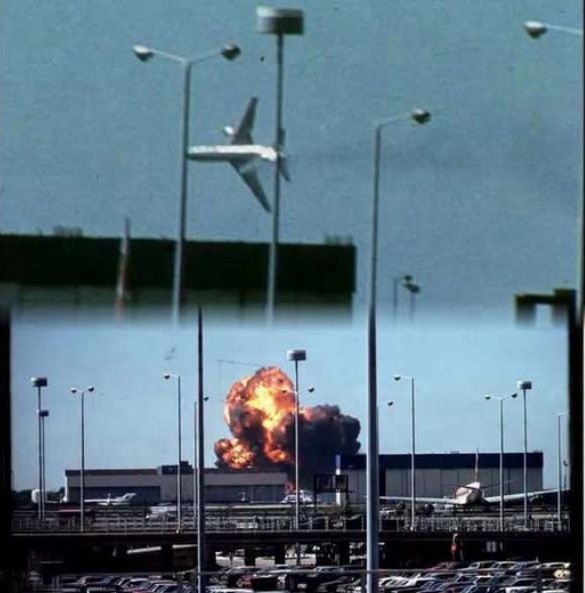
Flight 191 continued rolling until its wings passed through a nearly vertical position. The nose then pitched downward, and the aircraft began descending rapidly. The NTSB reported that the airplane crashed into an open field near the airport, with wreckage spreading into an adjacent trailer park.
A devastating fire followed.
The DC-10 was destroyed.
Every person aboard Flight 191 died.
Two people on the ground were also killed, and two others on the ground were injured. Buildings, vehicles, and a mobile home were damaged or destroyed.
For the families waiting for loved ones in Los Angeles, the news would have been unimaginable.
For Chicago, it became a day remembered for decades.
And for the aviation industry, Flight 191 became a powerful warning about what can happen when maintenance procedures, aircraft design, warning systems, and operational procedures interact in unexpected ways.
WHAT CAUSED THE DISASTER?
The official investigation did not conclude that the accident was simply caused by an engine failure.
The NTSB determined that the probable cause was an asymmetrical stall and resulting left roll following the uncommanded retraction of the left wing’s outboard leading-edge slats. The underlying chain of events began with maintenance-induced damage that ultimately led to separation of the No. 1 engine and pylon assembly during takeoff.
Investigators found that improper maintenance procedures had damaged the pylon structure.
The investigation also identified several contributing factors, including vulnerabilities in the aircraft’s pylon attachment points, vulnerabilities in the leading-edge slat system, weaknesses in FAA surveillance and reporting systems, and communication problems involving the airline, manufacturer, and regulators.
In other words, the disaster was not attributed to one isolated mistake.
It was a chain of failures.
That distinction became extremely important for aviation safety.
THE LESSONS OF FLIGHT 191
Major aviation accidents often lead to changes that passengers may never notice.
After an accident, investigators examine everything: the aircraft design, maintenance procedures, pilot training, warning systems, regulatory oversight, communication between organizations, and emergency procedures.
Flight 191 was no exception.
The FAA’s historical analysis notes that the accident exposed serious problems involving the separation of the engine and pylon, damage to the aircraft’s control systems, and the resulting loss of control.
The accident became an important case study in aviation safety because it demonstrated how maintenance procedures can have consequences far beyond the immediate component being serviced.
A procedure that appears efficient on the ground can introduce hidden structural damage.
That damage may remain unnoticed.
Then, under the enormous stresses of takeoff, it can suddenly become catastrophic.
WHY THE NUMBER 273 IS OFTEN ASSOCIATED WITH THE CRASH
When people remember Flight 191, they sometimes state that 273 people were killed aboard the airplane.
That wording is not technically correct.
The official NTSB record states that 271 people aboard the aircraft died, while two people on the ground also died. The total loss of life was therefore 273.
That distinction matters when telling the history accurately.
There were 258 passengers and 13 crew members aboard.
None survived.
Two additional fatalities occurred on the ground.
The combined death toll was 273.
REMEMBERING THE PEOPLE, NOT JUST THE NUMBER
Behind every statistic was a person.
There were families traveling together.
There were people beginning vacations.
There were business travelers.
There were people returning home.
There were crew members doing their jobs.
For the families involved, Flight 191 was not simply an aviation statistic. It represented a parent, spouse, child, sibling, friend, colleague, or loved one who never reached Los Angeles.
That human dimension is important whenever historical disasters are discussed.
Numbers help us understand the scale of a tragedy, but they cannot describe the individual lives behind those numbers.
A TRAGEDY THAT LEFT A LASTING LEGACY
American Airlines Flight 191 remains one of the most studied accidents involving the DC-10.
The accident demonstrated how several seemingly separate problems could combine into a catastrophic event within seconds.
It also reinforced an important principle of aviation safety:
Every part of an aircraft matters.
A maintenance procedure matters.
A warning system matters.
A communication between engineers matters.
A regulatory inspection matters.
A design decision matters.
And when something goes wrong, investigators must look beyond the final moments of an accident to understand the entire chain that made it possible.
The tragedy at Chicago O’Hare was devastating, but the lessons learned from it contributed to efforts to make commercial aviation safer.
More than four decades later, the names and memories associated with Flight 191 remain part of aviation history.
On May 25, 1979, 271 people aboard American Airlines Flight 191 lost their lives, and two people on the ground were also killed.
273 lives in total.
Their story should be remembered with dignity—not simply as a shocking headline, but as a reminder of why aviation safety depends upon constant attention to engineering, maintenance, training, oversight, and communication.
🕯️ May the memory of all those who lost their lives be honored.