🚨 MASSIVE DRONE ATTACK ON MOSCOW: OIL REFINERY CAUGHT FIRE
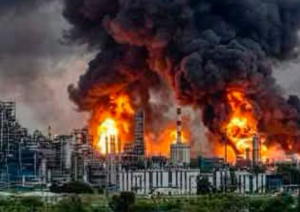
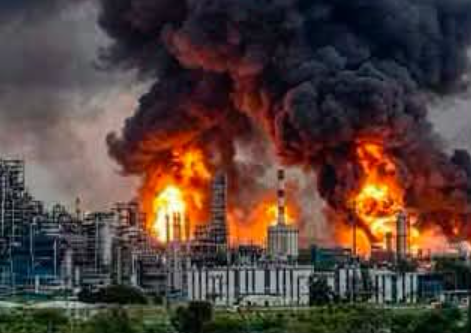
A dramatic wave of drone attacks over Moscow sent shockwaves through Russia after an oil refinery in the capital was struck and a fire broke out at the facility.
Images and videos showing flames and heavy smoke quickly circulated online, creating a powerful impression of the scale of the attack. The incident became one of the most closely watched episodes in the continuing drone war between Russia and Ukraine.
But there is an important detail that viral posts sometimes leave out: this particular Moscow refinery attack occurred on June 16, 2026, rather than today.
At the time, Russian authorities confirmed that a drone had damaged a facility at the Moscow oil refinery in the Kapotnya district. Moscow Mayor Sergey Sobyanin said there were no reported injuries. Ukrainian officials described the operation as retaliation for Russia’s continuing attacks on Ukraine.
The attack nevertheless demonstrated something that has become increasingly difficult to ignore: the war is reaching farther into Russian territory.
For years, much of the fighting was concentrated on Ukrainian territory. But the development of long-range drones has changed the nature of the conflict.
Modern unmanned aircraft can travel enormous distances and strike infrastructure far from the battlefield.
That has made energy facilities, fuel depots, military installations and transportation networks increasingly important targets.
The Moscow refinery is particularly significant because it is closely connected to the fuel supply of the capital region.
Reports at the time said the refinery could meet a substantial portion of Moscow’s fuel needs. A disruption at such a facility therefore has consequences that extend beyond the immediate fire or physical damage.
When a refinery is damaged, engineers must assess individual processing units, pipelines, electrical systems and other equipment before normal operations can safely resume.
Even a relatively localized strike can therefore create complications.
Fuel production may be reduced.
Transportation networks may be affected.
Supplies may have to be redirected.
And authorities may face increased pressure to protect other energy facilities from additional attacks.
The psychological impact can be just as significant.
Moscow is Russia’s political and economic center. Seeing drones reach the capital can challenge the perception that the war is geographically distant from ordinary Russian citizens.
For residents, the sound of air-defense systems, explosions, sirens and aircraft overhead can transform an ordinary night into a frightening experience.
The attack also highlighted the growing importance of air defense.
Russian authorities reported intercepting numerous drones during the wider barrage. Moscow’s airports also experienced restrictions during the attack, illustrating how drone warfare can disrupt civilian life even when aircraft are intercepted before reaching their intended targets.
This is one of the most important features of modern drone warfare.
A drone does not necessarily have to destroy its intended target to create disruption.
The threat itself can force authorities to close airspace, redirect aircraft, deploy additional air-defense systems and temporarily restrict transportation.
That creates economic costs and public anxiety.
And the attacks have not been limited to Moscow.
In recent weeks, Ukraine and Russia have continued exchanging increasingly long-range strikes against infrastructure and economic targets. Reuters reported on September 10 that both sides have intensified attacks against logistics and energy infrastructure, while Ukrainian strikes have reached deep inside Russia.
One recent example occurred in Novy Urengoy, a major Russian gas-producing center in the far north. Russian officials said a drone attack caused a fire at an industrial facility there, illustrating how far the reach of the conflict has expanded.
The strategic message is clear.
Distance is no longer the protection it once was.
For Ukraine, long-range drone attacks provide a way to put pressure on Russian infrastructure without sending large numbers of aircraft deep into heavily defended territory.
For Russia, attacks on Ukrainian cities and infrastructure serve a similar purpose: degrading military logistics, energy supplies and industrial capacity.
The result is an increasingly dangerous cycle.
One side attacks.
The other responds.
The response produces another attack.
And the cycle continues.
The danger is not limited to military targets.
Energy infrastructure sits close to civilian populations.
Refineries, fuel depots, electrical facilities and transportation networks are part of the systems that ordinary people depend on every day.
When these facilities are attacked, civilians can feel the consequences through fuel shortages, transportation problems, higher prices and disruptions to everyday services.
The economic consequences can also extend internationally.
Energy markets closely monitor attacks on major oil and gas infrastructure because disruptions can affect expectations about future supplies.
That concern is already visible in global markets. Reuters reported on September 10 that oil prices climbed sharply amid escalating attacks affecting energy shipping routes and supply concerns.
The Moscow refinery incident therefore represents more than a fire at an industrial site.
It is part of a much larger transformation in the war.
Drones have become central to the conflict.
They are relatively inexpensive compared with traditional aircraft and missiles, can be produced in large numbers, and can potentially reach targets hundreds or thousands of kilometers away.
Their growing use means that the geography of the battlefield continues to expand.
For civilians watching these events unfold, the most important thing is to distinguish confirmed information from recycled or misleading social-media posts.
The phrase “breaking news” is often attached to old photographs and videos.
A dramatic image of flames over Moscow can be genuine while the date attached to it is completely wrong.
That is why readers should always check when a video was recorded and whether credible news organizations or officials have independently confirmed the event.
The Moscow refinery attack was real.
The fire was real.
The broader drone campaign was real.
But the incident should not be presented as though it happened today when the event being referenced occurred in June.
That distinction matters because accurate information is especially important during wartime.
Rumors can spread fear.
Old footage can create unnecessary panic.
And misleading headlines can make an already dangerous situation even more confusing.
The continuing conflict between Russia and Ukraine remains extremely serious.
Recent attacks demonstrate that neither side has stopped using long-range weapons against strategic infrastructure, and both countries continue to accuse the other of escalating the conflict.
The Moscow refinery fire was therefore a powerful symbol of how dramatically the war has changed.
A conflict that once seemed geographically contained is now capable of producing explosions and fires far from traditional front lines.
For people watching from around the world, the message is sobering.
The age of drone warfare has changed the battlefield.
Cities once considered relatively distant from the fighting can suddenly become part of the conflict.
Energy infrastructure can become a target.
Airports can be disrupted.
And a single night of attacks can produce consequences that extend far beyond the location where a drone falls.
The flames eventually disappear.
The smoke clears.
But the strategic consequences can remain long after the fire is extinguished.
And as the Russia-Ukraine war continues, the world will be watching closely to see whether these long-range attacks become an even larger part of the conflict—or whether diplomacy can eventually stop the cycle before it grows more dangerous.