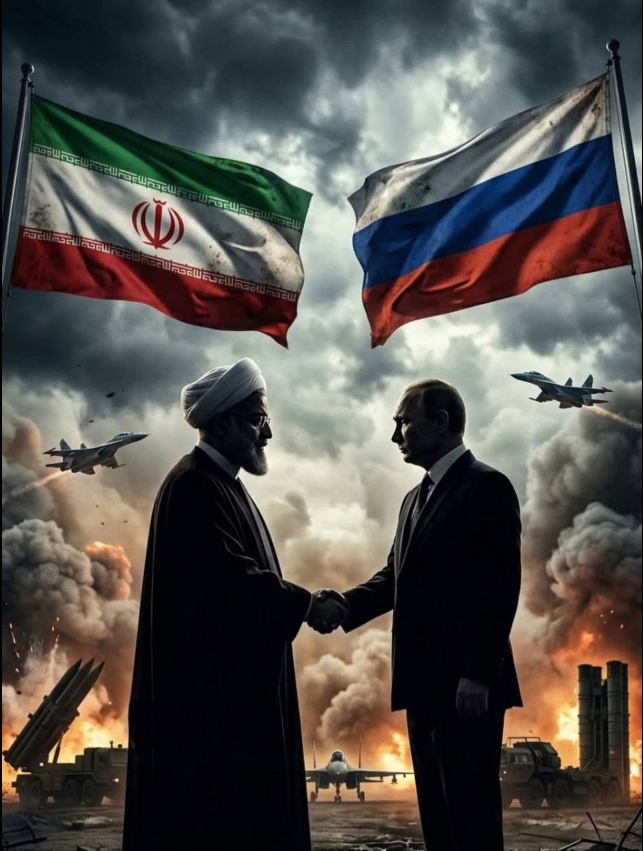
The dramatic image presents a powerful scene: the flags of Iran and Russia wave above a landscape filled with smoke, military aircraft, missile systems, and the unmistakable atmosphere of conflict. In the center, two political figures appear to shake hands, suggesting cooperation between governments while destruction unfolds in the background.
Although the picture should not be treated as a literal news photograph, its symbolism raises important questions about the relationship between Iran and Russia, the changing balance of power in international politics, and the consequences that military partnerships can have far beyond the countries directly involved.
At first glance, the image communicates a simple message: two countries standing together during a period of confrontation. The handshake represents cooperation, while the aircraft, missiles, and smoke represent the dangers surrounding that cooperation. Together, these elements create a picture of a world in which diplomacy and military power exist side by side.
Iran and Russia have developed closer relations in recent years, particularly in areas involving trade, energy, defense, and strategic cooperation. Their relationship has attracted international attention because both countries have faced significant pressure from Western governments and have sought to strengthen connections with other international partners.
However, cooperation between two governments does not necessarily mean that they share identical interests on every issue. Countries often work together because doing so serves particular strategic goals. One government may value another country’s energy resources, geographic position, military capabilities, markets, or diplomatic support. At the same time, each country continues to pursue its own national interests.
That distinction is important when interpreting dramatic images like this one.
The flags in the picture suggest unity, but international relationships are rarely as simple as a handshake. Behind every diplomatic agreement are negotiations involving economics, security, technology, energy, transportation, and political influence.
Military cooperation is particularly sensitive.
When nations increase defense cooperation, neighboring countries and rival governments may interpret the development as a potential threat. This can create a cycle in which one country’s attempt to improve its security causes another country to strengthen its own military capabilities.
Eventually, a competition can develop.
The background of the image—with aircraft flying through a dark sky and explosions appearing on the horizon—captures that fear. It represents the possibility that geopolitical competition can become increasingly dangerous when diplomacy fails.
Yet military imagery can also exaggerate reality. A picture showing missiles and burning buildings may create the impression that war is inevitable, even when governments are still negotiating, communicating through diplomatic channels, or attempting to avoid direct confrontation.
That is why dramatic online images should always be examined carefully.
A picture can communicate emotion without providing evidence.
In the modern information environment, photographs, illustrations, digitally generated images, and edited graphics can spread rapidly. A dramatic picture accompanied by the words “breaking news” can make an event appear confirmed even when no reliable evidence has been presented.
Readers should therefore distinguish between an image that symbolizes a geopolitical situation and an actual report documenting an event.
The image also highlights another important issue: the growing importance of alliances in a divided world.
International politics has increasingly involved competing partnerships. Countries seek stronger relationships with governments that can provide economic opportunities, military cooperation, diplomatic support, or access to strategic markets.
For Russia, relationships with countries outside the traditional Western alliance system can provide opportunities for trade and diplomatic engagement. For Iran, stronger international partnerships can similarly provide economic and strategic advantages.
But these relationships can also create complications.
When countries cooperate more closely, actions taken by one government can affect perceptions of the other. International observers may begin interpreting agreements as evidence of a broader strategic bloc. Rivals may respond with additional sanctions, military deployments, diplomatic pressure, or new alliances.
The result can be a more complicated international environment.
The Middle East is especially sensitive because of its geography and its existing political tensions. Iran occupies a strategically important position, while Russia has significant interests in the region. Developments involving either country can therefore attract attention from governments far beyond their borders.
Energy is another major factor.
Both countries are significant energy producers, and global energy markets can be influenced by geopolitical developments involving major oil and gas exporters. Conflict, sanctions, disruptions to transportation routes, or changes in international trade can affect prices and create economic consequences for consumers around the world.
This is one reason geopolitical tensions rarely remain confined to diplomatic meetings in distant capitals.
A crisis thousands of miles away can eventually influence fuel prices, transportation costs, inflation, investment decisions, and government budgets elsewhere.
The image’s dark sky can therefore be interpreted as more than a representation of military conflict. It can symbolize uncertainty.
What happens when countries become increasingly dependent on strategic partnerships? What happens when diplomatic disagreements become connected to military competition? And how can governments prevent misunderstandings from becoming dangerous confrontations?
These questions matter because modern military technology has made the consequences of escalation much more serious.
Aircraft, missiles, drones, cyber capabilities, and long-range weapons can dramatically change the speed at which a crisis develops. Decisions that once required days or weeks can now have consequences within minutes.
That makes communication essential.
Diplomatic channels, international organizations, military hotlines, negotiations, and agreements can all help reduce the possibility of accidental escalation. Even countries that strongly disagree can sometimes maintain communication because both sides understand the dangers of allowing a crisis to spiral beyond their control.
The handshake shown in the image can therefore be interpreted in two different ways.
One interpretation is that it represents a military alliance becoming stronger.
Another is that it represents diplomacy itself—the idea that governments can sit across from one another and negotiate even when their interests are sharply different.
The second interpretation offers a more hopeful message.
The smoke in the background does not have to represent the future. It can represent the consequences that governments are attempting to prevent.
For ordinary people, these geopolitical developments can feel distant. International agreements are negotiated by officials, military strategies are developed by governments, and diplomatic disputes often unfold behind closed doors.
But the consequences are ultimately human.
Wars and prolonged tensions can affect families, businesses, communities, refugees, soldiers, and civilians. Economic restrictions can affect ordinary workers. Disrupted energy markets can affect household budgets. Military escalation can create fear far beyond the immediate region.
That is why discussions about international alliances should go beyond dramatic headlines.
Understanding the underlying interests of each country is far more useful than assuming that every handshake means a permanent alliance or that every military image signals an imminent war.
The most important lesson from the image is perhaps that international politics is complicated.
Flags can symbolize national identity. Military equipment can symbolize power. A handshake can symbolize cooperation. Smoke can symbolize danger. But none of these symbols alone tells the complete story.
The real story exists in the negotiations, agreements, economic relationships, security concerns, and decisions made by governments over time.
As Iran and Russia continue to navigate their relationship with each other and with the rest of the international community, the world will continue watching closely.
The greatest challenge will be balancing national interests with the need to prevent escalation.
In an increasingly interconnected world, cooperation can create opportunities, but confrontation can create consequences that spread quickly across borders.
The dramatic image ultimately serves as a reminder of that reality. It shows two sides of international politics at once: the desire for partnership and the shadow of conflict.
Whether the future is defined by greater cooperation or deeper confrontation will depend not on a single photograph, but on the decisions governments make when diplomacy, security, economics, and national interests collide.