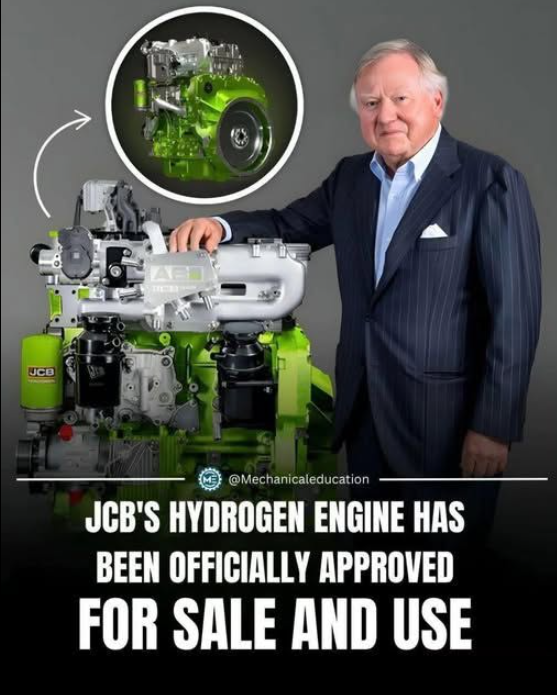
A Hydrogen Combustion Engine with Zero CO₂ Emissions and Diesel-Like Power
For more than a century, diesel engines have powered trucks, buses, construction equipment, ships, and agricultural machinery thanks to their unmatched torque, durability, and fuel efficiency. However, diesel engines also produce carbon dioxide (CO₂), one of the primary greenhouse gases linked to climate change. As governments and industries search for cleaner alternatives, hydrogen combustion engines are emerging as a promising solution. They offer the familiar performance of traditional diesel engines while producing virtually no carbon dioxide at the tailpipe.
Unlike battery-electric vehicles, hydrogen combustion engines retain much of the technology mechanics and manufacturers already understand. Instead of burning diesel fuel, they burn hydrogen gas. Because hydrogen contains no carbon atoms, its combustion does not generate CO₂. The main byproduct is water vapor, making hydrogen an attractive fuel for a cleaner future.
Hydrogen combustion should not be confused with hydrogen fuel cells. Fuel cells generate electricity through an electrochemical reaction, which then powers electric motors. Hydrogen combustion engines, on the other hand, operate much like gasoline or diesel engines, igniting hydrogen inside cylinders to create mechanical power.
Although the technology differs, the fuel itself is the same.
External loade−e^-e−e^-H2\mathrm{H_2} inO2\mathrm{O_2} inH2O\mathrm{H_2O} + heat outH+\mathrm{H^+}
One of the greatest strengths of hydrogen combustion engines is their impressive power output. Engineers have developed hydrogen engines capable of delivering torque levels comparable to modern diesel engines, making them suitable for heavy-duty applications where batteries may be too large, too heavy, or too slow to recharge.
Heavy trucks often travel hundreds of miles while carrying massive loads. Construction equipment operates continuously under demanding conditions. Agricultural tractors spend long days working in fields far from charging stations. In these situations, hydrogen combustion engines can offer fast refueling and consistent performance similar to conventional diesel power.
Another advantage is that hydrogen engines can use many existing engine components. Manufacturers can modify current internal combustion engine designs rather than creating entirely new vehicle platforms. This reduces production costs and allows companies to leverage decades of engineering expertise.
Drivers may also appreciate the familiar driving experience. Hydrogen combustion engines provide strong acceleration, immediate throttle response, and the sound and feel of conventional engines, characteristics valued in commercial transportation and motorsports.
Hydrogen itself is the most abundant element in the universe. However, it rarely exists in pure form on Earth and must be produced from other compounds such as water or natural gas. The environmental benefits depend heavily on how the hydrogen is made.
When hydrogen is produced using renewable electricity to split water through electrolysis—often called “green hydrogen”—its overall carbon footprint can be extremely low. If hydrogen is produced from fossil fuels without capturing emissions, its environmental benefits are significantly reduced.
Despite producing virtually no CO₂ during combustion, hydrogen engines are not entirely emission-free. High combustion temperatures can create nitrogen oxides (NOₓ), pollutants that contribute to smog and poor air quality. Engineers address this challenge using advanced combustion strategies and exhaust after-treatment systems similar to those used in modern diesel vehicles.
Safety is another important consideration. Hydrogen is highly flammable, but modern storage tanks are engineered to withstand extreme impacts, high pressures, and severe temperatures. Multiple safety valves and leak detection systems help ensure hydrogen-powered vehicles meet strict safety standards.
One challenge facing widespread adoption is infrastructure. Hydrogen fueling stations remain relatively scarce in many countries. Expanding production facilities, transportation networks, and refueling stations will require substantial investment from governments and private industry.
Several major automotive and industrial manufacturers are actively developing hydrogen combustion technology. Companies see particular promise in heavy-duty transportation, mining, agriculture, marine applications, and backup power generation—areas where battery-electric solutions can face practical limitations.
Hydrogen engines also offer shorter refueling times than battery-electric vehicles. Filling a hydrogen tank may take only a few minutes, allowing commercial vehicles to return to work quickly instead of waiting for lengthy battery charging sessions.
Another benefit is cold-weather performance. Batteries often lose efficiency in freezing temperatures, while hydrogen combustion engines behave much like traditional internal combustion engines, making them attractive for operations in harsh climates.
Researchers continue improving engine efficiency through advanced fuel injection systems, turbocharging, optimized combustion chambers, and electronic engine controls. These innovations aim to maximize power while minimizing fuel consumption and emissions.
Hydrogen storage technology is also advancing. Modern composite tanks can safely store compressed hydrogen at very high pressures while remaining lightweight enough for commercial transportation.
Some experts believe hydrogen combustion engines and hydrogen fuel cells will complement rather than replace each other. Fuel cells may be better suited for some applications, while combustion engines could remain ideal where durability, simplicity, and high continuous power are essential.
Governments worldwide are investing billions of dollars in hydrogen research, production, and infrastructure. These investments are helping accelerate innovation and reduce costs, bringing hydrogen-powered transportation closer to mainstream adoption.
Challenges remain, including hydrogen production costs, distribution networks, storage systems, and overall energy efficiency compared with battery-electric vehicles. Nevertheless, the technology continues to advance rapidly as manufacturers seek multiple pathways toward lower-carbon transportation.
For industries that depend on reliable, high-powered engines, hydrogen combustion represents a compelling bridge between familiar engineering and a cleaner future. It combines many of the strengths of diesel engines—high torque, long operating hours, and rapid refueling—with the possibility of dramatically reducing carbon emissions when powered by sustainably produced hydrogen.
While no single technology will solve every transportation challenge, hydrogen combustion engines could become an important part of the global transition to cleaner energy. As production expands, infrastructure improves, and engineering innovations continue, these engines may help power trucks, buses, tractors, ships, and industrial equipment for decades to come—delivering diesel-like performance with virtually zero tailpipe CO₂ emissions and offering a promising new chapter in the evolution of internal combustion technology.